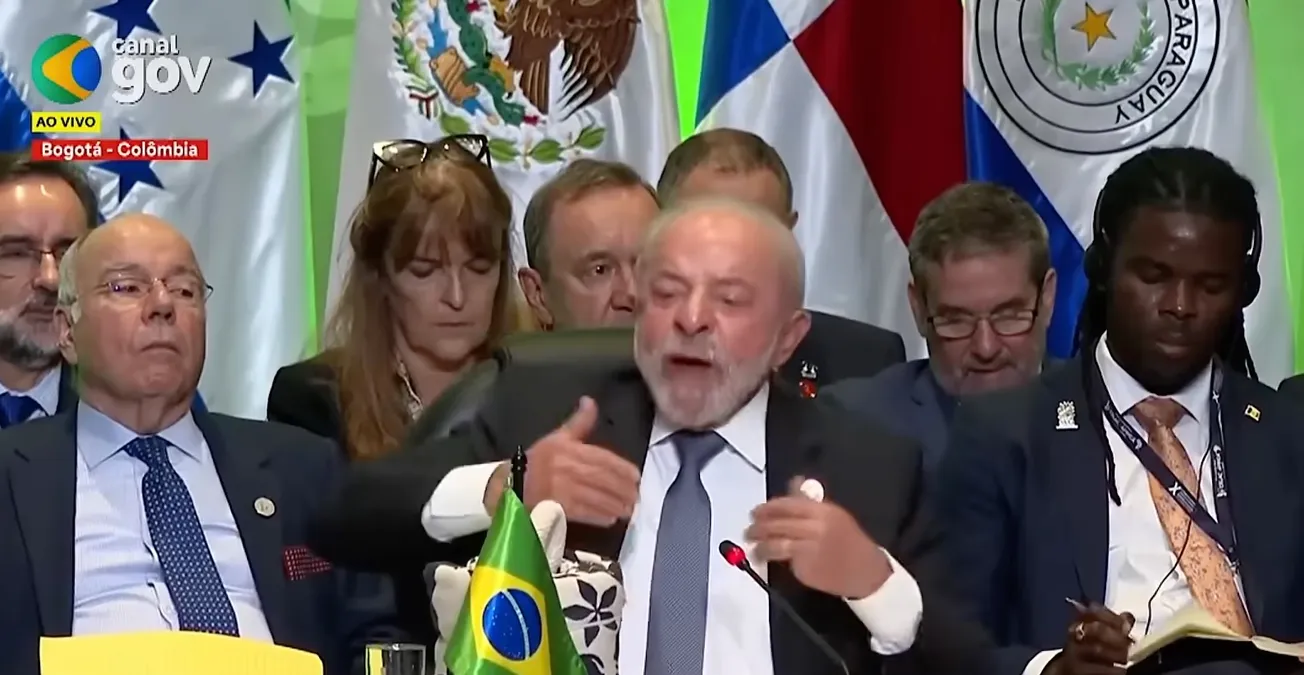
Addressing the first-ever CELAC-Africa High-Level Forum held in Bogota, Colombia on March 21, Brazil’s President Luiz Inacio Lula da Silva laid out a perspective for the nations of Africa and Central and South America, which he pointed out together make up nearly half of the world’s nations and a quarter of the world’s population, to join forces to block the return of colonialism, and secure a just world order free of the wars now engulfing the world.
The formation of the Community of Latin American and Caribbean States (CELAC) was inspired by the African Union (AU), he noted; the AU “shows that it is possible to rely on regional institutions even in the face of diverse national political agendas.” He named several “synergies” in AU and CELAC long-term goals which could be taken up as shared initiatives, starting with eradicating the hunger suffered by 340 million people in their combined regions. Another priority, he proposed, should be to jointly develop the technological capability to process our rare earths and critical minerals, so that they are not looted as in the past when our resources were exported as raw minerals, with no value-added.
Lula then lit into the global strategic crisis, which has created “the highest concentration of conflicts since World War II.” He denounced how it could be, that “while $2.7 trillion was spent last year on weapons and wars, we still have 630 million people going hungry. We still have millions of people without electricity. And we still have millions of human beings without access to education and millions upon millions of women and children who are the result of these fratricidal wars and who are left abandoned without documents, without a home, without even a homeland to live in.
“That is why we have been insisting, more and more, that we must stop and reflect on our behavior. We are no longer colonized countries. We achieved sovereignty with our independence. We cannot allow anyone to interfere and violate the territorial integrity of each country,” he warned. “When are we going to take action to prevent the most powerful countries from acting as if they own the most fragile ones? .… Does whoever has more cannons, more ships, more planes, more money, think they own the world?
“When,” he asked, “are we going to say that this is not normal? When are we going to say that we want to restore civilized relations among nations, that we will not allow the end of multilateralism, and that we will ensure that only peace can enable the poor world to develop? What does war build other than death and destruction? And when are we going to react?... “Can we really keep living in a world of lies, where people create enemies and paint a negative picture of them to justify destruction?”
“They’re trying to colonize us again,” he warned. Look at Cuba, at Venezuela. “We need to shout loud and clear so that this doesn’t happen in other countries—as it recently did in Gaza.”