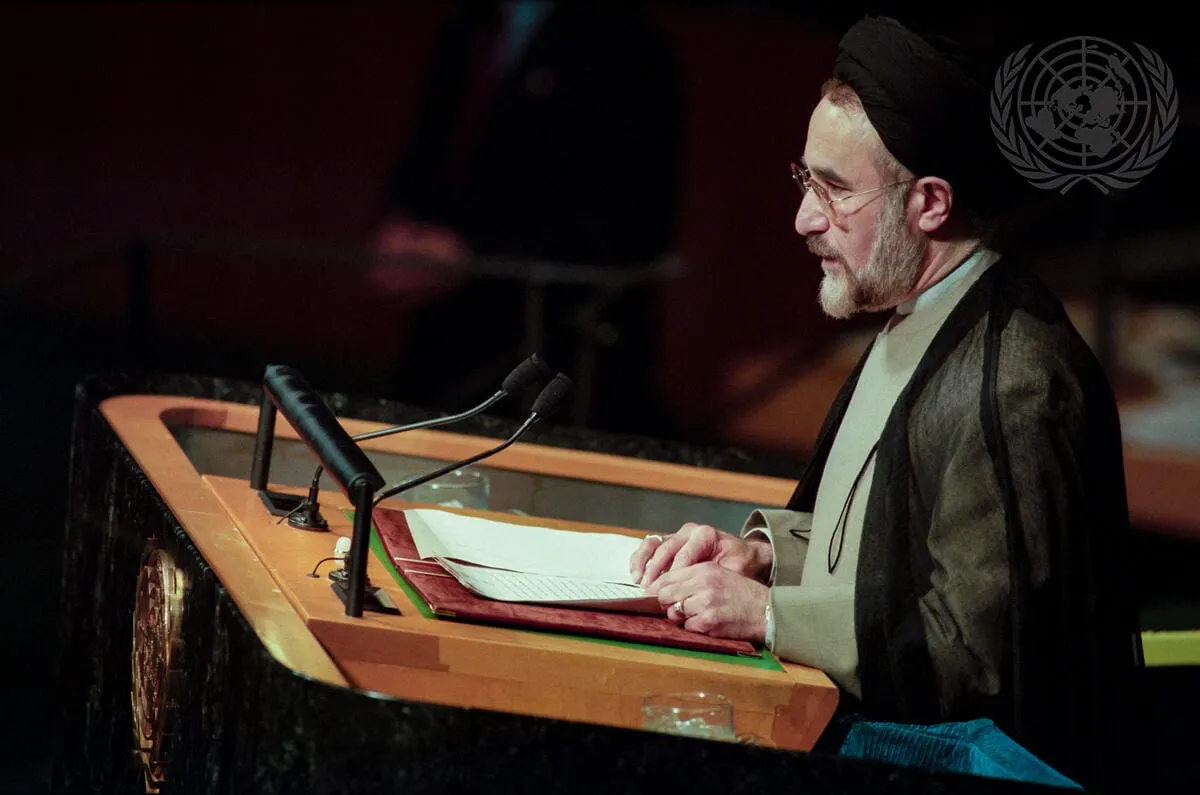
In September 2001, as the rubble of the Twin Towers still smoldered and the logic of civilizational war was becoming American policy, Iran’s President Mohammad Khatami rose before a United Nations conference and made a different argument. The UN General Assembly had just endorsed his country’s proposal for a Dialogue of Civilizations. The moment, Khatami said, called not for the “glorification of might” but for something harder: the surrender of the will-to-power in favor of “empathy and compassion.” Believing in dialogue, he insisted, lays the basis for hope: “the hope to live in a world permeated by virtue, humility, and love, and not merely by the reign of economic indices and destructive weapons. Should the spirit of dialogue prevail, humanity, culture, and civilization shall prevail.”
That road was not taken. Twenty-five years later, his son Emad—a senior figure in his father’s reformist party—writes from Tehran to explain what the road not taken produced. The war, he argues, is achieving precisely the opposite of its stated aim: consolidating the hardliners, deepening the martyrdom narrative within the IRGC-linked networks, and closing the political space that reformists like his father spent their careers trying to open. The bombing is not liberating Iran. It is fortifying the forces that have always argued that the West only understands force.
Is there still a path back to the road Khatami pointed toward? Helga Zepp-LaRouche believes there is. In an open letter to Pope Leo XIV, she calls on him to act at the level of Nicholas of Cusa, who in 1453—with Constantinople freshly fallen to Ottoman forces and Europe braced for civilizational war—wrote De Pace Fidei, envisioning an assembly of the wise from every faith and nation who might discover, beneath their differences, a common commitment to the One. The Pope has already signaled something: he invoked De Pace Fidei in an October sermon; he has refused to participate in Trump’s “Board of Peace"; he travels to Algeria, not Washington. And now, independently of Zepp-LaRouche’s letter, a senior Iranian Shia scholar, Ayatollah Seyed Mostafa Mohaghegh Damad, has written his own letter to the same Pope—asking him to remind the President of the United States of the teachings of Jesus Christ, and to call a halt to the bloodshed. Three-time French presidential candidate Jacques Cheminade, speaking to Algerian television this week, sees in these convergences the outline of something real: a gathering of religious forces—Muslim, Catholic, Orthodox, Protestant—united not by theology but by their shared refusal of the eschatological logic that started this war.
But Zepp-LaRouche’s letter is not a petition to a single institution. It is a call for the kind of mobilization that has, at decisive moments in history, changed what governments believed was politically possible, and what was demanded by the people. She is asking religious leaders of every faith—and people of good will who may hold no faith at all—to sign and circulate it, and to make audible what bombs may drown out: It cannot be that people kill each other in the name of God, and that the human species was not gifted with reason in order to destroy itself for the lack of it. She calls for the bells of churches to ring, the call to prayer to sound from mosques, the shofar to be blown from synagogues, in a worldwide declaration that the species refuses to be annihilated on the basis of satanic delusions.
Mohammad Khatami asked humanity to listen “in earnest to what other cultures offer.” His son now witnesses what happens when that offer is refused. The question is not only what the Pope will do. It is what the rest of us will.
That question is already being answered. Today’s meeting of the International Peace Coalition brought together Schiller Institute founder Helga Zepp-LaRouche, Iranian Ambassador to Mexico Abolfazl Pasandideh, former President of Guyana Donald Ramotar, and longtime Catholic peace activists Father Harry Bury and Jack Gilroy, in a dialogue across national, cultural, and religious lines of the kind that, were it the prevailing mode of international relations rather than the exception, would mean the end of war.
The petition Zepp-LaRouche has addressed to the Pope is here. The moment it describes is now.