


In mid-March news reports began to appear to the effect that the Trump Administration was “preparing to request $200 billion additional funding” for the war on Iran. Since the Pentagon reportedly had spent $12 billion in the first two weeks of an attack which the White House confidently claimed would be over in four-six weeks at most, this surprising upcoming “request” begged explanation. Was Iran’s demanded surrender actually expected to be much more costly and much farther off? Or was the huge sum being sought, actually for something else? Something bigger—a massive replenishment, buildup, and upgrade of weapons systems?
After a Washington Post report of the $200 billion figure on March 17, which followed a report by administration-leaning Semafor news on March 15, U.S. Secretary of Defense Pete Hegseth was asked about it at his press briefing March 19. Axios reported that he said only that “the Pentagon was seeking more money to accelerate production of weapons systems,” and that “that number could move”—presumably meaning, upward from $200 billion. “It takes money to kill bad guys,” Hegseth added in his typical bad-guy style.
He was not specific about any upcoming request to Congress. None had been made as March was ending (and as the war on Iran, according to the President and his Cabinet members, was also close to ending!) Nor would such a request have much chance of success, as Members of Congress from both parties know that the American public is increasingly opposed to President Trump’s war policy.
A Sovereign Wealth Fund for Lethality?
Let us keep in mind that President Donald Trump has proposed, informally, to have a Pentagon budget for Fiscal 2027 of $1.5 trillion—representing a huge, 50% increase in one year, of a war budget already larger than the next 12 largest war budgets in the world, combined. He has also expressed the desire to run a U.S. sovereign wealth fund.
As early as March 11, reporters from Reuters News Agency were canvassing Wall Street banks and Washington executive search firms, trying to confirm a report that the Pentagon was
building a team of investment bankers steeped in private equity, to invest $200 billion over three years in defense deals.
Trying to involve Wall Street bankers of private credit expertise to make $200 billion in military contracting deals for the Pentagon (and “that number could move”), at a point when the private credit sector of high finance is famously hemorrhaging investors and threatening a $2 trillion-or-so crash? That would be more than risky.
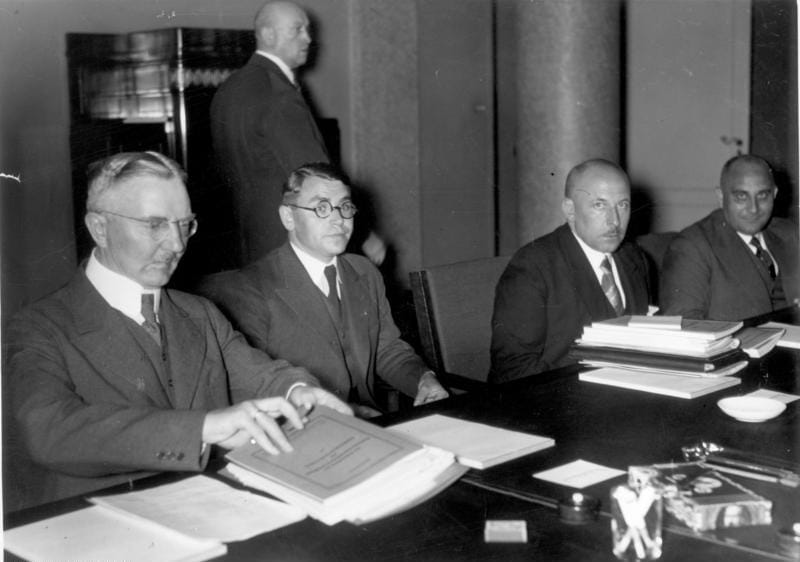
The direct involvement of Wall Street investment bankers in finding the weapons firms at the latest cutting edge of killing, and setting them up with everything they need for their weapons breakthroughs, including plenty of investment money, leveraging funds from some public source to do so, would directly echo the method by which Adolf Hitler’s Economics Minister and Reichsbank chief, Hjalmar Schacht, militarized the German economy during the 1930s. “Schachtian economics,” as it has been called since, turned corporate loan obligations into central bank money and raised the share of war production in Germany’s GDP from 2% to 20% in just three years, 1933-36.
Reuters on March 11 said it could not confirm the report about “investment bankers steeped in private equity” taking over U.S. military spending. But the report was true. There is a deck of slides prepared by the leading Washington, D.C. executive search firm Heidrick and Struggles, which contains the offer to the investment bankers being recruited. A March 14 article on the ZeroHedge website shows some of these slides. They were said to target recruitment of a team of “30 top investment bankers” to be selected from Goldman Sachs, JPMorgan Chase, Bank of America, and Morgan Stanley. They offered these bankers “the chance to serve your country” while earning $300-500,000 a year, for two years at the Pentagon, in an “Economic Warfare Unit,” picking out startups and other companies which were “war unicorns” developing the most advanced surveillance, guidance, and killing technologies, and making investments in those companies, which the bankers could continue to manage after their Pentagon stint, at great profit to themselves. The “top bankers” were otherwise promised an embarrassing array of perks, contacts with foreign royals, famous banking families, heads of sovereign wealth funds, setting up their post-Pentagon futures for even greater wealth and profits than they command now.

Specifically, the Pentagon’s Office of Strategic Capital, formed in 2022, is being reorganized and pumped up with new billions, by the influential Deputy Defense Secretary Stephen Feinberg, the billionaire former founder and CEO of Cerberus Capital Management hedge fund. That fund is best known for the takeover, bankruptcy, and Treasury bailout of Chrysler/Stellantis at the height of the financial crisis of American automakers in 2004-05. But Feinberg has also owned and traded military-production startups since then. He is reportedly a close friend of Peter Thiel, Vice President JD Vance’s mentor and the Mephistopheles of neocons and defense/surveillance firms.

Feinberg is giving charge of the reorganized Office of Strategic Capital to two of his former Cerberus hedge fund officials, David Lorch and George K. Kollitides II. These two apparently oversee the Economic Warfare Unit as well, which has already taken stock investments in such companies as L3Harris Technologies (surveillance, electronic warfare, avionics, space technologies), Trilogy Metals, MP Materials (rare earths), Vulcan Elements, ReElement Technologies, etc.
Whence $200 Billion-Plus? Whence $1.5 Trillion?
Now the scale of “strategic capital” is being increased. The executive search slides referred to $250 billion in investment capital for these “top bankers,” in two years, not three; and as the source, the accounts by Semafor and the New York Times, for example, speak of “brass-knuckled trade deals.” This refers to Trump’s trade agreements, which used the threat posed by massive and illegal U.S. tariffs to extort “agreements to invest” hundreds of billions of dollars of foreign funds in the United States defense-industrial economy.
The biggest apparent extortions were from Japan, South Korea, the UK, the European Union, and Saudi Arabia. All of these promises, with the exception of Japan’s, have become more questionable since being made; but the Trump Administration continues to pursue them using new, supposedly legal tariffs and continuing imperial threats.
It may be that Trump’s own announced preference for an immense total authorized war expenditure of $1.5 trillion beginning later this year, heavily overlaps the extortion of investments from those and other countries, and the sale of oil seized from others. All of these “are fungible,” as the saying goes, for making war.
The New York Times, in its March 13 coverage of the investment banking “team” being recruited to the Pentagon, noted that
The investment teams would focus on an array of industries and technologies, including undersea cables, minerals extraction and refining, strategic logistics, munitions, drones, satellites and energy generation.
And Semafor on March 18:
The U.S.’ military-industrial complex is quickly morphing into a military-industrial-financial complex, in which risk capital is flowing toward increasingly specialized defense bets. The Pentagon is hunting for investment bankers to strike more defense deals [emphasis added].
This sounds unlike fighters and bombers for the Iran war. Rather it sounds like China, the economic adversary above all others. And it sounds like Hjalmar Schacht, Hitler’s Economics Minister/Reichsbank chief, using his fingertip control of the central bank and his trade extortions from Brazil, Argentina, Czechoslovakia, Romania, Poland, and eventually France, to generate armaments and war production up to 20% of the entire German economy in the mid-1930s.
The Basic Problem: Non-Productivity in Manufacturing
While the Administration drives business investment toward war production, using dubious public funds placed in the portfolios of private investment bankers, an underlying rationale for the supposed necessity of this Schachtian policy has spread on both sides of the Atlantic. That false and unfortunate theory is that military spending is the key to restoring lost industrial productivity in the American and European Union economies.

The EU has established a rearmament fund in the hundreds of billions of euros, supposedly “because Russia is preparing to go to war” in three, five, or six years depending on the source of the oracle.
In the United States, to take one important example, the very prestigious Industrial Performance Center of MIT’s Sloan School of Management, in a Feb. 13 piece on its website, “Future Manufacturing: How To Solve the U.S. Productivity Paradox,” describes and discusses what it considers “the productivity paradox that is dragging down U.S. manufacturing”—particularly, of course, relative to China’s manufacturing sector. That problem is, “real productivity has declined, out of pace with new investments”; i.e., since early in this century, real technological productivity in manufacturing has declined, as shown by manufacturing activity and production failing to rise even in the very brief periods when the number of workers involved in manufacturing did rise.
The Sloan School’s first recommendation to solve the problem—“use government defense contracts as a lever for technology investment”—is a virtual oxymoron, since federal funding of arms production produces shiny, high-technology economic waste. Even a firm which discovers a new technological principle in production of armaments, does not leave the very profitable path of producing the armaments, in order to seek civilian applications elsewhere.
The Industrial Performance Center does not recommend raising manufacturing wage levels, although its report documents that manufacturing in America has completely lost what used to be its recognized, 40% entry-level wage premium; and in the South, manufacturing workers’ wages start below Target or Amazon employees.
In Europe the situation is worse: Industrial production is sinking under anti-Russian energy sanctions and wrong environmental energy bets, and is trying to relocate. The armaments mobilization fund is reportedly being used to plug other budget holes.
The idea that war production restores manufacturing productivity is a basic factor motivating the $200-250 billion Wall Street slush fund to develop startups with new kill technologies—“war unicorns,” as they’re called—against Russia, China, and the major developing nations.
The Real Productivity Solution
The recognized “Golden Age of American Productivity”—roughly 1930 to 1960 or so—was marked by very high rates of increase in technological productivity (“total factor productivity”) which resulted from Franklin Roosevelt’s and John F. Kennedy’s great infrastructure projects, including space transportation. Total factor productivity growth assesses GDP growth after subtracting what results from more applied capital, more applied labor, and more education and skill in the labor applied. In theory, GDP growth due to technological advances is what remains.
The National Bureau of Economic Research (NBER) in Cambridge, Massachusetts, in several studies, has determined that the peak technological productivity growth in this “golden age” occurred during the 1930s decade of economic depression and recovery, rather than in the 1940s when all of society and the economy were mobilized for the “arsenal of democracy”!
The fundamental reason, said NBER, was Roosevelt’s great projects of infrastructure for electrification, navigation, transportation, and irrigation. Infrastructure projects fundamentally new in scale and reach, are accomplished by near-continuous major breakthroughs in engineering technologies and sciences; and those, NBER found, spread rapidly through the infrastructure sectors and manufacturing generally, generating true and widespread increases in industrial productivity.
It is very fortunate, then, that for the sake of international law, diplomacy, and peace, the state of “perpetual war” in Southwest Asia can’t be solved without the Schiller Institute’s Oasis Plan as a central part of its solution. This truly great infrastructure project, whose design was laid out a half-century ago by the late American-System economist and statesman Lyndon LaRouche, is centered on bringing fresh water to the entire desertified area of Southwest Asia, crossing it with new rail and road transportation corridors, and putting nuclear power to peaceful use to serve this general economic development.
The nation of Oman, whose mediation between Iran and the United States was pushed aside to start bombing Iran, had proposed a “new nuclear consortium” for the region, centered on Iran’s production of low-enriched uranium for the Gulf Cooperation Countries under IAEA inspection and safeguards. That idea was detailed in a June 2, 2025 article in the Bulletin of the Atomic Scientists.
American industry and manufacturing, rather than a foolhardy “Schachtian shift” to war production, could recover lost productivity through cooperation with sovereign wealth funds in the region for this great project of infrastructure.