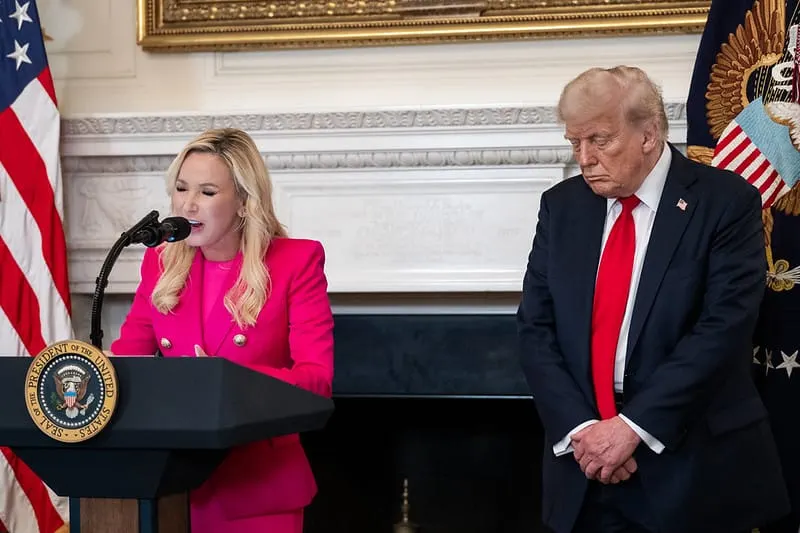
As President Trump threatens to bomb Iranian power plants, desalination facilities, and bridges—threats that international law experts have called a call to commit war crimes—it is worth recalling that an American president once made the opposite appeal.
On September 1, 1939, as Europe went to war, President Franklin Roosevelt sent an urgent message to the governments in London, Paris, Berlin, and Warsaw. Roosevelt gave his assessment of the destruction of civilian areas:
“The ruthless bombing from the air of civilians in unfortified centers of population during the course of the hostilities which have raged in various quarters of the earth during the past few years, which has resulted in the maiming and in the death of thousands of defenseless men, women and children, has sickened the hearts of every civilized man and woman, and has profoundly shocked the conscience of humanity.”
He made a demand:
“I am therefore addressing this urgent appeal to every government which may be engaged in hostilities publicly to affirm its determination that its armed forces shall in no event, and under no circumstances, undertake the bombardment from the air of civilian populations or of unfortified cities, upon the understanding that these same rules of warfare will be scrupulously observed by all of their opponents. I request an immediate reply.”
The appeal was not heeded. In February 1940, Roosevelt sent Undersecretary of State Sumner Welles on a peace mission to London, Paris, Berlin, and Rome. Welles was told by German financier Hjalmar Schacht, and subsequently by Pope Pius XII, that the German military had prepared a putsch against Hitler to prevent his planned Blitzkrieg into France—a plan with roots in General Ludwig Beck’s 1938 effort to break with Hitler before his attack on Czechoslovakia. Beck had secretly notified London and Paris of the plan, but was ignored. Prime Minister Neville Chamberlain went to Munich instead.
In February 1942, Winston Churchill and his Cabinet approved area bombing of German civilians, with Air Chief Marshal Sir Arthur Harris taking command of Bomber Command and carrying out the policy to devastating effect. The verdict on that policy came from FDR himself, who in 1945, before his death, mandated the United States Strategic Bombing Survey. Its addendum report, headed by economist John Kenneth Galbraith, concluded that bombing of civilian populations neither demoralized the working class nor made dysfunctional the family members of Wehrmacht soldiers on the front. It did not work.
What came next was Hiroshima and Nagasaki, which opened the door to the present situation in which the elimination of all humanity is considered an acceptable potential outcome of war.
Trump’s Holy Saturday post—"all Hell will reign down on them. Glory be to GOD!"—is not a new idea, and history has already recorded where it leads.