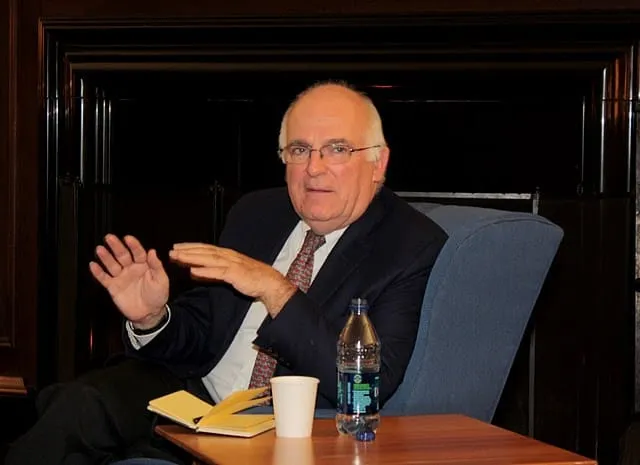

In an article published in Defend Democracy Press, former MEP and Schiller Institute friend Tatjana Zdanoka raises serious questions on the role of Baltic countries in the recent Ukrainian attacks against Russian oil facilities in the Gulf of Finland.
Based on a map of where Ukrainian drones recently crashed in all three Baltic States, during the same period of the attacks against terminals and refineries of the Russian ports Ust-Luga and Primorsk, situated nearby St. Petersburg, on March 25, 27, 29 and 31, Zdanoka easily demonstrated that the Ukrainian drones followed a route over Poland and the three Baltic states in order to reach, undetected, Russian territory a few kilometers away from their targets.
Although it was officially recognized that these were Ukrainian drones “gone astray” and Kiev apologized towards the three Baltic states, “Judging by the very limited coverage of the issue in both Russian and Baltic public media, it seems that no one wants to fall for the provocation,” Zdanoka suggested. However, some cracks in the unity of the three Baltic states seem to emerge, maybe related to concerns about future consequences if such provocations continue.
On the one hand, Lithuanian Prime Minister Inga Ruginienė is making reassuring statements, and after the publication of Zdanoka’s article, the head of the Estonian Defence Forces Intelligence Center, Col. Ants Kiviselg, asked the Ukrainians to use different flight paths. On the other hand, the head of Latvia’s security service (VDD), Normunds Mežviets, is hyping up the population with a terror campaign. In an interview with the Telegraph on March 18, Mezviets said: “I understand very well that if the Russians come here for the third time, it won’t just be the end of our statehood, Latvia as a country, our sovereignty, it will be the end of Latvian ethnicity … they will kill us all.”
According to Ms. Zdanoka, this is not paranoia but tactics. The VDD, in fact, is putting up a justification for the inhuman treatment the VDD is giving to political opponents. “The widespread practice of punishing the innocent, as carried out by the VDD, amounts to an attempt to dehumanize the victim. Mr. Mežviets justifies the unjust violence perpetrated by the agency he heads by arguing that the same thing could happen to him tomorrow.”
“The Latvian VDD is actively initiating politically motivated proceedings against persons whose position does not coincide with that of the authorities. The majority of such cases are initiated under far-fetched pretexts of assistance to Russia in its activities. The legal ground for these cases relates to two chapters of the Criminal Law: Crimes against Humanity and Peace, War Crimes and Genocide; Crimes against the State.”
Last year, the VDD asked the Prosecutor to initiate legal cases against 58 individuals. Ms. Zdanoka mentioned two cases, both involving members of her party, the Latvian-Russian Union: 68-year-old Doctor of history Viktors Guščins and 39-year-old activist Polina Kamļova. Both were arrested and are in pre-trial detention.
“The Baltic countries are very small. But it is a big mistake to ignore what happens there. Rehabilitation of Nazi collaborators and rewriting the history of WWII, segregation of society, forced assimilation of minorities, flourishing Russophobia,—all these viruses have been spread from there,” Ms. Zdanoka warned.
The former MEP concluded by suggesting a different policy for her country: instead of being manipulated into an element of conflict, to become a bridge between the EU and Russia. She quotes from a speech given at an international conference which took place in Greece in 2015 and served as the impetus for the “Delphi Initiative” and its portal www.defenddemocracy.press.
“In my opinion, the European Union could be a strong geopolitical player on the basis of its strategic partnership with Russia only. The role of my country, Latvia, with its large Russian-speaking population, could be extremely important, building bridges between the EU and Russia. This is because we are the ones who know Russia best as a part of our own identity. Unfortunately, the role played by the Baltic states, and Latvia in particular, up to now has been quite the opposite. Our leading politicians are playing the role of permanent provocateurs to our eastern neighbour. While claiming that the EU ‘should speak with one voice towards Russia’ they are in fact taking the EU train in completely the wrong direction if pursuing economic interests is to be the priority.”