
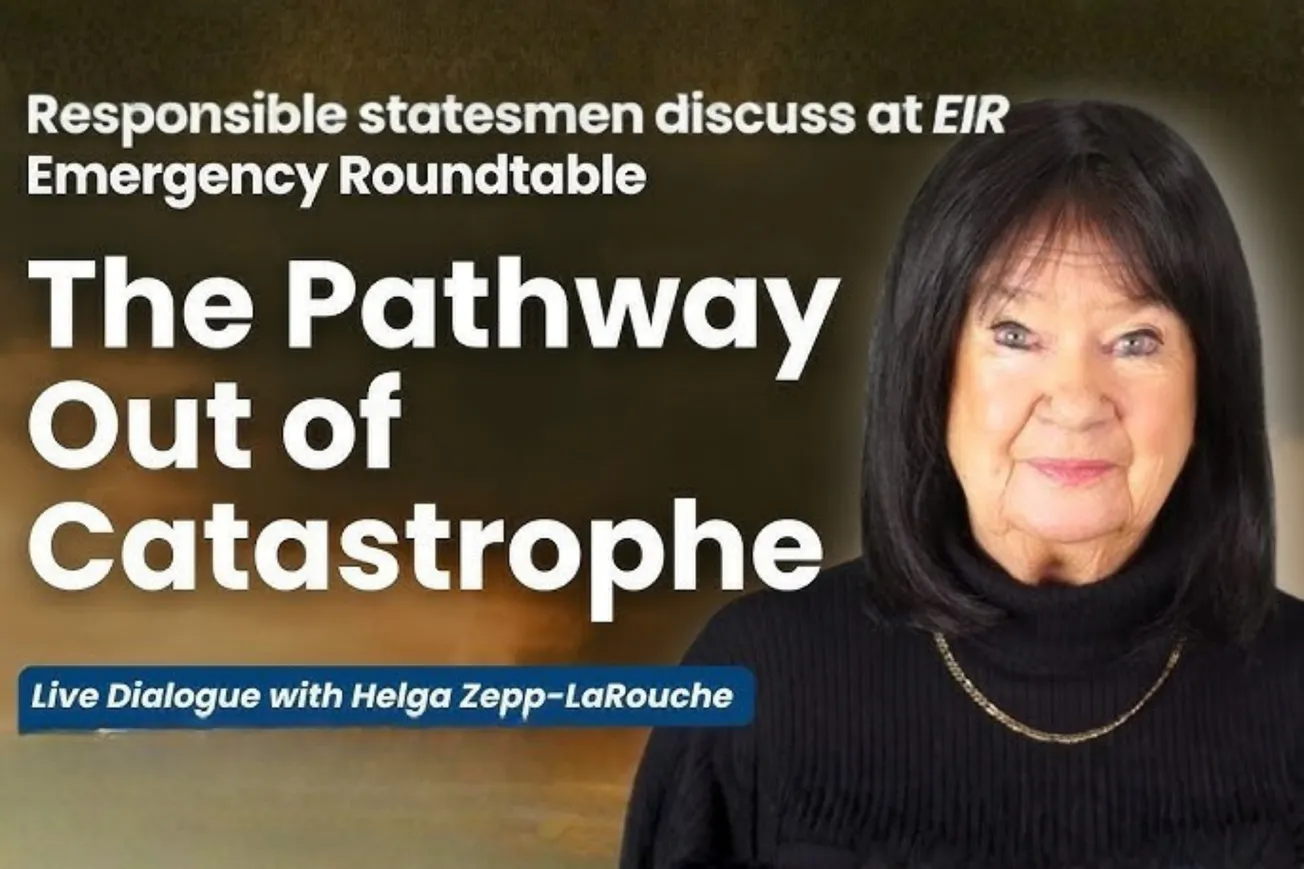
HARLEY SCHLANGER: Hello and welcome to our weekly dialogue with Helga Zepp-LaRouche. She’s the founder of the Schiller Institute and the convener of the weekly Zoom call of the International Peace Coalition. And I’ll be your host.
I think we should begin today, Helga, with a report from you on the Executive Intelligence Review Emergency Roundtable event on Monday, April 6, which addressed the topic, “A Dialogue of Civilizations: Is There Still Time to Prevent the War against Iran from Escalating into a Global Nuclear Conflict?” What can you tell us about the process of the discussion of the call, and also your thoughts about the report that an agreement had been reached to at least stop the danger of a full-scale assault against Iran?
HELGA ZEPP-LAROUCHE: Well, I think that many people in the whole world were absolutely horrified yesterday by the martial statements coming from President Trump that he would annihilate the entire Iranian civilization, the entire civilization, for them never to come back. And others were saying that there are still tools in the arsenal of the Americans which have not been used. So the whole buildup was that when I went to bed last night, I was really not sure whether I would wake up in the morning being in the middle of World War III.
And this morning, naturally, when I turned on the news and realized that Trump at the last minute had called this off 90 minutes before the ultimatum was running out, I just said, “How could the world be in such an unbelievable situation?” And I think for a President of the United States to say something like this, that he would eliminate an entire civilization. I mean, now there are many people, even international law experts, senators in the United States, who all basically agree that even the mentioning of such a thing, leave alone carrying it out, does represent a war crime. So there is now a far-reaching debate everywhere in Europe, in the alternative media, naturally in the Global South, but even in the United States, that the President has committed a war crime. Naturally, the unprovoked war of aggression was that already. But to go to such an extreme, I mean, I think we have reached a point of no return, because this will have an after-effect.
I mean, naturally, the situation in Southwest Asia, well, it’s still very fragile, but there is the 10-point agreement mediated mainly by Prime Minister Sharif of Pakistan, with China being in the background as a strong voice. And it seems that there is an agreement possible right now. Naturally, totally up in the air is what Israel will do, because they had clearly a completely different war aim throughout the whole time. So it’s still very fragile.
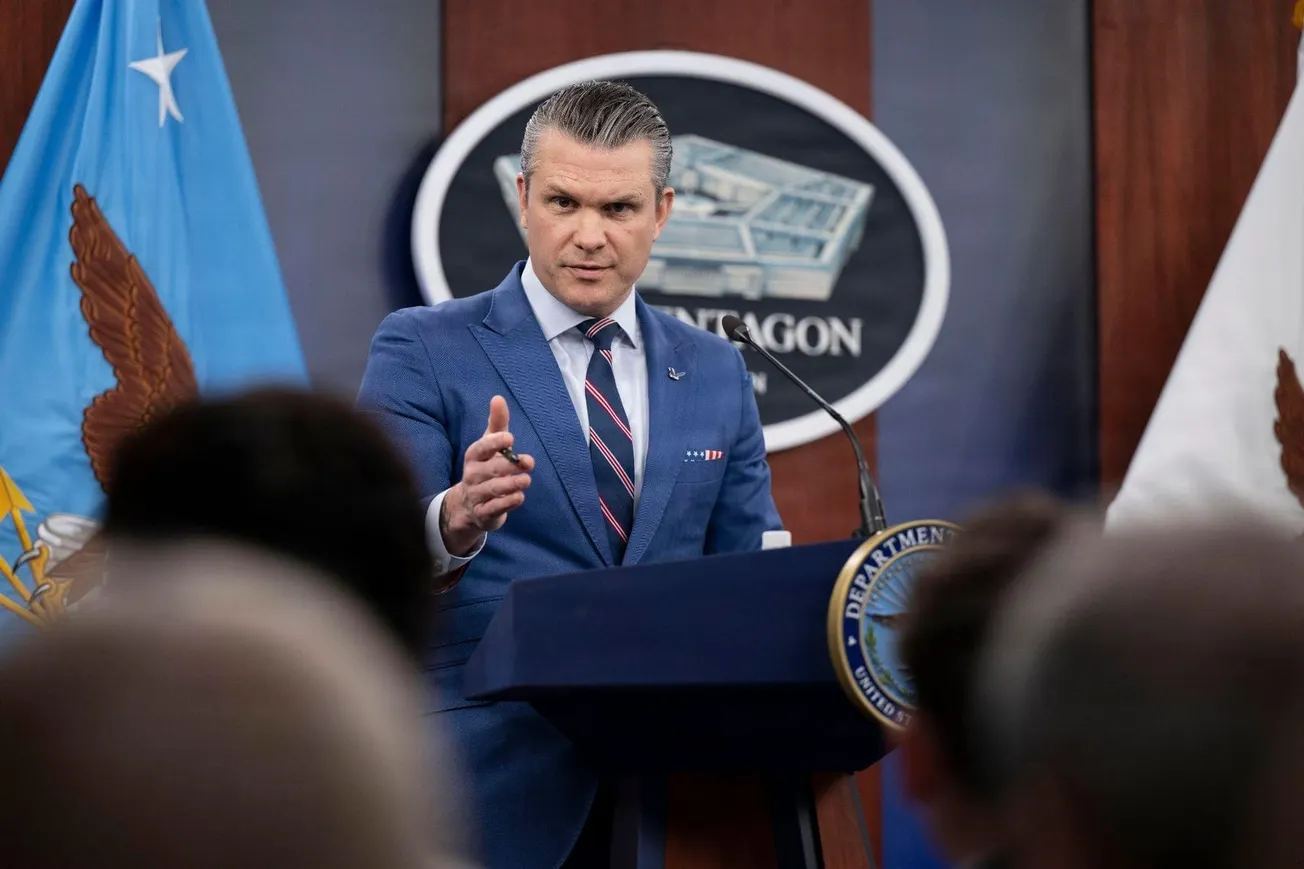
Naturally, Hegseth declared victory already. President Trump, for sure, is also trying to present it somehow as his victory. But if you look at the reality, it is a complete break, because I think it will not be going after the perception and recognition of many military experts around the world that this was a smashing defeat for the United States. I mean, Trump went into this war with the idea that he would cause regime change in Iran. Now, that clearly is not there, because you still have the same President Pezeshkian, Foreign Minister Araghchi; you have the military being the same military, even though some of the key leaders have been assassinated. So that objective has failed.
The ballistic missiles of Iran are still there. The uranium enrichment program is still there. The only major difference is that now Iran has control of the Strait of Hormuz, and in all likelihood will change the condition of how this Strait will be used in the future. So naturally, what the United States, or better, President Trump accomplished, was to kill a lot of people, to destroy a lot of mostly civilian infrastructure. But from those so-called war aims, he has accomplished nothing.
So I think in the eyes of the world, this will be added to Vietnam, Afghanistan, Iraq, Ukraine, and now, Iran, as being one of these lost wars, and it will for sure greatly diminish the political and military standing of the United States in the world. I think morally, it is the absolute low point which has been reached because to go into such lengths, for what? To take the oil, as he said, at a certain point. So I think we are in a new phase.
We had called the EIR special meeting you referred to, which we had on Monday very successfully, still being under the cloud of Damocles’ sword that this conflict could go out of control and involve the use of nuclear weapons.
I think that danger now is significantly less, but I would not go so far to say that it has been eliminated because the ceasefire is two weeks, it’s not yet a permanent peace settlement. As I said, the situation in Lebanon remains very unclear. Israel is not giving up its intention to control that. So I think we are still in a period of utmost tension.
What we had tried to put on the agenda with our EIR special meeting was the idea to change the paradigm completely, to finally draw the lesson out of this long, long suffering of the entire region. You know, one conflict after the other, many countries being destroyed by interventionist wars—Afghanistan, Iraq, Syria, Yemen, Lebanon, and actually the fate of Palestine is still completely up in the air. So we had suggested to put on the agenda a real change, what we call the Extended Oasis Plan, which was the idea that all the countries of the region and the big neighbors should agree on a joint economic development plan based on the Extended Oasis Plan, meaning especially developing new water resources for irrigation, because essentially this entire region of Southwest Asia is a gigantic desert.
And as the Chinese have demonstrated, they can transform large deserts like Xinjiang and the Northeast into green farmland, forests, and tourist areas. They could play a role together with others, so that basically this region would become an area of development in the tradition of the ancient Silk Road. Now, I think that remains on the table. We will keep organizing for it. And if the countries of the region agree to overcome this present crisis, that is still the absolute workable perspective on the agenda. So I think, you know, fortunately, it did not so far come to the worst crisis, but I think our development perspective is still the way to go if you really want to not just avoid war, but to gain peace.
SCHLANGER: In regard to this Extended Oasis Plan, experienced U.S. diplomat Chas Freeman issued a strong endorsement of the LaRouche organization’s Oasis Plan, which was drafted originally by your late husband, and you’ve been taking this as a major issue in the development of the New Paradigm. It seems as if there’s a growing momentum behind this, because people are looking for something that would be more than just a signature on a truce, but actually something that could be more lasting. So what are the plans to realize this potential?
ZEPP-LAROUCHE: Well, we had in the organizing for the event, a very actually electrified response from intellectuals, diplomats from various countries. Very significantly, we had now the second event with the participation of an Iranian ambassador, first the Ambassador of Iran to Mexico, and then at the event on Monday, there was the Ambassador of Iran to Armenia. And both endorsed this perspective very, very strongly. But we also had other speakers, some of whom could make it, others got involved in all kinds of hold-ups, but are on board nevertheless.
So we will plan follow-up meetings, because intellectuals and military and top diplomats from Pakistan, from Oman, from other countries from the region, all expressed a keen interest in this program. So I can foresee that we are now reaching out to a lot of institutions with the program which we presented on Monday. We will produce a lot more video material, so that people get a vivid idea of what it actually would look like if the region of Southwest Asia, from India to the Mediterranean, from the Caucasus to the Gulf region, would be fully developed. Both in terms of water management, where a lot of different sources for fresh water can be developed from canals, to using space technology to locate new underground lakes, because you can actually now detect where there are huge reservoirs which nobody knew ahead of time that they exist. Now you can find them, you can access the aquifers, you can ionize the moisture in the atmosphere with new rain patterns. And actually as you grow the forests and farmland and so forth, new weather systems, new rainfall patterns develop. So this is actually a beautiful perspective where you can think that now this desert is expanding, it’s increasing on a continuous basis, but with modern technology you can reverse that and make land which is completely uninhabitable a beautiful place for people to live.
And I think that will inspire especially the young people of the region. So I’m convinced that this is a winning perspective for everybody involved.
SCHLANGER: I just got a question from our viewers. “What do you see as the main obstacle that has to be overcome to bring humanity into this New Paradigm that you and your husband had been fighting for since the 1970s?”
ZEPP-LAROUCHE: I would say it’s the greed and depravity of the Epstein Class, because you know, I mean, you can say it’s the forces who still think the world should be run as an empire and as a colonial oligarchical system. But when you actually look at who are the people who are doing it, you find such people like Epstein and his cronies, people who have been basically misusing young women, young girls, like toilet paper, throwing them away; but at the same time making big business deals, laundering money, being involved in weapons trades, and all of that is one package. So if you think of the Panama Papers that were published 10 years ago, well, not much has changed, and now it’s the Epstein class being discovered, and new crimes being found every day. I think it points to a fact, you know, when President Trump was making these absolutely unbelievable statements about ending civilizations and that they never come back and so forth, I said, “Where are the governments of Europe or any other place to come out and say, ‘this is too much, we denounce this, this must be stopped’?” And you couldn’t hear anything.
And this morning when I listened to the German radio, they were asking a reporter from Washington what his views were on this whole matter, he said, “Oh yeah, this announcement of President Trump that he would end the Iranian civilization and they would never come back, that was actually a cry for help. And then he got himself so high up on the tree and he didn’t know how to come down, and then the Pakistan government was so friendly that they showed him a bridge to get down from the tree.” I mean, that kind of language is a cover-up, and it shows the depravity of what journalism has become.
This is what we are suffering from, and I think people better reflect that the entire West has become so decadent that these kinds of outlandish statements are not only possible, but people rush over it and say, “This could have gone to World War III!” People have to wake up and get their notions straight. This was an absolute abomination, and the journalists are obviously completely complicit in it. And the cover-up of the Epstein crimes, and what is happening now in grabbing resources, going to steal the oil of some other nation, that is all part of the same thing. And I’m absolutely certain, and I know it from discussions I had, the people in the Global South look at that, and for them, the collective West has gone under morally like the end phase of the Roman Empire, which after all, decayed not least because of its decadence. And I think we are looking at something quite like that.
SCHLANGER: We have a question to probe this a little bit more from Debashis[ph]. He asks, “Has Trump got a few screws loose, and does he need removing as soon as possible for being morally and mentally unfit?”
ZEPP-LAROUCHE: Well, I think this will have an aftermath, because I saw that, I think it’s a Democratic Senator Markey, is that correct, Harley? Senator Markey?
SCHLANGER: Yeah, from Massachusetts.
ZEPP-LAROUCHE: Yeah, he already called to begin the impeachment process. I can only think that that is what will happen, because, you know, I mean, the MAGA base for sure is totally divided about that. At the No Kings demonstrations, there were many Democrats, but there were also a good portion of the MAGA movement, which is completely disappointed that Trump broke all the promises he had made and on the basis of which he was elected.
So I can very well imagine that between the Republicans having to think twice about what they will do if they lose the midterm election, and if the midterm election is lost, then the 25th Amendment and impeachment could actually take place. So I’m for sure, I think this is the end of the Trump Presidency, and he did it all to himself.
SCHLANGER: You mentioned the journalism problem. There’s a question that came in. In a long article, the New York Times writes that the decision by Trump to join Israel in a war against Iran was largely due to the intervention of Benjamin Netanyahu and the intel chief Barnea when they came to meet Trump in Washington, or maybe Mar-a-Lago, just before the war started, and they convinced him that Iran was weak and would fold very quickly.
So a podcaster who’s interviewed you in the past asked the question, “Do you think what the Times is reporting is accurate?”
ZEPP-LAROUCHE: Well, I’m pretty sure it is accurate because, you know, many other sources also reported that it was that visit when Netanyahu and others convinced President Trump that this would be a piece of cake, that regime change would be possible. That by delivering a lot of weapons to the demonstrators—which President Trump admitted in the meantime that they did deliver these weapons—that that would do it, because the people would hate the regime and topple it. That obviously has proven completely off the wall. So Trump better think what it means that his friend Netanyahu and the Israeli government lied to him in such a way. So, you know, maybe Trump will reflect on that and draw the conclusions out of that.
I think the situation in Israel also is naturally explosive as a result of it. So who knows, maybe regime change will take place, not in Iran, but some in the governments of the attackers.
SCHLANGER: Yeah, a question just came in from the United Kingdom. “Does anyone know the response in Israel to the ceasefire?” I haven’t heard much. Have you?
ZEPP-LAROUCHE: No, but I think from what I figured is that the Israeli government is not, I mean, the Iranians are demanding that the ceasefire should also involve all the forces of the resistance; that is Hamas, Hezbollah, the Houthis. I do not think that Israel will agree to that. And I think they do not agree that this involves Lebanon, which is the Iranian demand. So that remains to be seen because that country is still in complete disarray. A large part is still destroyed. And I think more than a million people are refugees without any shelter or conditions. So this remains a huge crisis. And I think it depends on the negotiations taking place, if that can be remedied or not. I think it’s a big problem.
SCHLANGER: Now, you mentioned the MAGA movement before. There’s someone who’s identifying as a former MAGA supporter who writes, "I watched Tucker Carlson’s monologue last night, and he said that Trump’s threats against Iran and wiping out the civilization and his language was so vile and anti-Christian that I can’t imagine anyone staying with him. What do you think is going to happen?
ZEPP-LAROUCHE: Well, I would guess that many people agree with Marjorie Taylor Greene, who has taken a very strong position in attacking Trump on that, because that’s the sentiment of most of the people who voted Trump the first time and who, voted Trump the second time because he promised to be a president of peace. He promised to end all wars and not start new ones. And then to hear that from Trump, that he would eliminate entire civilizations, not to come back. I mean, you can say this is typical Trump talk, but there’s a limit to what you can say without really crossing the line of human decency or, you know, that’s probably too weak an expression. I mean, he has crossed the line. I mean, you cannot threaten, to threaten genocide, to threaten the end of a civilization already is a war crime. You don’t have to do it by just saying you’re intending to do it. It’s a war crime.
So, you know, I think that the MAGA people will leave him in very large portions.
SCHLANGER: Here’s something that came in from an Eastern European activist. She writes, “My information is that Russia and China are playing an important role in the background in the attempt to end the war against Iran. But the Western media is not reporting on it at all. Can President Trump afford to ignore the views of Russia and China, especially as he’s planning to go to China in the very near future?”
ZEPP-LAROUCHE: I’m not claiming at this point that I do understand what President Trump thinks or not thinks. I mean, it’s impossible to know. What I can say is that China is basically trying to maintain stability in an ocean of chaos. Let me put it in another way. I know a lot about China; I know a lot about Africa; I know a lot about India; I know a lot about other countries. And when I look at what the West is describing these countries to be, it’s like talking day and night. It’s like talking about a parallel universe. I think the Western media and actually the Western mainstream politicians have developed a narrative that the liberal democracies are the good ones, and all the other ones are the dictators, the autocrats, the dictatorships, who are suppressing their people. And nothing could be further from the truth.
I mean, look at the Western liberal system. It has become so decadent that some phenomena like the Epstein Class are there for decades, and the other ones who are not part of that particular entity tolerate it. They don’t do anything about it to stop it. You know, the Western culture has become a counterculture since at least the 1960s, and from there going downhill every single year, producing worse garbage. And garbage is probably a compliment to what they are putting out in terms of movies, in terms of songs, in terms of so-called art.
I mean, we are in a dark age! And these so-called autocracies or dictatorships, these are mostly countries who are rejecting the degeneracy of the collective West by saying, we are not going for 150 sexes and 151 sexes tomorrow, because we have traditional values which value, you know, the traditional family. We want to keep up the improvement of our society. In the case of China, this is explicitly through the aesthetic education of all citizens. Xi Jinping has said repeatedly he wants to have a culturally advanced society where everybody participates in the spirit of science and art. They are encouraging people to become better. And just because the liberal system says everything is allowed, everything goes, nobody can tell me that there are any criteria for morality anymore, because the more crazy you behave, the more you are being cherished by the media and played up. So, who has the better society?
I have come to the conclusion and conviction that most of the governments of the Global South countries are doing a much, much better job than we in the so-called collective West, which is not so collective anymore in any case; it’s falling apart.
I hope that President Trump makes good on his promise that the United States leaves NATO, because NATO should have been dissolved in 1991 when the Warsaw Pact was dissolved. And I’ve been promoting a new security and development architecture, because I think we need a system where the interest of every single country on the planet is being respected, because otherwise we always have the danger of war and conflict. Naturally the forces of empire do not want such a system, because they like to divide and conquer, and that is how they rule.
But I think, you know, we are in an epochal change right now, so I think this idea of a new security and development architecture is not a utopian idea at all. It’s the only way we will get harmony and stability back into the system. And I’m pretty sure that we will be successful in putting it officially on the agenda.
SCHLANGER: Now, there’s an emailer from Pakistan who said, “I’m proud of the role my government is playing to ease the crisis. I know that you, Harley, and Madame LaRouche are often interviewed on Pakistani TV. Can you say something about what the government of Pakistan is trying to do? And is this related to the fact that they’ve been involved in a fight, a border skirmish with Afghanistan, the divide and conquer strategy?”
ZEPP-LAROUCHE: Well, I don’t claim I know all the details of this war between Afghanistan and Pakistan. But what I can say is that all of the conflicts in the region right now have a larger aim, and that is to ruin the success of the BRICS countries, the Shanghai Cooperation Organization, the Belt and Road Initiative, and the idea to have development of the Eurasian continent, of which, naturally, Pakistan and Afghanistan are centerpieces. So look for the hand of the British, or sometimes the British work not directly, but they work through contaminated networks in other countries. Because this whole region has been split on the basis of the Sykes-Picot Treaty. The division of India into Pakistan and Bangladesh after the Second World War was designed to do the same thing as Sykes-Picot to create borders and regions between countries like Balochistan or other areas which will be contested forever and therefore are only there to manipulate the relations among these countries.
Now, I think Pakistan has taken an enormously positive role in mediating this present conflict, and I think one should really also support Oman. Oman, the foreign minister has made a similar very positive intervention, and all of these countries, Pakistan, Oman, and others who have tried to mediate, have to reflect on who is trying to sabotage these efforts and make sure that they are getting together in one voice and not allow any more to be played against each other.
SCHLANGER: I have one more question for you from someone in the United States. He writes, “As we have been living under the threat of nuclear annihilation on Earth, we may have missed the excitement of the Artemis moon mission. When I tried to discuss it at work yesterday, I found a lack of interest, and even worse, many co-workers saying it is a fake, we never went to the moon, etc. I was shocked, but I guess I should not have been. What can we do to change this?”
ZEPP-LAROUCHE: Well, I think we are looking at a complete dumbing down of the population, because the Moon Apollo project was a huge breakthrough, and it took 50 years for the human species to reconnect. I think on Monday, when we had our EIR special emergency event, I suggested in my opening remarks that in order to solve the conflicts on Earth right now, including the conflict between Iran and the United States and the other countries of the region, that we should think about how the human species has to be in 100 years from now.
Now, it should be clear that either we succeed in this period to overcome the present geopolitical conflicts, or we will not exist. We can blow each other up, we can blow ourselves up in a thermonuclear war. That danger is very real. We had Professor Postol on our program, and he made a very, very strong warning. That warning, we will break that out as a special video, and we’ll get it around, because that danger still exists. But if we are thinking in terms of where we should be in 100 years from now, let’s assume we have eliminated this geopolitical insanity. Then we will already have a fusion economy. That means we will have plenty of energy for all nations in the world. Going to other countries to steal the oil will be superfluous, because we will have cheap, plentiful energy for everybody.
We will have fusion as a propulsion fuel for space travel. That means the travel time is much shorter than presently. That means we probably can reach safely not only Mars, but maybe also other nearby planets. And as the astronauts, the four astronauts now with the Artemis II mission, they were reporting again, what every astronaut who went to space, they all say the same thing; how beautiful the world, the planet Earth looks from outer space. It’s a little blue planet. You realize how small it is, how big the darkness around it is, two trillion galaxies of which we have only very little knowledge. I mean, just the idea that we have two trillion galaxies, it’s such a mind-boggling idea, because just to imagine our own galaxy is already, wow, I have a hard time to imagine our galaxy even if I think about the Milky Way. You know, anyway, think two trillion galaxies, and there may be more, because these are all the ones which have been discovered by the Hubble telescope and also the newest telescope showing even better pictures.
But that means we are at the absolute beginning of knowing what kind of a universe we live in. And I’m now answering your question from the United States. When you have colleagues who are so stupid, be polemical. Just say, "What an ignoramus, what a know-nothing you are. I can show you some videos and read some books. Read, for example, the absolute fantastic books of the German-American space and rocket scientist Krafft Ehricke. He has written books in the 1950s and ’60s already, showing what an incredible perspective for mankind exists through the extraterrestrial imperative when people start to change the identity of the human species, because we will be a space-faring species. And this is totally exciting.
I think this stupidity around us—my German teachers, who were excellent, tortured us with polemics. They didn’t treat us like little princesses, you know. And I met one of these teachers later on and thanked her for having been so polemical, because that meant we did read the classics, we did go home and study Wallenstein and other things we didn’t feel originally so inclined to do. And I sent her, I said, if you would not have done that, I would never have created the Schiller Institute, because that motivated me to really go into the depths of the matter. She then said, you were the last class where I could do that, because then we had the education reforms. And, you know, if I would talk to the pupils nowadays like that, the parents would come with the lawyer the next day and say, you insulted my daughter.
But that’s stupid. People have to be, you know, you have to polemically wake them up. The famous Amelia Robinson always said, if you have a donkey who doesn’t want to move, you have to take a stick and make it move. Now I had a disagreement with her, because I like donkeys, but the equivalent, you know, by being polemical with human beings. I mean, don’t allow stupidity around you, because it doesn’t help you and it doesn’t help them.
SCHLANGER: Well, I think it’s pretty clear that you don’t need to use a stick to prod the people who are participating in the International Peace Coalition Friday Zoom calls to get involved. We have another call coming up this Friday, 11 a.m. Eastern time. What do you have in store for us for that one?
ZEPP-LAROUCHE: Well, first of all, we will probably have somebody from the VIPS, the Veteran Intelligence Professionals for Sanity, because we want to get their reading on what the United States looks like after this completely failed war against Iran. Then we will for sure have some experts to discuss more on the Oasis Plan, because that would be a continuous organizing perspective. So this would be very exciting.
So join us on Friday, absolutely, and help us to build this process, because, you know, we have not only the desert to conquer, but especially the stupidity around us.
SCHLANGER: And if you need a stick to prod people, just let us know. So Helga, thanks for joining us today and for the work you’re doing, and we’ll see you on Friday.
ZEPP-LAROUCHE: Yes, till Friday.