May 20—Two very different possible futures stare humanity in the face, and we, as a species, have reached what the poet Friedrich Schiller called a punctum saliens, the salient point in history at which we must choose one of two very different directions.
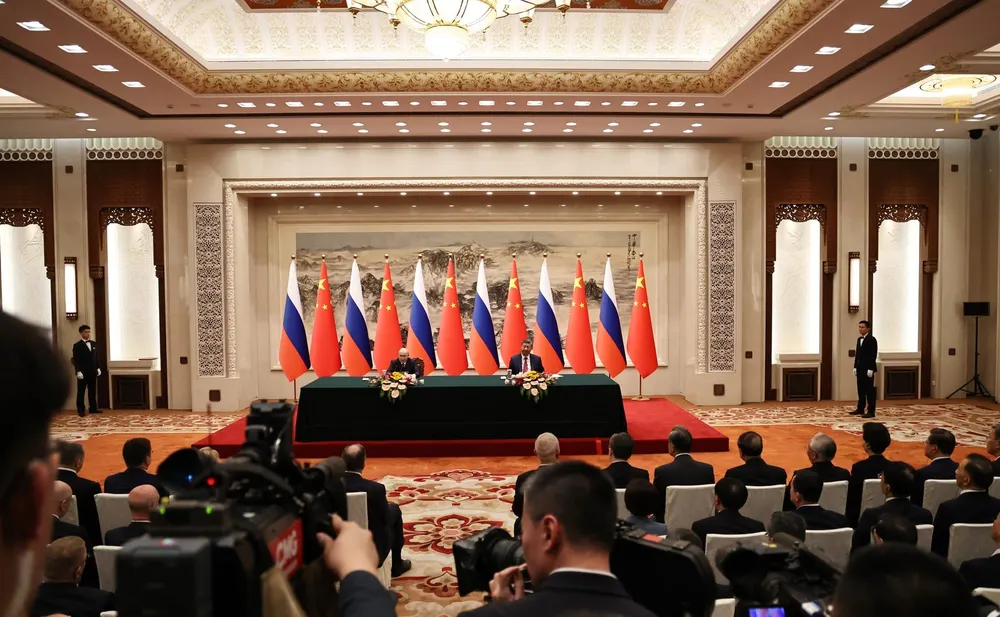
The first possible future was advanced in the important state visit concluded May 20 by Russian President Vladimir Putin to Beijing, where he met with his friend and counterpart Chinese President Xi Jinping for what Putin characterized as “successful, intense, and fruitful work.”
In addition to the dozens of agreements reached between the two delegations, further strengthening many facets of the Russia-China partnership, an important document signed by the two Presidents, “Joint Declaration of the Russian Federation and the People’s Republic of China on the Establishment of a Multipolar World and a New Type of International Relations,” put forward in the clearest terms that the neocolonial system is now in the process of being replaced by a new, more just system of relations between nations—and that Russia and China are playing a central role in bringing that system into being.
The statement, which draws upon a series of documents going back to 1997, notes the “dawn of a new era” in which fundamental interests of all nations are respected “without dividing the world into opposing regions and blocs,” in contrast to “the attempts of a number of states to unilaterally manage global affairs, impose their interests on the entire world, and limit the possibilities for the sovereign development of other countries, in the spirit of the era of colonialism,” which attempts, they say, “have failed.”
A crucial component of such a new era is the recognition, “that the security of one state cannot be achieved at the expense of the security of another,” and that a new architecture of indivisible and equal security must be established for the entire globe. This is exactly in line with Helga Zepp-LaRouche’s urgent call in 2022 for a new international security and development architecture, and her more recent international mobilization leading into the May 26 UN Security Council special session for a security and economic architecture for Southwest Asia, including the extended Oasis Plan; such a new-paradigm solution for that region, coherent in principle with the Russian and Chinese Presidents’ joint statement, could set off a broader process of pulling humanity away from the brink.
And that “brink” is dangerously close: The second potential and very dangerous future for humanity might be triggered by a renewed attack on Iran on the part of the United States and/or Israel—which U.S. President Donald Trump has promised he might unleash at any moment, and which the IRGC has warned would extend the regional war “beyond the region”—which could quickly lead the world into a global depression and possibly a nuclear war.
Likewise, the unwillingness to abandon a war fantasy against Russia by delusional leaders in Europe could also lead to tragic consequences, as Russian Deputy Foreign Minister Sergey Ryabkov recently warned: “As a result of this escalation of tensions, including blatantly provocative moves in the nuclear sphere, strategic risks are increasing, as is the danger of a head-on clash between NATO and our country, with potentially catastrophic consequences.”
It is urgent that we stop the further escalation of war before it starts. How? Join the momentum coming from China and Russia, and led in the West by Helga Zepp-LaRouche. Circulate Zepp-LaRouche’s open letter, “A Policy To Bring Peace and Development to Southwest Asia.” Organize for a completely new concept of relations among nations. Such a new paradigm emphatically includes the United States and Europe, which must be turned—and can be turned—away from the present, unnatural course of self-destruction.