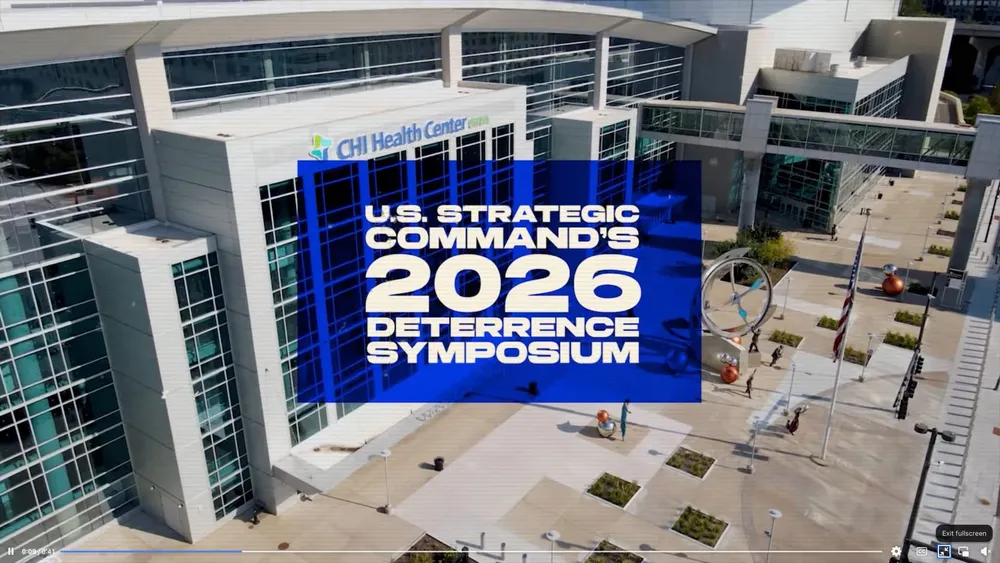
U.S. Strategic Command convened its annual Deterrence Symposium in Omaha, Nebraska on Wednesday and Thursday this week, at which “a more aggressive nuclear vision focused on strengthened deterrence and production is front and center,” Hans Kristensen, the director of the Federation of American Scientists’ Nuclear Information Project, wrote on X. He cited Brandon Williams, the head of the National Nuclear Security Administration, as saying that the plan is to produce 100 plutonium pits (nuclear bomb triggers -ed.) at Los Alamos National Laboratory by Dec. 2028 and to “develop capacity to field a new nuke in 3-5 years.”
The speakers list for the symposium reads like a roster for the nuclear weapons policy makers across two Trump administrations, but the star of the show was Elbridge Colby, the undersecretary of defense for policy, who was the subject of an Aug. 5 NBC News report identifying Colby as being behind a change in US nuclear strategy that would place greater emphasis on tactical nuclear weapons, a change that critics say would make them more likely to be used. “Colby didn’t actually offer much specific but broad strokes,” Kristensen wrote in an earlier posting on X on Wednesday. “It’s a review or re-look at strategic guidance to create more strike options, not strategic versus tactical, but will utilize and drive capabilities for limited regional scenarios.”
Daryl Kimball, executive director of the Arms Control Association, noted that the Aug. 5 NBC report on Colby’s review would “de-emphasize—but not necessarily eliminate—the long-standing requirement for ‘damage limitation’ capabilities, which calls for a massive strategic nuclear attack against a U.S. nuclear adversary to try to destroy as many of their nuclear forces as possible.”
Raising a discussion of “damage limitation” at this point is little more than part of the effort to make nuclear war conceivable, and no longer “off limits.” Kimball, however, wrote: “We believe the proposed shift in strategy could, if it phases-out the ‘damage limitation’ requirement, reduce certain risks, but adding more tactical nuclear strike options would complicate the tenuous nuclear deterrence relationships the United States maintains with other nuclear-armed states and increase the risk of nuclear war,” Kimball and his co-author, Xiaodon Liang, Senior Policy Analyst, wrote in an Aug 7 commentary.
They note that the concept of “damage limitation” drives the size of the strategic nuclear arsenal and dropping it, they argue “would facilitate progress if the Trump administration were to actually try to renew talks on nuclear arsenal reductions with Russia and/or nuclear arms restraint talks with China.” But the Trump team has taken no meaningful steps towards getting negotiations with China and Russia underway.
“Without a firm rejection of the option to use nuclear weapons first in a conflict, by building and fielding more tactical nuclear weapons the administration is signaling its intention to use them against enemy forces and industrial infrastructure in a conflict. ...” Kimball and Liang argue further, adding: “Once nuclear weapons are used in a conflict involving another nuclear-armed state, there is no guarantee that any use of nuclear weapons, even on the smallest scale, could reliably be expected to remain limited.”