Heat water and nothing appears to happen—until it reaches its boiling point and becomes something else entirely. That is a phase change, and it is what Helga Zepp-LaRouche says the world is now facing: “A phase change has to occur one way or another, because the existing trajectory is coming to an end.” The Iran war and the Ukraine war have each reached a boundary condition. While the new state is not yet determined, it is certain that the present one cannot continue.
Consider the evidence in today’s briefing.
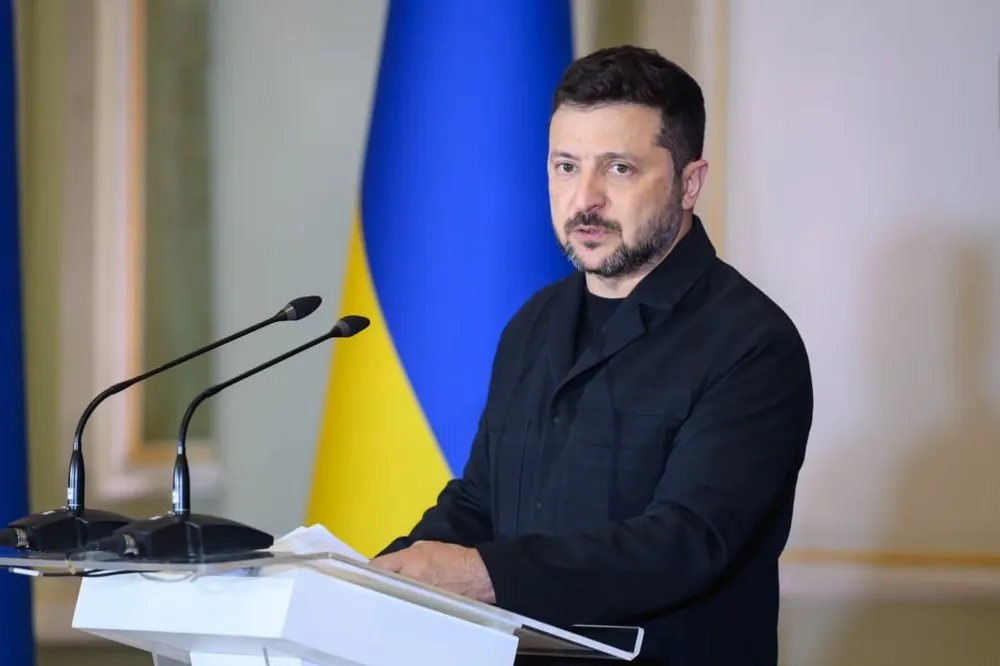
Can the U.S. continue to supply both wars? The interceptors do not exist. When Russia struck Kyiv on Aug. 1, Ukrainian air defenses stopped one ballistic missile out of 27, and Zelensky’s demand for 300 Patriot interceptors collides with the fact that the United States procured an average of just under 270 per year over the past decade. The U.S. Army has quadrupled its own stated requirement—from 3,376 missiles to 13,773—an acknowledgment that NATO’s air-defense architecture was sized for a world that no longer exists. The American commander in Europe now reports he must choose between defending the U.S. homeland and defending Israel.
Can the wars be contained? Turkish crewmen are now in critical condition after drones struck their ship off Novorossiysk, and Turkey—a NATO member—is appealing to both Russia and Ukraine for the safety of navigation. Both sides are now striking the ships that carry the world’s bread: Russia’s grain exporters warn of a 30-35 million ton shortfall and famine in the poorest countries, while a Western journalist returning from Odessa reports that no shipowner dares approach Ukraine’s ports at the peak of harvest. Food and fertilizer are not reaching people around the world who have nothing to do with this war, except being its distant victims.
Meanwhile, Europe can barely keep its own lights on. Hungary’s nuclear plant stands idle beside a river its intakes can no longer reach; France has deactivated or throttled eleven reactors; Germany has cobbled together, in place of a reliable energy system, a Rube Goldberg machine for managing intermittent supplies of energy. In the same week, China connected new reactors to the grid, passed France in installed nuclear capacity, and approved eight more units.
What will be the new phase the world enters?
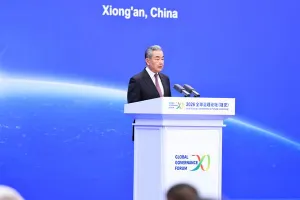
One is cooperation. Izvestia is openly mooting a Putin-Xi-Trump trilateral summit at the APEC meeting in Shenzhen, Nov. 18-19—Russia’s senior APEC official calls it “entirely feasible, since the three leaders of the major powers are expected to attend”—with strategic stability at the top of the agenda, now that no treaty constrains the world’s two largest nuclear arsenals. Xi comes to Washington in September; Trump has invited Xi and Putin to the G20 in December. How profoundly could the world change if the U.S. collaborated with Russia and China?
That question is terrifying the British empire. The Economist answer came on July 30, in the form of instructions to America’s Asian allies to break up Trump’s summits with Xi—to “follow Zelensky’s example,” as they put it, in changing the President’s mind, exactly as the British-led coalition broke the Alaska understanding with Putin last year. The City of London is steering the phase change toward a wide, qualitatively more dangerous war, and they have published their how-to guide.
Between these two states stands nothing but the question of what people do. That is why the July 31 EIR Roundtable, “Solve the Immigration Crisis with Development,” is not a commentary on the crisis but an intervention in it: the only program on the table by which the Western nations and the BRICS jointly develop Africa, Southwest Asia, and the Americas—and the impoverished regions of Europe and the United States with them. This is the importance of internationalizing Diane Sare’s presidential campaign: in a world terrified of an America that seems to have abandoned reason altogether, an American voice speaking in cohesion with the interests of the majority of mankind is a powerful weapon.
The water is about to boil. What it becomes is up to us.