
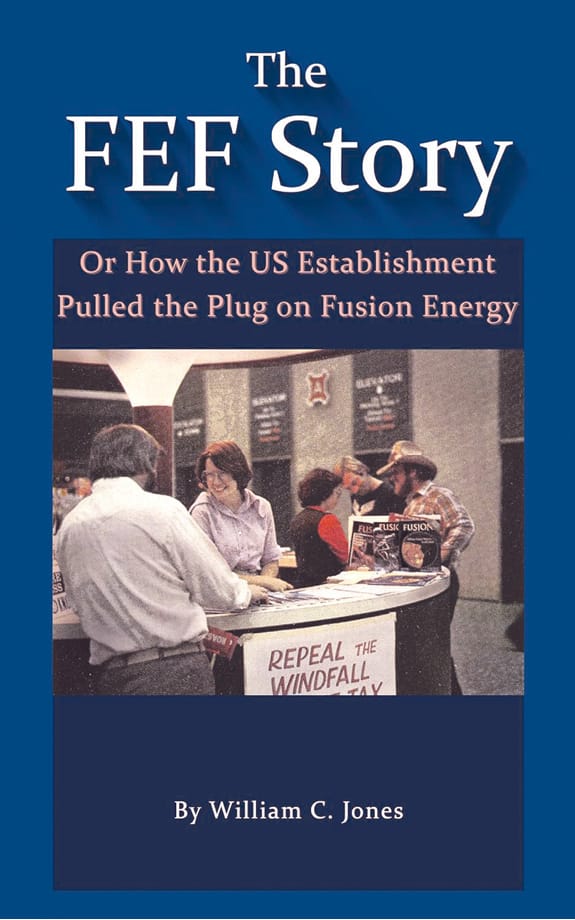
The FEF Story—Or How the US Establishment Pulled the Plug on Fusion Energy
by William C. Jones
Leesburg, Virginia, 2026
Paperback, 321 pages, $15.00
Aug. 2—Most Americans today have little or no appreciation of the actual historic implications of the decades-long brutal suppression and silencing of the ideas and political activity of the late American statesman and economist Lyndon H. LaRouche, Jr.. Fortunately, William Jones’s The FEF Story goes a long way to finally flush out the real world effects of what former U.S. Attorney General Ramsey Clark called “a broader range of deliberate and systematic misconduct and abuse of power over a longer period of time in an effort to destroy a political movement and leader, than any other federal prosecution in my time or to my knowledge.”
Utilizing recently released Freedom of Information Act documents from the FBI and other government agencies regarding the LaRouche case, Jones paints a vivid picture of how a corrupt, permanent bureaucracy inside the U.S. government effectively nixed not only the successful development of thermonuclear fusion, but had a chilling effect on those wishing to collaborate in the discovery and promotion of the most fundamental breakthroughs lying at the frontiers of science.
Jones explains that as early as 1972, LaRouche’s National Caucus of Labor Committees began to aggressively expose the fraudulent Malthusian “zero population growth” movement and ideology, and began an active political and educational campaign to promote the development of thermonuclear fusion energy. By 1974, this activity of LaRouche and his associates had sparked the interest and excitement of some of America’s top scientific minds, leading to the creation of the Fusion Energy Foundation (FEF) that November.
In only a few years, the FEF grew into one of the most active, pro-nuclear, anti-Malthusian scientific organizations in the United States, with its Fusion magazine reaching approximately 100,000 subscribers by 1980. That same year, with indispensable FEF assistance, the Rep. Mike McCormack sponsored Magnetic Fusion Engineering Act of 1980 was passed and signed into law by President Jimmy Carter, calling for “demonstrating the engineering feasibility of magnetic fusion by the early 1990’s.”
The FEF Story provides extensive documentation of the depth and extent of LaRouche and the FEF’s influence throughout not only the United States, but across the globe, including, most emphatically within the Soviet scientific community, with Russian representatives frequently attending FEF seminars and conferences. Jones also provides a thorough review of LaRouche’s central role in the formulation and promotion of President Ronald Reagan’s 1983 Strategic Defense Initiative, including his assignment to serve as a “back channel” negotiator with Soviet representatives on behalf of the Reagan Administration.
Up until the mid-1980s, with Fusion magazine and FEF continuing to grow and exert a major influence on U.S. policy making, it is fair to say that the United States still had a fighting chance of dumping the neo-Malthusian, anti-science policies of an entire section of the U.S. political and financial establishment, and instead embarking on a completely different future based on the mass development of nuclear fission and, perhaps by now, commercial fusion energy. However, all of that came to a crushing end on October 6, 1986, with the unprecedented raid by hundreds of heavily-armed FBI, ATF, and local and state law enforcement personnel on the offices of LaRouche publications in Leesburg, Virginia, followed by raids on the offices of the Fusion Energy Foundation six months later. In an unprecedented case of massive government misconduct, the FEF was placed in involuntary bankruptcy, and Fusion magazine, America’s foremost publication advocating the rapid development of fusion energy and related advanced scientific research, was effectively shut down.
Although The FEF Story could have perhaps used some further editing and polishing (possibly in a second edition), the story presents a powerful picture of perhaps the most egregious case of how the abuse of government power by corrupt private interests has brought the United States to the sorry state that it is in today.
The concluding paragraph of the last chapter of The FEF Story (appropriately titled “Belated Reprieve But Exoneration Still Lacking”) effectively sums up the absolute necessity of every concerned, patriotic American to not only read this book, but become a passionate advocate for Lyndon LaRouche’s exoneration:
… it was the courage and determination of this unique veteran of the Second World War, Lyndon H. LaRouche, [Jr.,] with his whole-hearted commitment to make the world a better place, which imbued the work of the FEF. And that spirit never failed to empower those who came to know and love him. If U.S. science is ever to attain a place in the panoply of world powers, this story has got to be told—and the lessons learned—in order to revive the real spirit of America, a spirit felt most deeply by this most patriotic American—and this most dedicated citizen of the world.
