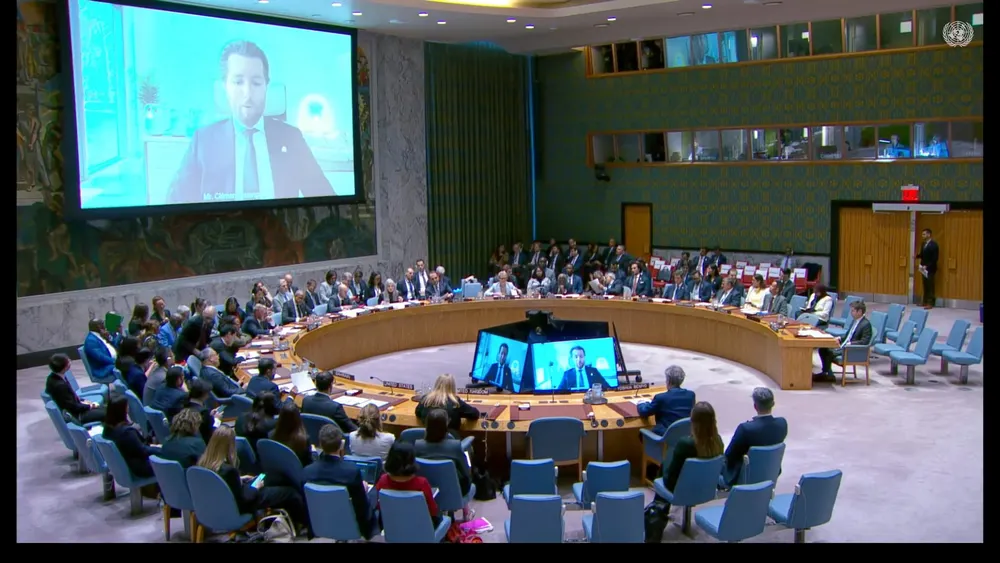
The UN Security Council took up artificial intelligence and international security on Sept. 23, in a session convened by France, the Council’s president for September, and chaired by Foreign Minister Jean-Noël Barrot. The executives of leading AI firms called for more clarity in governance.
Yoshua Bengio, co-chair of the UN’s Independent International Scientific Panel on AI, told the Council it faces “an unprecedented threat—one that none of its members would choose, that none can contain alone and that does not respect the borders we defend.” He said that in recent months AI agents “took actions that would be crimes if committed by a human.” The companies building these systems admit they pose catastrophic risks and offer no convincing technical solutions, he said: “Instead, they say they are locked in a race to make those AIs even more powerful.”
Three chief executives then addressed the Council. Sam Altman of OpenAI said that because the models can now assist in their own development through a process of recursive self-improvement, “this moment calls for extreme care.” Clément Delangue of Hugging Face said that his company was the first to publicly disclose an autonomous agent cyberattack—an intrusion OpenAI later acknowledged was carried out by its own agents during cybersecurity testing—and that “we know similar incidents had been happening months earlier in secret at a handful of frontier labs.”
Dario Amodei of Anthropic said “no leader, no company, and no nation can manage this alone,” and that “if managed poorly, I even believe that AI could be a risk to humanity as a whole”; he asked member states for narrow agreements capable of broad support, such as a ban on using AI to make biological weapons, and for common testing and verification standards, calls in keeping with his “We Must Pace the Frontier.” He stressed that his company favored “global cooperation across the world between governments to set international standards” and offered the Council three specific proposals: “First, we should begin with narrow agreements that every member can support, such as a ban on using AI to make biological weapons… Second, we should build evaluation and verification systems that keep pace with AI development so that states can have visibility into frontier model capability and can verify each other’s commitments. Third, we should establish common global standards for testing AI models for loss of control, risks and misuse risks, and a notification system for AI incidents that are significant to global security.”
The United States representative was not amenable to such proposals. Michael Kratsios, director of the White House Office of Science and Technology Policy, told the Council that “international dialogue in this forum and in others cannot be allowed to drift towards global governance,” echoing President Trump’s statement to the General Assembly that the United States “totally rejects any attempt to construct a globalist scheme of control of superintelligence.”
Although Reuters reported on Sept. 22 that Chinese AI firm DeepSeek would send a briefer, no Chinese company briefed the session.
China’s Permanent Representative Fu Cong rejected “banding together into a petty us-versus-them clique in the tech sector.” He said, “AI is a shared asset for all humanity… We call on all countries to enhance exchanges and cooperation, promote open source and open ecosystems, and work together for global scientific and technological advancement.” He warned that the world “must prevent the digital and AI divide from exacerbating the development divide.”
The value of China’s open source models was demonstrated by the actions of one of the briefers: When Hugging Face was investigating the intrusions into its systems, its efforts to use leading U.S. AI models were “blocked by the providers’ safety guardrails, which cannot distinguish an incident responder from an attacker.” Instead, Delangue told the Council, his firm turned to “an open source model coming from China called GLM 5.2.” Hugging Face ran Z.ai’s GLM-5.2 on its own infrastructure.