Editor’s Note: This article is being published in EIR for the first time. It was originally written August 10, 1982.
The following is the introduction to Operation Juárez, a book-length study on prospects for the economic development of Mexico and, more generally, the entirety of Ibero-America. The complete report can be found here.
Throughout Ibero-America today, one hears often the wishful delusion: We must remain credit-worthy. Ostensibly, unless this precious commodity, called “credit-worthiness,” is protected with the utmost zeal, the angered international financial institutions will withhold new issues of credit from Ibero-American nations.
This is a delusion on three leading accounts.
First, during the Winter months of 1981-1982, the continuation of the so-called Volcker measures in the United States triggered the eruption of a second, worldwide “Herbert Hoover” depression. It is agreed by leading figures of most London and Switzerland financial circles that this new depression will probably lead into a general, chain-reaction collapse of financial institutions by September 1982, or, alternatively, that the collapse can not be postponed beyond early 1983.
Under these conditions, the external debt of all Ibero-American states will be pushed into a condition of irreparable default, and there will be no margin of international lending to provide refinancing or any other significant form of new credit.
To what financial institution will an Ibero-American nation then present its certificate of credit-worthiness?
Second, as a matter of policy, the principal international financial centers, including the irregular Eurodollar market, have resolved to “decouple” from further financial commitments to Ibero-America, Africa, and Asia—barring a handful of possible exceptions among the nations of those continents. Rather, the appearance of “threatening to lend” is being used merely to seduce credulous Ibero-American governments into accepting cruel, arbitrary devaluations and savage economic austerities, by threatening to withhold the future credit, which is not intended to be forthcoming in any case.

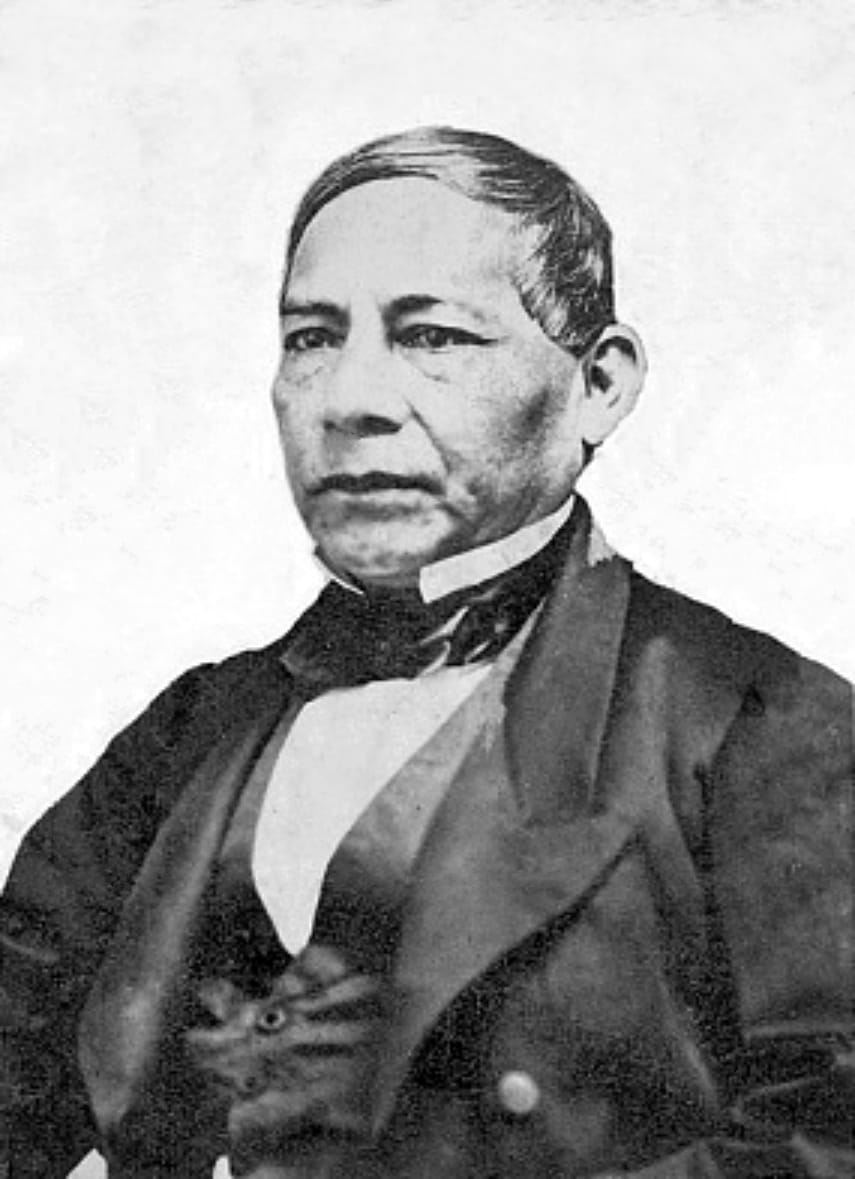
President of Mexico Benito Juárez (right) and President of the United States Abraham Lincoln (left), who served as contemporaries in the mid-19th Century, epitomized the proper relationship between their two nations. Credit: Public Domain
Third, it is the commitment of forces behind former U.S. foreign minister Henry A. Kissinger, to destroy the nations and populations of Meso-America and South America, through scenarios which combine austerity, insurrections and regional warfare, to unleash the depopulating effects of perpetual “Thirty-Years’ Wars” in this region of the world over a span of decades.
These murderous policies are the policies of certain powerful U.S.A. rentier-financier families, including the Morgans, the Harrimans, the Moores, the Rockefellers, and so forth, “families” which control major portions of both the Republican and Democratic parties, and which, at the present moment, are exerting control over the policies of the government of the United States of America.
These are also the policies of the International Monetary Fund, the World Bank, GATT, the Bank for International Settlements, and NATO’s Political Secretariat. NATO’s “out-of-area deployment” policy, pushed through during the course of the recent Malvinas Crisis, is a commitment to conducting what are called “population and raw-materials wars” against the continents of Ibero-America, Africa, and Asia. These and allied institutions are wittingly committed to the greatest genocide ever conceived: they intend that billions of people shall die of “accelerated deathrates” over the course of the remaining two decades of this century, reducing savagely the numbers of the “non-Anglo-Saxon race.”
Their policy is best described as “Malthusian world-federalism.” These are the policies of the Club of Rome, of Chatham House’s “Year 2000” program, and the Global 2000 program of the recent U.S.A. Carter Administration. These are the policies of Henry A. Kissinger and the circles which own Kissinger.
If any nation of Ibero-America imagines that it has any “credit-worthiness” worth defending, under the rule of such institutions, the government tragically misguides itself. Under present IMF and other “conditionalities” policies, there is no fate available to any nation of Ibero-America but utter destruction of the political, social and economic structure of the continent during the course of the decade immediately unfolding.
In principle, there is a workable, equitable solution between the debtor-nations of Ibero-America and the creditor-nations of the OECD grouping. To the degree any among the governments of those OECD nations are clinically sane, those governments would gladly accept such a solution. However, as we shall indicate, not all among those nations’ governments are sane, either psychologically or morally.
In this report, we accomplish chiefly four general tasks. First: we describe the workable solution to the present monetary crisis, in terms of an equitable rescheduling of the external indebtedness of Ibero-American nations. Second: we examine the economic policies needed to ensure the success of the monetary reorganization. Third: we examine the causes for the insanity, psychological and moral, among powerful supranational forces dominating policies of the OECD grouping. Finally: we reexamine our proposed program in light of the problems posed by this insane, but powerful opposition.
We have named this report “Operation Juárez,” in memory of the proper alliance between the American Whigs of the United States and the Mexican liberals from whose ranks Juárez emerged as a leading figure. If the interests of the United States of America are properly defined, from the vantage-point of the 1775-1783 War of Independence and the 1787 Federal Constitution, then the well-being and secure sovereignty of the republics of Ibero-America is the most vital interest of the United States of America, and whoever breaks that alliance is variously enemy, traitor, or simply fool. In the history of the United States, it is our relations to Mexico’s republicanos which have best symptomized whether or not the United States of America is pursuing a proper approach to Ibero-America as a whole. Only patriots of the United States who remember Benito Juárez as our brave and precious ally can understand Ibero-America and its interests.
The deeper importance of that same point will become clearer in due course within the body of the report.
We have accompanied the transmission of this report with two book-length documents. The smaller of the two is a text of a book written for use (primarily) of patriotic economists of India and Mexico, A Conceptual Outline of Modern Economic Science. This is rewarded to complement material included in the body of this present report. The second, longer text, transmitted in prepublication print, limited-edition-form, is entitled, The Toynbee Factor in British Grand Strategy. Although the latter text was written for general, public circulation, it was written to serve as an appendix to the writer’s testimony to the U.S. Senate Foreign Relations Committee on the nomination of George Shultz to become Secretary of State. It is submitted here not only as the most thorough study of the policy-shaping ideology behind U.S. foreign policy today, but as in-depth treatment of the problem of moral insanity among forces influencing powerfully the governments of OECD-grouping nations.
New York City
August 10, 1982