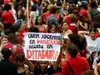
Italian steelworkers in Taranto and Genoa are on strike to protest against the closure of the last blast furnace in the Taranto plant, once the largest in Europe. Taranto was the only Italian integrated steel plant, in former times producing up to one third of the national output. Furthermore, Taranto has been the only Italian site to produce primary steel and steel sheet, which are fundamental for the automotive, home appliances, and shipyard sectors.
The closure of the last of the 5 blast furnaces in Taranto is the last chapter of anti-industrial policy carried out by an unholy alliance of Green fundamentalists and radical members of the Judiciary. The decision to close the last furnace, in particular came through a Court injunction in Milan, which has acted on a preemptive class action filed by two groups: “Free and Thinking Citizens” and “Pediatricians For Environmental Emergency,” both groups created and led by the M5S version of radical environmentalists.
The Milan court has ruled that the Taranto steel plant should stop activities by Oct. 24. The plant, currently run by a government caretaker, has filed a complaint at the Court of Cassation, whose ruling is expected for Oct. 20. In order to put pressure on the government, the management has already stopped production and the trade unions have started a strike in Taranto and Genoa, where the group has plants that process the steel produced in Taranto.
Without Taranto, the Genoa plants will be forced to buy abroad the primary steel needed to supply the Italian automotive and home appliances industries, already hit by a severe crisis, and the shipbuilders. Managers in Genoa have already announced that they will stop producing by Nov. 25, hopefully temporarily.
At its historic peak (2005-2008), the Taranto steel plant produced 9.5-10 million tons of steel, almost one third of the entire national output (31.6 million tons), putting Italy in second place of steel production in Europe, after Germany.
Troubles for Taranto started after the privatization of Italy’s steel sector, implemented by Mario Draghi when he was head of the Privatization Committee of the Italian Treasury ministry. The plants were sold to the Riva family, a historical private steel producer in Northern Italy. Eventually, the Riva family was prosecuted for an “environmental disaster,” its members were jailed, and the plant was run by four government caretakers. It was then sold to Arcelor Mittal, which eventually threw in the towel and was again put under caretaker. During this period, the blast furnaces were turned off one by one, leaving only one active, which now has been put on standby, which means zero production.