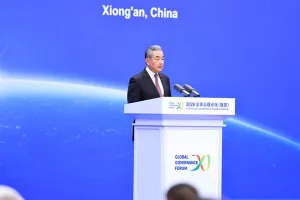
Helga Zepp-LaRouche returned from Xiong’an and called the Global Governance Forum there “a conference which one can only describe as truly historic": more than 400 participants, half of them senior figures from abroad, 22 seminars, and a spirit “unbelievably optimistic, rich in terms of creativity.” Wang Yi opened it by setting out two paths, one of “unilateralism, bullying, double standards,” the other “characterized by multilateralism, cooperation, and working together in harmonious development.” Churchill said nations have no friends, only interests. Zepp-LaRouche reported that the delegates from Africa, Asia, and Latin America regard China “not only as a partner but as a friend,” and told the West why: “We could have developed in the last decades highways and railways, ports, and industries in the Global South, but we did not. The Western model emphasized ‘security,’ building many military bases around the world, but not providing development.”
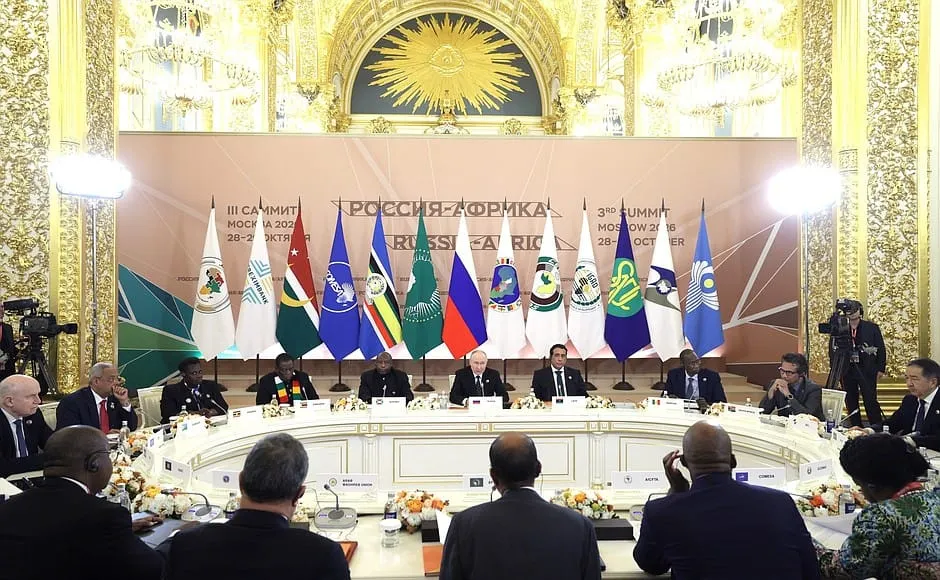
The same day as Zepp-LaRouche’s report, 48 African states opened the third Russia-Africa summit in Moscow, hosted by Putin. Africa’s infrastructure “was built in colonial times to serve the export of raw materials to the metropoles. Even today, by expert estimates, value added in the continent’s manufacturing industry is less than 2%. Of the total annual trade turnover of African states—$1.5 trillion—only 15% consists of transactions within the continent itself.” He quoted the 1987 speech to the OAU by assassinated President of Burkina Faso Thomas Sankara: “Debt is neo-colonialism, in which colonizers have transformed themselves into ‘technical assistants.’” Putin added: “Unfortunately, little has changed since.” Russia sells Africa grain and fertilizer, 13 million tonnes this year, but “Africa has agricultural potential of its own and is capable of feeding itself. I believe this is one of the continent’s most important tasks.” The African Union’s chairman, Burundi’s Évariste Ndayishimiye, answered for the continent: “We would like to achieve a level of cooperation that goes beyond commodity exports.” Africa’s most important capital, he said, “matters much more than material resources. It is our youth.... They need engineering education.”
He has the order right, and so does Putin. A country with half its people in the fields cannot staff the factories, the laboratories, or the engineering schools; sub-Saharan Africa has made progress, but today half its workforce is involved in growing food, on land that yields 1.7 tonnes of grain per hectare against a world average of 4.2. The United States was there in 1850. China was there in 1990. The way out is not a secret. Lyndon LaRouche laid it out in 1975, in his proposal for an International Development Bank, and named the Sahel “the potential breadbasket of Africa.” Development, he wrote, is “an increase in the social productivity of agriculture, reducing the proportion of the total population required to produce the nutritional requirement of the same total population, creating an enlarged industrial population from surplus agricultural populations.” The means are known: “Fertilizers, hydraulic engineering, tractors, and agricultural equipment, together with biological work on seed stocks” can produce “a significant leap upward in the per-hectare and per-capita productivity of agricultural output,” and that surplus, “plowed into housing, sanitation, education,” builds the people who build the industry. “The principal historic issue of colonialism and imperialism,” he wrote, “is not that it extracted primary resources from the southern regions of the globe, but that in this process it failed to develop the quality of agriculture and an industrial labor force.” Resources are not wealth. The human mind that transforms them is, and a nation’s wealth is measured by the number of its people able to do so.
That is what Xiong’an and Moscow were about this week, and what Britain’s insistence on being “ready to fight and win a war” is not. Contrast Britain’s approach to developments in the Gulf. Oman’s foreign minister called on Monday for a regional security pact that includes Iran and excludes outside powers, and Iran’s President Pezeshkian told Putin in Moscow that the region can settle its problems “without the United States.”
Let us choose to build the capacity to make people more productive, rather than stockpiling for a war to maintain dominance.