
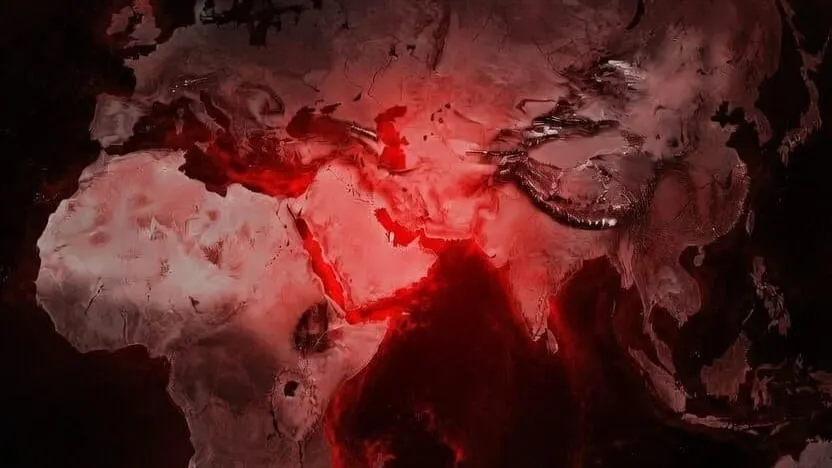
Over the recent months, Helga Zepp-LaRouche has pointed out that the world is experiencing a collision between two fundamentally different paradigms—that of the dying imperial order, and that of a polyphonic community of world nations—and the shaking out of such a process is going to get messier before it gets better. Therefore, it shouldn’t be a surprise that chaos is increasingly spreading around the world as a result of such a collision of systems.
In Southwest Asia on Oct. 10, Yemen’s Houthis confirmed they had struck the King Khalid International Airport in Riyadh, killing 13 and injuring over 300. The airport was struck again on Sunday, as was the King Fahd International Airport in Dammam, and two Aramco facilities—the Shugadam gas facility and the Tanajib oil refinery. Saudi Arabia responded with strikes back against Yemen.
This escalation now adds another trigger to a region already teetering on the verge of spiraling out of control. Saudi Arabia, along with Pakistan, Türkiye, and Egypt, released a statement condemning the Houthi strikes, as have many other governments—including the United States. This further threatens the involvement of Pakistan and Turkiye, which have recently signed the Mecca Defense Pact with Saudi Arabia, pledging that an attack on one is an attack on all. Both countries have been hesitant to join the fighting as Saudi Arabia’s hostilities with the Houthis have heated up, but they will now be pushed to a point of decision. Further, when asked on Oct. 10 if the U.S. was planning to join Saudi Arabia’s campaign against the Houthis, President Trump left the door open, saying, “We may. We’re gonna look at it.”
Given the already bleak outlook for economies around the world and the central role this region has for global trade, these developments can only mean a worsening of the situation.
Meanwhile, apparently out of desperation from the complete failure of his Iran policy, President Trump has caused much fur to fly with regard to the war in Ukraine. After demanding that Ukrainian acting president Volodymyr Zelensky halt strikes on Russian oil infrastructure or “leave office,” reports are now circulating that the U.S. has threatened to cut off intelligence sharing or weapons purchases. Then on Sunday, Trump announced an “energy ceasefire,” which neither side seems to have known about.
Of course, none of these harebrained schemes will resolve the underlying situation—they are merely an expression of the desperation facing the U.S. and the West as their policies hit a brick wall. A similar phenomenon is occurring in Europe today as protesters flood onto the streets, deeply frustrated about the lack of opportunity and the hypocritical stances of their governments.
It would be naïve to think that this phenomenon is merely in response to a single “issue” or location. After all, the arrogant veil of bliss that was erected in the West following the assassinations of John F. Kennedy and other leaders in the 1960s, as epitomized by Francis Fukuyama’s The End of History, Thomas Friedman’s The World is Flat, and EU High Representative Josep Borrell’s depiction of Europe as a “garden” and the rest of the world as a “jungle,” is rapidly coming down. At the same time, the Global Majority, which had been denied access to modern industrial economies for much of the recent decades, is now asserting its right to a new, post-colonial existence.
Therefore, initiatives to give bold leadership in this period of ferment are more urgent than ever. Not to simply put a bandage on it, but to introduce a new security and development architecture that puts humanity on a course to live up to its true potential.