
Could the summit meeting of the presidents of China, Russia, and the U.S.A., now scheduled to be held on the sidelines of the Nov. 18-19 Asia-Pacific Economic Cooperation (APEC) Economic Leaders’ Meeting in Shenzhen, China, become a turning point away from war and toward a secure future for all mankind? Academician Sergei Glazyev, the eminent Russian economist, thinks there is hope for such an outcome. He argues that such a meeting of the three leaders—despite their evident divergent views and different interests—“could provide a significant impetus for a negotiation process in which the interests of the world’s leading civilizational centers are brought into accordance with shared rules for security and development.”
Glazyev polemicizes sharply against those who write off such a summit as just another “Yalta”—referring to the February 1945 meeting among Roosevelt, Churchill, and Stalin—in which the leading global powers would divide up the world into their respective spheres of influence. “There is now a historical necessity for a new ‘Yalta’ whose historical agenda should not be carving up the world among a few powers,” Glazyev wrote. “Its task, rather, is to agree upon rules for peaceful coexistence in the polycentric world that is taking shape.”
On Oct. 21, Kremlin official Yuri Ushakov had said that a trilateral summit of Presidents Xi Jinping, Vladimir Putin, and Donald Trump, if it were to take place on the sidelines of the Nov. 18-19 Asia-Pacific Economic Cooperation (APEC) meeting, would be organized by the Chinese hosts, and that Russia has already made some “practical suggestions” for its agenda. The Wall Street Journal, London’s Telegraph, and an array of publications in East Central Europe—anxious to sabotage the summit before it starts—promptly named the prospective meeting a “Yalta 2.0,” at which three “authoritarian” leaders would carve up Ukraine, or even the whole world. In Russia, meanwhile, some commentators on the upcoming trilateral summit have objected that an analogy with the February 1945 Yalta conference doesn’t hold, because its participants were allies in the anti-fascist coalition, whereas the U.S.A. has lately been an adversary of both China and Russia.
Academician Glazyev turned both arguments on their heads, in the extensive commentary we publish in full below. It first appeared Oct. 27 in the business daily Vedomosti under the headline, “Yalta 2.0: Why Russia, the U.S., and China Need to Agree on New Rules for the World Order.” And on Nov. 2, the author posted the full text on his Telegram channel, adding the subhead: “Hope for a Peaceful Transition to a New World Economic Order.” He made clear that he was presenting his bold ideas in his capacity as an economist, a member of the Russian Academy of Sciences, rather than as official Russian policy (or Belarusian; Glazyev currently is the General Secretary of the Union State of Russia and Belarus).
The setting for the upcoming trilateral summit could not be more dramatic, Glazyev wrote: “The contemporary world order is undergoing a systemic crisis, driven by the shift in technological and world economic paradigms. Not only is the old architecture of international security collapsing; the economic centers of power, the financial system, the technological leaders, and the very principles of international engagement are all changing…. The old international institutions are no longer capable of providing stability, while new ones are taking shape amidst a struggle between the old and the new centers of power.” At any moment, he warned, flare-ups of this struggle, this “hybrid war,” could lead “to the conflagration of a nuclear war.”
Despite the fact that the U.S. “ruling elite,” including Trump, is clinging to its imagined status of global hegemon, and launching wars for that purpose, Glazyev presented a carefully reasoned argument that reaching agreement with China and Russia is in American interests. “An escalation of the world hybrid war,” he warned, “could prove catastrophic for the United States by triggering the collapse of the quadrillion-dollar bubble of financial derivatives.” He added pointedly: “Russia, moreover, possesses a ‘needle’ capable of bursting these bubbles. Should this happen, the financial and military might of the United States would deflate, the financial pyramid of its national debt would collapse, and the dollar would lose its status as the global reserve currency: Pax Americana would repeat the fate of the British Empire.”
But there is a solution that avoids such a disorderly and dangerous collapse: “The possible solution is not the destruction of the global monetary and financial system, but its transformation into a multi-currency architecture. The dollar could retain its international role, even as the use of national, regional, and international settlement currencies expands and independent payment and settlement mechanisms are established.”
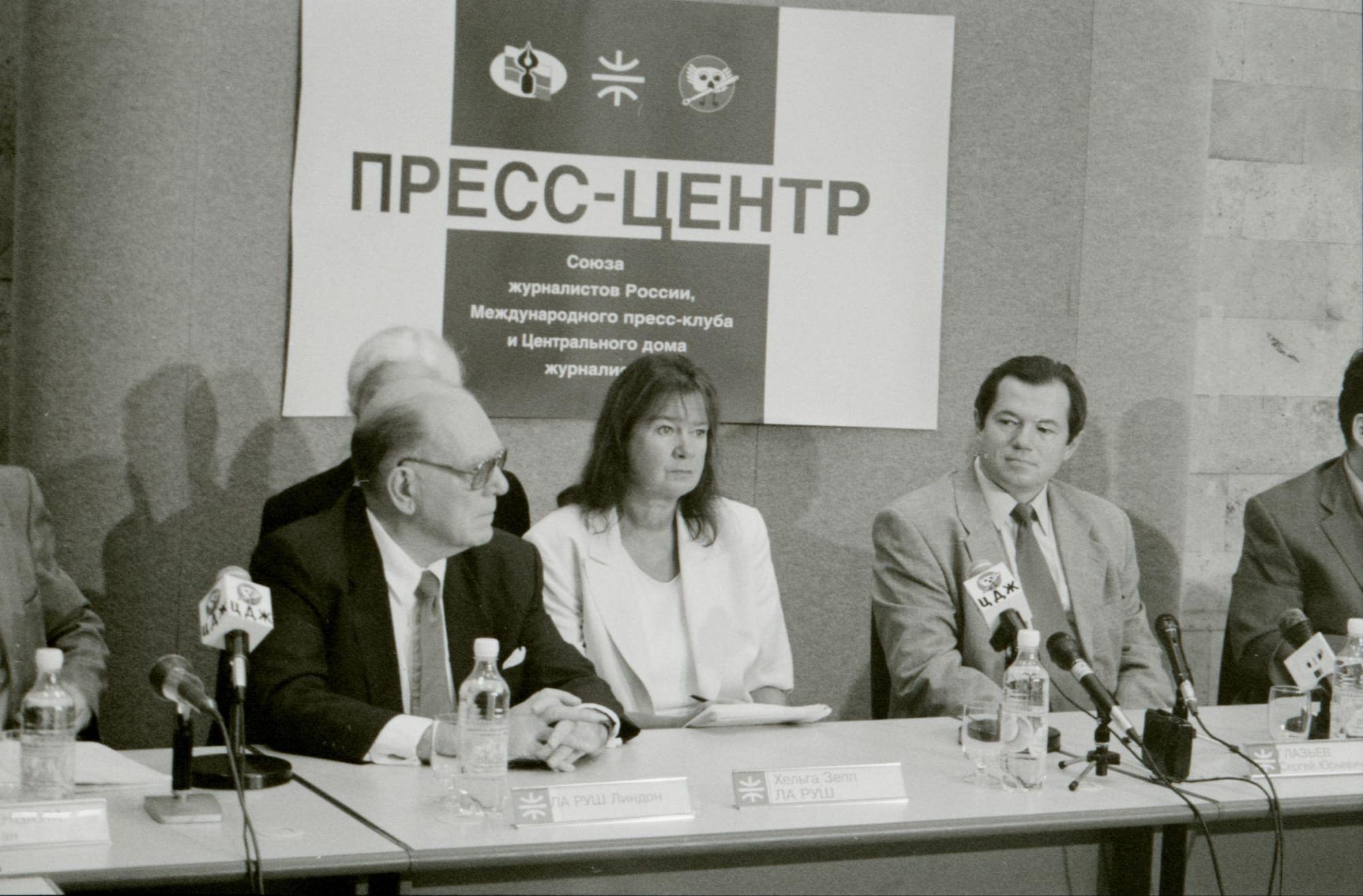
LaRouche Address to the Russian Duma
Left unsaid by Glazyev in this particular article, but a topic frequently raised by the late American economist Lyndon LaRouche in his extensive exchanges and dialogues with Glazyev over the years, is that the only way the dollar can remain intact is under an orderly bankruptcy reorganization of the dollar-based system, and the removal of the $2.4 quadrillion speculative cancer that has today made that dollar worthless. For example, on June 29, 2001, Lyndon LaRouche presented testimony to a meeting of the Russian State Duma’s Economic Committee, chaired at the time by Glazyev.
Presently, the world as a whole is dominated by the fact, that we are in the end-phase of the IMF system, at least as it has existed in the form it developed following U.S. President Nixon’s introduction of a so-called “floating exchange-rate” monetary order in mid-August 1971…. Nothing can save the present world financial and monetary system in its present form.
A continued refusal to accept certain necessary, sweeping reforms in those systems, would bring about not only an economic catastrophe worse than the worst period of the 1930s economic depression. The present crisis, unless it is stopped by drastically needed reforms, will also be a demographic collapse more or less comparable to what is called by historians “the New Dark Age,” which dominated Europe following the Fourteenth-Century bankruptcy of the so-called Lombard banking system.
Therefore, to speak of any economic policy which does not include a early and sweeping reform of the IMF system, is worse than a waste of time. We can overcome this collapse, but only if we are able to bring about a certain degree of international cooperation.
Glazyev’s Economic Thinking
Over decades of work as a scientific economist, and in the several government posts he has held that dealt with creating new institutions for international economic cooperation, Sergei Glazyev has displayed an incisive understanding of the nature of the current systemic crisis. From 2008-2024, he worked in various capacities to organize the Customs Union of Russia, Belarus, and Kazakhstan and its expanded successor organization, the Eurasian Economic Union. His participation in a long-running series of seminars called the China-Russia Economy Dialogue involved in-depth discussion with Chinese scholars on the methods of credit-creation and directed productive investment, used in China’s economic rise. Glazyev’s dialogue with economists in the other great Eurasian power, India, dates back to the early 2000s and has focused on the ongoing shift of the world economic center of gravity to the Global South.
Academician Glazyev has expressed his keen appreciation of LaRouche’s unique breakthroughs in the Leibnizian science of physical economy. For example, in a video message of appreciation of the thinking and impact of LaRouche on the centenary of his birth, September 8, 2022, that he sent to his widow and co-thinker Helga Zepp-LaRouche, the founder of the Schiller Institute, Glazyev said:
Lyndon LaRouche looked decades ahead. He warned the U.S.A. and its partners about the inevitable collapse of their financial expansion policy, under which the interests of speculators eclipse the national interest and the development of the economy…. In practically all the major countries in the world that today are developing successfully—above all India, and China—there are partisans of LaRouche. They have used his thoughts and ideas, for creating their economic miracles. It is the principles of Physical Economy championed by LaRouche, that today underlie the Chinese economic miracle and are there in the foundations of India’s economic development policy.
