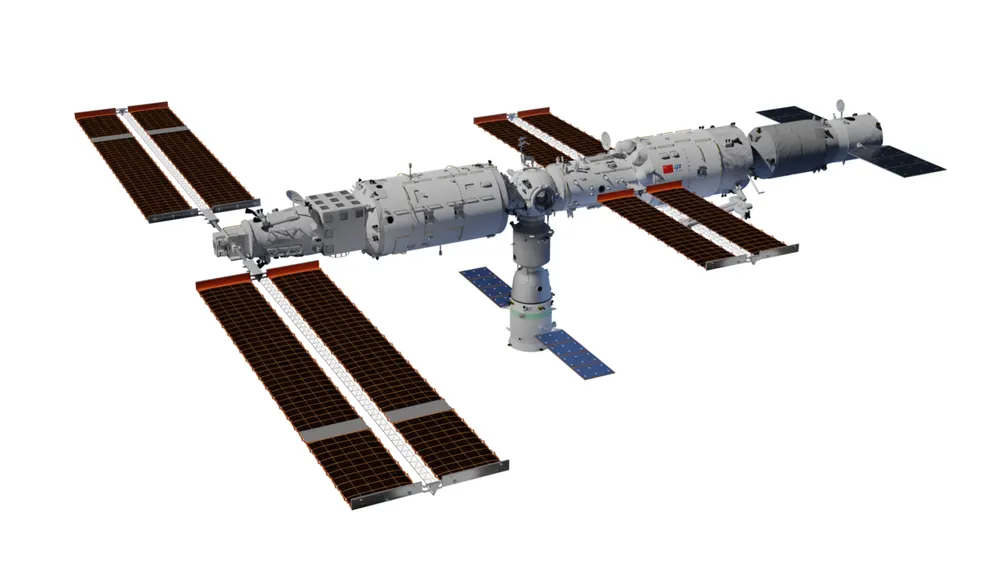
With the launch and entry of the Shenzhou-24 crew aboard China’s Tiangong space station, including its third member, Pakistani astronaut Muhammad Zeeshan Ali, a new chapter in international space cooperation has begun, as Global Times hailed it in its Nov. 24 editorial. Ali will serve as payload specialist on the Tiangong during a week or so.
“Now, Pakistan is on the verge of realizing its dream of human spaceflight, and its lunar rover project has been included in the list of international cooperation initiatives for [China’s] Chang’e-8 mission to the Moon,” the daily wrote, but “this also marks a new beginning” for the Tiangong station, “with more countries, particularly those in the Global South, joining hands to build a wider circle of partners.”
Global Times notes that under the “Wolf Amendment” enacted by the U.S. Congress in 2011—and still in force—, China has been excluded from cooperation with NASA or the ISS. “Having been denied a “ticket” to the ISS back then, China launched its own space station through self-reliance—and has reserved “seats” for other nations as well…. Having once stood in the rain ourselves, we are all the more eager to hold an umbrella for others.”
On their own, most Global South countries lack the industrial infrastructure, scientific research capabilities, and financial investment required for human space operations, the editorial points out. Yet the 1967 Outer Space Treaty “explicitly stipulates that the exploration and use of outer space shall be carried out `for the benefit and in the interests of all countries,’ irrespective of their degree of economic or scientific development.”
China believes that Global South nations “have the right and the dream to reach the heights of scientific and technological innovation,” and it is putting that belief in action.
“As humanity expands its horizons for survival and development into space, it should not replicate the North-South divide seen on Earth, nor should it allow this new frontier to become the exclusive domain of a few countries seeking to monopolize its benefits,” Global Times concludes.
”`To see a thousand miles farther, ascend another story.’ This line from an ancient Chinese poem was a particular favorite of Ali during his training in China. In the past, people tended to measure progress in space exploration by how far spacecraft could travel and how long astronauts could stay in orbit. Perhaps another yardstick should be added: How many countries have been able to participate in humanity’s journey into space, and how many people’s dreams have been realized along the way. Outer space is not an exclusive arena for competition among a handful of countries. Every nation with a dream has the right to reach for the stars.”