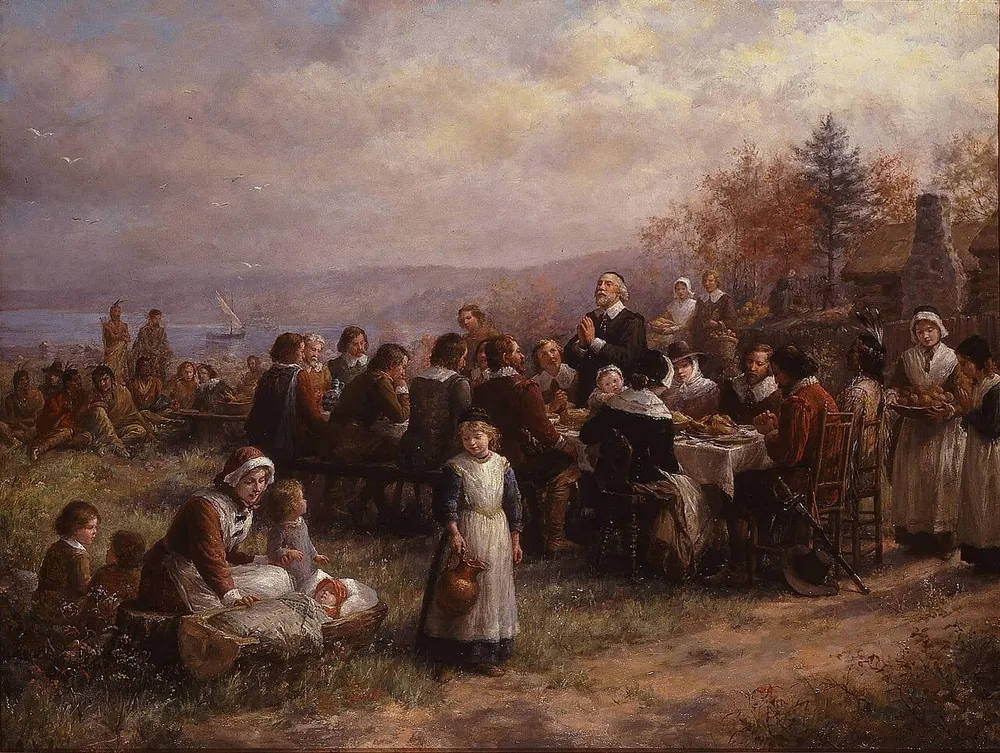
Even if prayer is not a habit to which many are inclined or accustomed, the occasion of the observance called by Americans “Thanksgiving” can, nonetheless, be profitably used, apart from its specific religious or national origins, as a moment of solemn reflection around the world. Pope Leo, the first pontiff to hail from the United States, pointed this out in his Thanksgiving message devoted to “a disarmed and disarming peace.”
There is, indeed, something to be profoundly thankful for. For weeks prior to the November 19 “Three Presidents” meeting in Shenzhen, China, the world had been closer to an immediate outbreak of thermonuclear war than it had ever been—including during the 1962 Cuban Missile Crisis. Though that danger is, in fact, continuing even after the Shenzhen meeting, the re-declaration of the Three Presidents that “nuclear war cannot be won and should never be fought” is the thin, but strong thread that has now been woven among them.
The “photo op summit,” as many disparagingly refer to it, was a most important meeting, and the visual image of a tripartite dialogue was, in fact, very powerful and necessary. After all, “The whole world was watching. “ For this meeting, the world, indeed, should be thankful, primarily for what those leaders are about to be caused to do, whether in public or not, to weather the coming storm—the transition to a new security and development architecture.
It is irrelevant to the truth, that most in the trans-Atlantic nations, including most policy analysts, choose to remain either ignorant of, or oblivious to certain strategic facts. Yesterday’s Wall Street Journal recounts, for example, that the real reason for the October 27 phone call made by Finnish President Alexander Stubb and Norwegian Prime Minister Jonas Gahr to Russia’s Alexander Putin, was to prevent a headlong confrontation between Russia and the 8 NATO nations bordering the Baltic Sea. “We have no intention of blockading the Baltic in peacetime, you can rely on that, we will act in accordance with the law,” said Stubb.
Then, just before the November 19 Presidents meeting, there was the Nov. 15 announcement by Foreign Minister Margus Tsahkna that Estonia would close its border crossings with Russia, as of Dec. 1. This followed claims that Russia had “attempted sabotage” of Threod Systems, a drone maker. “The more aggressively Russia behaves, the narrower its room for manoeuvre becomes,” Estonia said. Some wondered whether what was being contemplated was a Baltic “Strait of Hormuz” operation by NATO crazies.
The Russian Foreign Ministry responded on Monday, November 23. “…(The) Chargé d’Affaires of Estonia in Russia Marek Ühtegi was summoned to the Foreign Ministry. The Estonian diplomat was once again warned that such provocative and extremely dangerous actions are bringing the situation to the brink of open war with Russia.” The Wall Street Journal also reported that Alexander Voroshin, former Kremlin chief of staff, had indicated that “Any blockade of the Baltic Sea or the Kaliningrad region could not be prevented by conventional means.” Yulia Zhdanova, head of the Russian delegation to the Organization for Security and Cooperation In Europe (OSCE) Forum for Security Cooperation Vienna talks on military security and arms control, told that assembly
that “further escalation could make deliberate incidents more likely and increase the broader strategic risks of a head-on confrontation and direct armed conflict between nuclear powers.”
The policy, however, of using not only the threat, but even the provocation of nuclear war as a “viable” tool of imperial geopolitics, is that of the City Of London—not Russia, and certainly not China. Such a policy in the Ukraine theater was announced by the London Economist as early as 2007. “In the dangerous second decade of the (21st) century, when Vladimir Putin returned for a third term as Russian president and stood poised to invade Ukraine, it was the EU that pushed the Obama administration to threaten massive nuclear retaliation.”
Ukraine itself, though, is actually incidental to the British nuclear policy. Reporter Stephen Kinzer, author of All The Shah’s Men: An American Coup and the Root of Middle East Terror in an interview conducted last week by former CIA analyst Larry Johnson, was discussing why he wrote his most recent book, Boiling Point: How America Brought War to Ukraine.. “I was the New York Times correspondent covering the Contra War in Nicaragua…and one thing we all understood about that war is that it really was not about Nicaragua…. I see the same thing in Ukraine. This war is not about Ukraine and we don’t care anymore about the Ukrainian people dying and their land being ravaged than we did about the same situation in Nicaragua.”
Depopulation, deindustrialization, and dehumanization were the way of the old order, the obsolete “beast-man” disorder we see reflected in the State Department’s policy towards Cuba, Haiti, and Venezuela. The new policy throughout the emerging world must be based on the outlook expressed in the Tenth Principle for a New Security and Development Architecture authored by Helga Zepp-LaRouche in 2022. “The basic assumption for the new paradigm is, that man is fundamentally good and capable to infinitely perfect the creativity of his mind and the beauty of his soul, and being the most advanced geological force in the universe, which proves that the lawfulness of the mind and that of the physical universe are in correspondence and cohesion, and that all evil is the result of a lack of development, and therefore can be overcome.” That view of “the magnificence of humanity” was radiated in Pope Leo XIV’s recent visits to Uruguay, Argentina and Peru, and the response of the 13 million people that came out on the streets to greet and hear him.
Yesterday, the Pope celebrated Thanksgiving at the Vatican, for the first time in its history, by taking the occasion to issue a Thanksgiving message. ”The peace to which we all aspire, which has no need of weapons and is indeed capable of disarming armies and hearts, is therefore the peace of Christ and is a gift from God.” He told a reporter from NBC news, who asked him whether he had a special message for Thanksgiving: “Many things I am thankful for. I would encourage all people, especially with this beautiful feast that we have in the United States, which unites all people, people of all different faiths, people who perhaps do not have the gift of faith to say thank you to someone.”
Later, speaking to an assembly that had just spent three days deliberating on “The Contribution of Interreligious Dialogue to Educating for Unarmed and Disarming Peace,” (https://press.vatican.va/content/salastampa/it/bollettino/pubblico/2026/11/23/0947/01742.html) the Pope said that “Armed conflicts, the weakening of trust in multilateral cooperation and the manipulation of religion for political ends challenge us to renew our commitment to building peace.”
It is that, which the Three Presidents Meeting did, against the howling, whining, and screeching of the pit creatures of the International Epstein Class. May the world give thanks for what we hope those leaders are about to do. As Pope Leo put it yesterday: “Let us meet, let us talk, let us negotiate!”