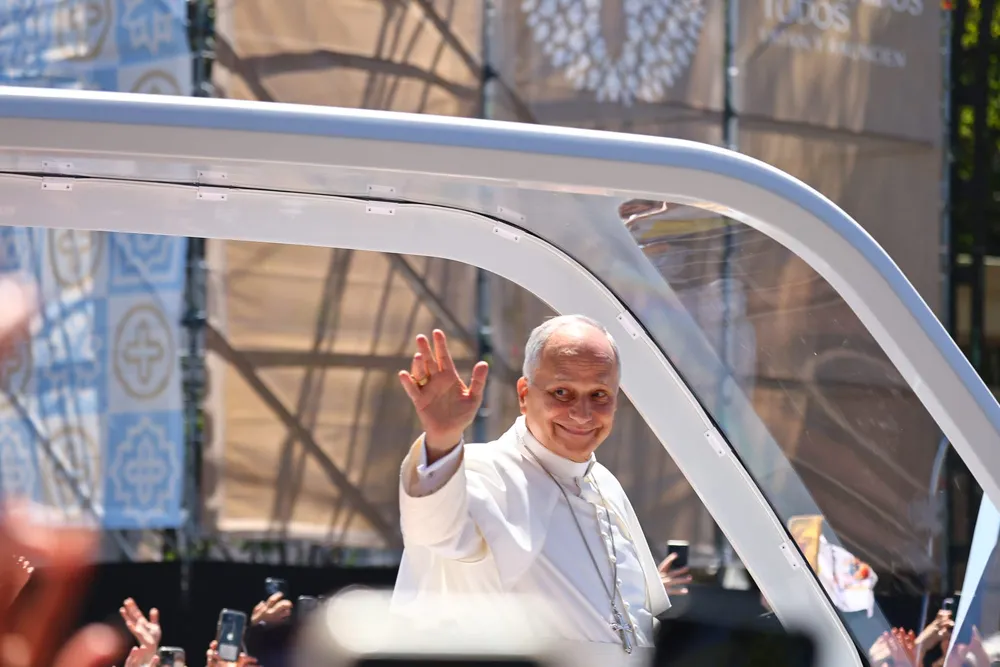
In Javier Milei’s Argentina, where fostering money-making for the rich while imposing vicious austerity upon the rest is officially the sole purpose of government, Pope Leo XVI continues to uphold the fundamental principle that because “the human person is the author, the center and the goal of all economic and social life, the economy…must be at the service of the person, and not the person at the service of the economy.”
In his Nov. 9 address to representatives of “the World of Work”—leaders of business, trade unions, and social movements related to the unemployed and poor—at the Catholic University of Argentina, he grounded his discussion of that principle in Catholic social doctrine, which asserts the primacy of securing the “dignity of the human person” and the common good.
His message was not limited to Catholics alone. As Andrea Tornielli, Editorial Director of Vatican News, wrote with excitement, this was an address which “is destined to leave its mark far beyond this country.”
Pope Leo identified “work” as Man’s contribution to God’s creation. “Just as music helps us lift our souls to God and transcend the everyday realities of our lives, work invites us to take part in the Lord’s marvelous and harmonious activity,” he said, citing Saint John Paul II from his encyclical Laborem Exercens: “Men and women, created in the image of God, share by their work in the activity of the Creator and, within the limits of their own human capabilities, in a sense continue to develop that activity, and perfect it as they advance further and further in the discovery of the resources and values contained in the whole of creation.”
Later in his address, Pope Leo expressed that same concept in his own words, saying that “from the very beginnings of our existence on Earth, work has belonged to the way in which the human person cooperates with God’s action in bringing the world to perfection.” Unemployment not only denies an income to those affected; it “deprives them of the ability to contribute to society,” thus undermining the common good.
From that standpoint, the Pope warned against “the domination of a few,” and urged that all “remain alert to the danger of greed.” He stated unequivocally:
“When economic profit is established as the sole criterion of success, a business becomes dehumanized and turns into a structure of sin that generates exclusion. Business leaders are called to overturn this technocratic mentality.”
Vatican News’s Tornielli, who in his editorial warned of “the immense power of financial markets,” cited Pope Leo XIV’s denunciation of economic “structures of sin” (echoing John Paul II), and urged that these “structures” be “challenged through appeals to conscience as well as through bold, practical proposals to build new economic systems that are more just and more respectful of human dignity, ‘eliminating the structural inequalities that marginalize the weak.’”