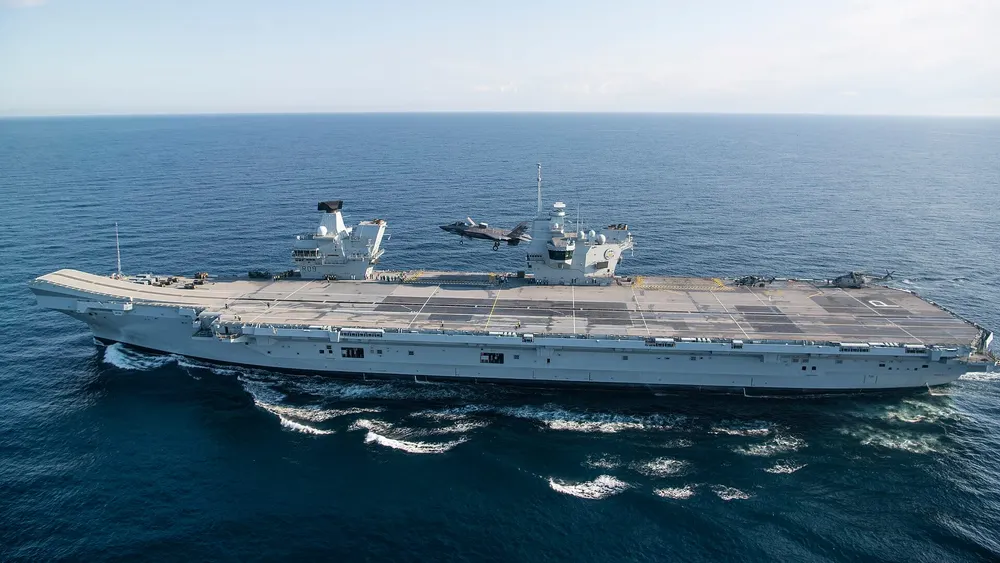
The naval chiefs of the ten members of the UK-Led Joint Expeditionary Force, joined by ministers, military chiefs, other senior officials and defense industry executives, met aboard the Royal Navy flagship HMS Prince of Wales in Oslo, Norway this past week for a naval conference that culminated with the signing of a new naval agreement to tighten cooperation among the ten navies. “For Britain, the JEF offers an opportunity to exercise military leadership in a vital region despite the shrinking size of its armed forces,” the Financial Times reported on Friday. “The JEF brings together Britain, the Netherlands, the five Nordic countries and the three Baltic states.” All are NATO members but the JEF can act independently of the alliance and it doesn’t require unanimity to act.
General Sir Gwyn Jenkins, Britain’s First Sea Lord, said the grouping was particularly useful in situations involving (alleged) Russian sabotage or other hostile activity that fell short of outright war. “It’s there for that sort of ambiguous scenario pre-Article V where JEF nations can come together and decide to act, perhaps before NATO is ready to bring that to life,” he told the gathering. “We’re going to have to train together, we’ve got to develop joint doctrine, and we’ve got to work out how these hybrid capabilities are interchangeable among us as navies.”