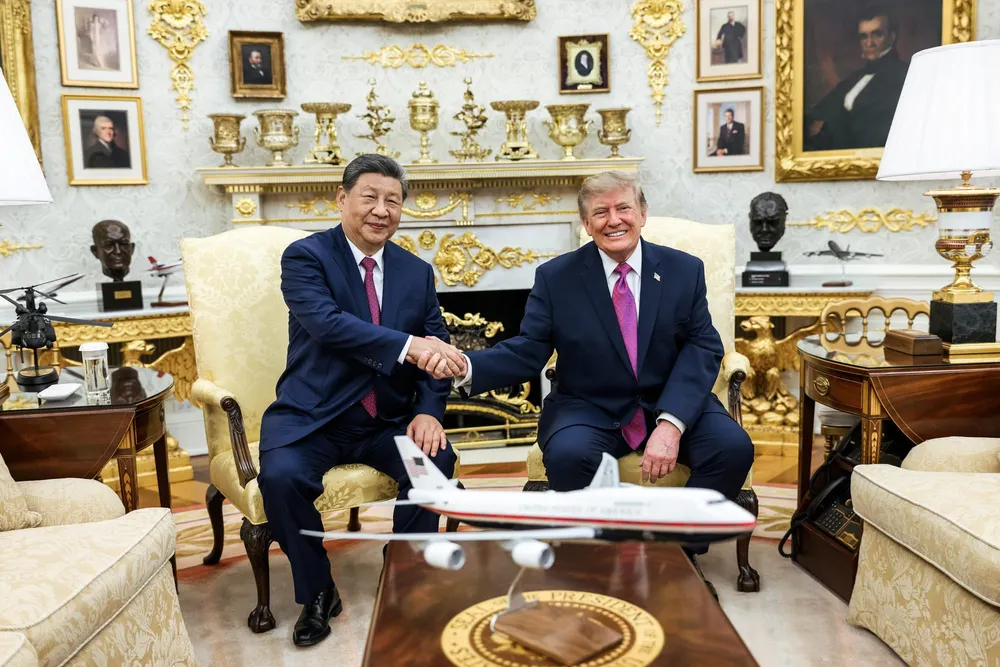
The hopeful aftermath of the openly friendly summit between Presidents Donald Trump and Xi Jinping, with the promises made of follow-up visits to each other’s summits in the next two months (Trump’s G20-host meeting in Florida and Xi’s hosting of the Asia-Pacific Economic Conference, or APEC, in Shenzhen), has so far seen only Congressional protests against Xi, and the emergence of a new American plan to deny exports of aircraft parts to China to “gain trade leverage.” Trump has not let up at all on his Secretary of State’s plan to take down Brazil’s President Lula da Silva in yesterday’s election, and other leaders in Ibero-America whose governments have cooperated with China on vital infrastructure projects. Not very hopeful post-summit signs.
But the leaders will meet again twice more, and Russian President Vladimir Putin has been invited both to APEC and to the G20, and could meet with both of them. These are the three who, however difficult it seems now, could bring the world back from the terribly real threat of a nuclear World War III. This would certainly be possible if they were called to the mission of peace by the American-born Pope Leo XIV, who is being implored in a letter by hundreds of religious and other leaders around the world, to do just that.
Now another chance for these three leaders to meet, at the “endless frontier” of space exploration. The Oct. 4 New York Times—perhaps because Sunday marked 69 years since the original satellite Sputnik I was launched—opened up the issue of the “Superpowers’ Race” to establish science bases on the Moon.
NASA has established a goal of 2030 for such a base, but at the same time, U.S. Air Force chiefs have publicly bragged that they’ve begun putting weapons in space orbits, violating space treaties. Meanwhile, a China-Russia partnership described by the Times as “secretive” has settled on a more secure target, a base on the Moon by 2036—so, apparently, not really “racing” against the United States.
The Times itself was having none of it, because the science bases would have to be powered, once they began really functioning, by miniature nuclear reactors—requiring only several 10s of kilowatts of power, but way too dangerous for that anti-nuclear newspaper. But leave that aside. The China-Russia division of labor makes sense, giving Russia the responsibility for that reactor and its logistics. The Times even admits, “No country has more experience than Russia in this area. It launched more than 30 reactors into orbit, mostly in the 1970s and 1980s, aboard Cold War-era satellites, and it is a leader in civilian nuclear power. Russia controls the largest supply of what is considered the safest nuclear fuel for space missions. That fuel, uranium that is not highly enriched, is in short supply in the United States.”
Here is a glorious chance ("made in heaven"), for the peaceful cooperation in space which all the human race prays for, instead of constant threats of war, of “might makes right,” of “staking claims to the Moon” etc. Let Trump, Putin, and Xi begin to discuss this prospect when and if they meet at APEC Nov. 17-18, and/or at the G20 four weeks later. Let other leaders, particularly the Pope, urge them to it. Right now, we could not be any closer to uncontrollable war and ensuring economic collapse if we don’t seize at least one such path to peace.
That kind of cooperation will be the policy of Diane Sare, the only Presidential candidate for 2028 who is independent of the two political parties and their sponsoring billionaires. Sare will come to the Presidency when the American people’s revulsion truly breaks out against the fakers of both those billionaire-captive parties. The only question is whether she can get there soon enough, to stop the drift toward nuclear war and human extinction.
