
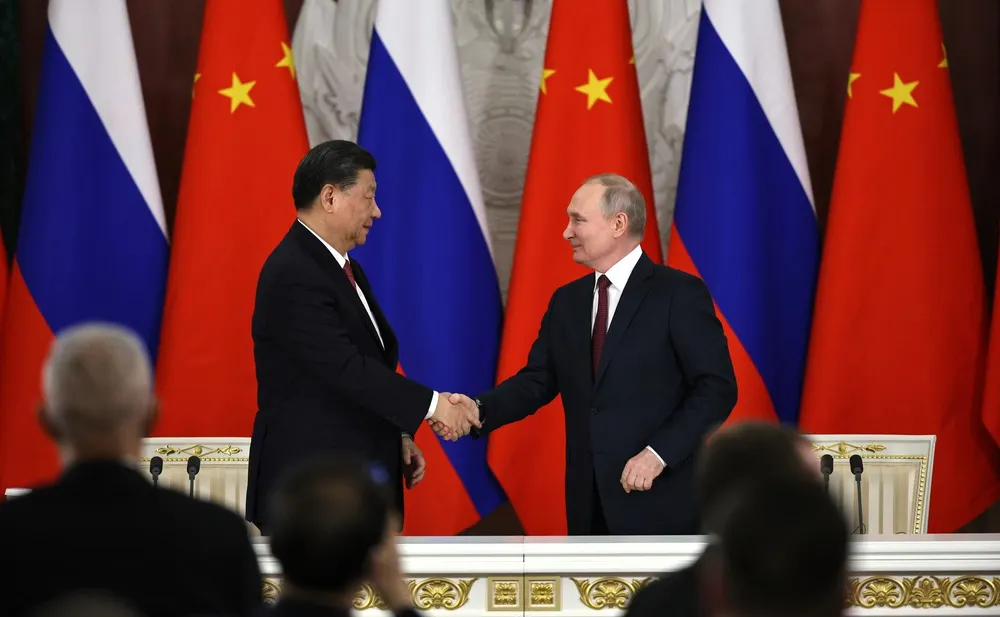
In an article in Sputnik, Pepe Escobar reports that the Third Belt and Road Forum and Putin’s in-depth meeting Xi Jinping “was a graphic illustration of Russia-China co-hosting the drive towards a multipolar world.” Putin, as the main guest of honor by President Xi, brought along with him a full delegation, including: two Deputy Prime Ministers, heads of the Foreign Ministry, the Economic Development Ministry, the Ministry for the Development of the Russian Far East and Arctic, the Central Bank governor and some other agencies. Business representatives also joined, including the heads of Gazprom and Rosneft, and the heads of Sberbank and VTB, according to TASS.
Escobar reports that the two Presidents “signed the largest deal in their shared history for the supply of grain; 2.5 trillion rubles ($26 billion) for 70 million tons of grain, leguminous and oilseed cargo delivered for 12 years.”
However the news is even more dramatic with natural gas agreements. Alexey Miller, CEO of Gazprom, and China National Petroleum Corporation (CNPC) Chairman Dai Houliang, met on the sidelines of the forum in Beijing, and “signed an Additional Agreement to the Gas Purchase and Sale Agreement along the Eastern Route for additional volumes of Russian gas supplies to China until the end of 2023,” Gazprom wrote on its Telegram channel.
The numbers for the growing China-Russia trade in gas are as follows: In 2022, Russia sold 15.5 billion cubic meters of gas to China via the Power of Siberia gas pipeline. In 2023, this number is expected to reach 22 billion cubic meters. With the extended agreements, the pipeline is expected to reach its designed capacity of 38 billion cubic meters by 2025, but will grow to 48 billion cubic meters shortly thereafter by implementing the Far Eastern Route. However, Gazprom is also considering utilizing the Power of Siberia 2, which runs through Mongolia, to increase gas supplies to China, in which case the total annual export to China would grow to 100 billion cubic meters.
As Alexey Miller pointed out on Russia’s Rossiya-1 TV channel Oct. 18: “Pipeline supplies to China only may reach the level of volumes exported to Western Europe in the near future.” The gas exported to Europe via Nord Stream 1 before the attacks on Sept. 26, 2022 amounted to around 110 billion cubic meters/year—an amount Russia is moving rapidly to replace by trade with new allies.
It is also being reported that Russia-China trade has now exceeded $200 billion/year, a feat which Putin called “really impressive” considering it was only at $100 billion in 2019. Sputnik quotes one analyst saying the growth in trade between the two countries is 30% year-on-year, and that amidst struggling Western economies.