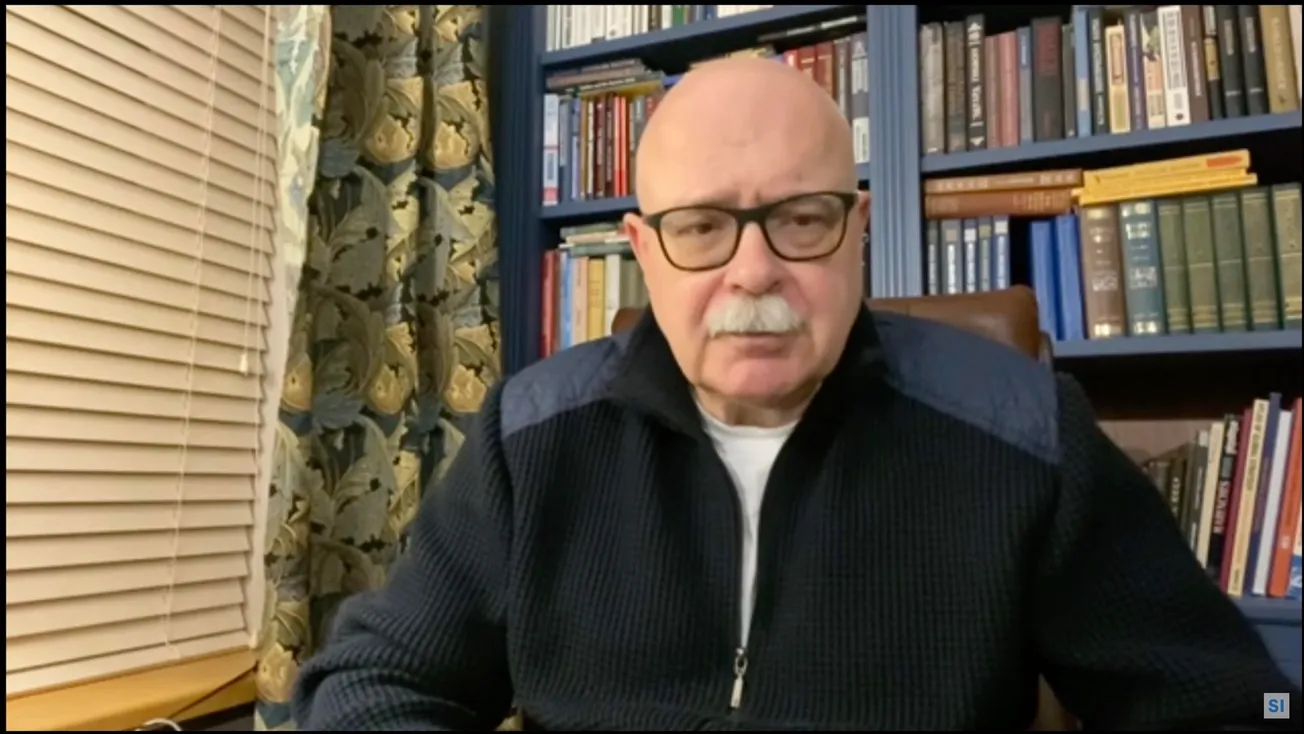
Russian military and strategic analyst Dmitry Trenin provided interesting insight into the way high-level Russian circles are thinking about Trump’s notorious policy ups and downs, and how Russia should respond to them. Trenin, the Director of the Institute of World Military Economy and Strategy at the Higher School of Economics, presented his views in Kommersant on Oct. 27, which were further discussed by the author with Dimitri Simes, Gen. Evgeny Buzhinsky, and former Ambassador to China, Sen. Andrey Denisov, on the widely watched Great Game TV show that same night—all of whom largely concurred with Trenin.
Trenin’s article begins by noting about Trump, that “following his train of thought is a fascinating experience—a kind of virtual roller coaster ride. It’s breathtaking. However, one shouldn’t get too carried away. Trump’s tactics are generally clear. He is rude and threatening, then flattering and reassuring.”
Trenin explains that Trump has three main objectives: “First, Trump wants to become the greatest president in U.S. history. His strategy is aimed primarily at achieving personal aggrandizement. Second, he seeks to suppress the U.S.A.’s economic competitors. Third, he seeks to claim the laurels of a global peacemaker—for himself and for the United States.
“For Russia, it is the third point that matters. For Trump, peace actually means a truce. He has neither the desire nor the patience to pursue a genuine peace settlement…. Trump doesn’t care what happens next: responsibility for the resumption of wars will fall on others, while he himself will remain the peacemaker. When this formula fails, Trump becomes ‘angry,’ ‘tired,’ ‘disappointed’—and threatens to use force to compel the recalcitrant to accept his peace terms.”
Trenin notes that “this formula doesn’t work with Russia. Unfortunately, the Russian formula doesn’t work, either—explaining to the American president the root causes of the Ukrainian crisis and why Moscow’s proposed conditions are not ‘maximalist,’ but the bare minimum necessary to achieve a lasting peace. Trump is all about the ‘here and now’; for him, history is a dead letter.”
Trenin then gets to the heart of his message: That Russia’s diplomacy can only be premised on the military reality on the ground; nothing else will work. “The ‘special diplomatic operation’—the dialogue between the Russian leadership and President Trump—has been useful…. It has demonstrated to the Russian leadership itself the limits of Donald Trump’s capabilities. Despite the cancellation or postponement of the next meeting between Putin and Trump, the Kremlin’s dialogue with the White House continues, but now on two parallel tracks: Lavrov-Rubio and Dmitriyev-Witkoff. It is important to understand, however, the function of diplomacy in war. It consists of confirming the results achieved in the theater of military operations. A special diplomatic operation can be useful, but it cannot replace a special military operation.”
Trenin correctly notes that “Donald Trump is not a completely independent figure.… He cannot ignore his European vassals, no matter how he personally views them. Even more so, he cannot ignore his fellow Republican Party members and Democratic opponents in the United States, who are practically united in their hostile, if not Russophobic, attitude toward Russia. He cannot, and he will not be able to.”
Trenin does not comment, however, on other more positive influences on Trump, including earlier periods of positive Russian relations with FDR, JFK, and even Reagan, let alone the influence of Lyndon LaRouche’s work on that relationship.