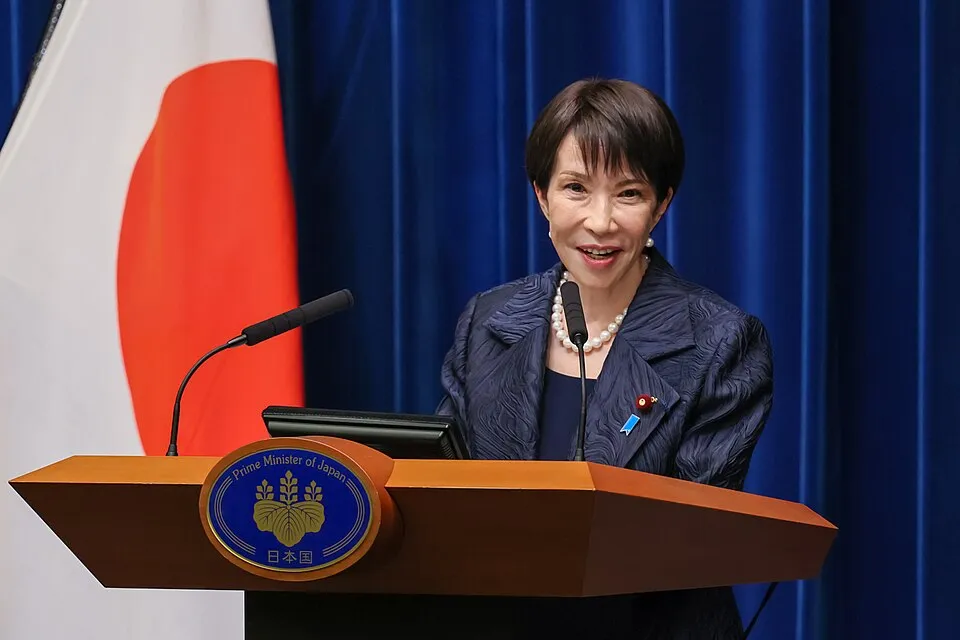
China has been unrelenting in its demand that Japanese Prime Minister Sanae Takaichi retract her Nov. 7 statement that Japan could declare a conflict around Taiwan as a “survival-threatening situation,” a legal term which could trigger Japanese military intervention around Taiwan. The fierceness of China’s response should be taken as a warning not only to Japan, but to U.S. and British warhawks as well, that China will take preemptive action to crush any effort to turn Taiwan into an Indo-Pacific “Ukraine,” a NATO base for war against China.
Japanese officials insist that Takaichi was merely reiterating Japan’s “existing position” on Taiwan, and did not change policy. Reuters reports that Japanese officials tell them on background that “it would have been better not to say it, but it’s not incorrect. We can’t retract it.”
In her Nov. 20 briefing, Chinese Foreign Ministry spokeswoman Mao Ning recalled that Japan had “forcibly occupied Taiwan and exerted colonial rule on the island for half a century,” under which the Taiwanese people suffered crimes and atrocities.
She dismissed out-of-hand the claim that Takaichi had just reiterated “existing” policy. Japan is “supposed to be upholding the one-China principle and abiding by the spirit of the four political documents between China and Japan, instead of being deliberately ambiguous, and still less turning back the wheel of history,” Mao stated. “Eighty years ago, Chinese soldiers and civilians, including our compatriots in Taiwan, defeated the Japanese aggressors after heroic and strenuous fighting, achieved the great victory of the Chinese People’s War of Resistance Against Japanese Aggression and realized Taiwan’s return to the motherland. Treaties and instruments such as the Cairo Declaration, the Potsdam Proclamation and the Japanese Instrument of Surrender clearly affirmed China’s sovereignty over Taiwan.
“China’s recovery of Taiwan is an outcome of the World War II victory and an integral part of the postwar international order…. If there has truly been no change to the Japanese government’s position on the Taiwan question, the Japanese leader should not have linked it to a so-called `survival-threatening situation.’”
Mao warned repeatedly this week that China will take “countermeasures” unless that policy is retracted. So far, China has cut off Chinese tourist travel to Japan (a Nomura Research Institute economist told Reuters that this could mean a loss of more than $14 billion a year for Japan); launched a boycott of Japan’s seafood exports to China (the Chinese people will ensure that “there will be no market for Japanese aquatic products even if they enter China,” Mao stated); the scheduled China-R.O.K.-Japan Culture Ministers meeting this month has been cancelled, and there will be no meeting between Takaichi and Chinese Prime Minister Li Qiang at the G20 meeting in Johannesburg, South Africa this weekend.
On Nov. 21, the Chinese embassy posted, in Chinese and Japanese, the following warning, which ups the ante dramatically:
“The Charter of the UN specifically includes the Enemy State Clauses, which stipulate that if any of the fascist or militarist states such as Germany, Italy and Japan takes any step to re-implement an aggressive policy, the founding member states of the UN including China, France, the Soviet Union, the U.K. and the U.S. shall be entitled to take direct military actions against it, without the authorization of the UN Security Council.”