The Lead
Call It 'the Primakov Effect'
by Dennis Small (EIRNS) — Dec. 05, 2025
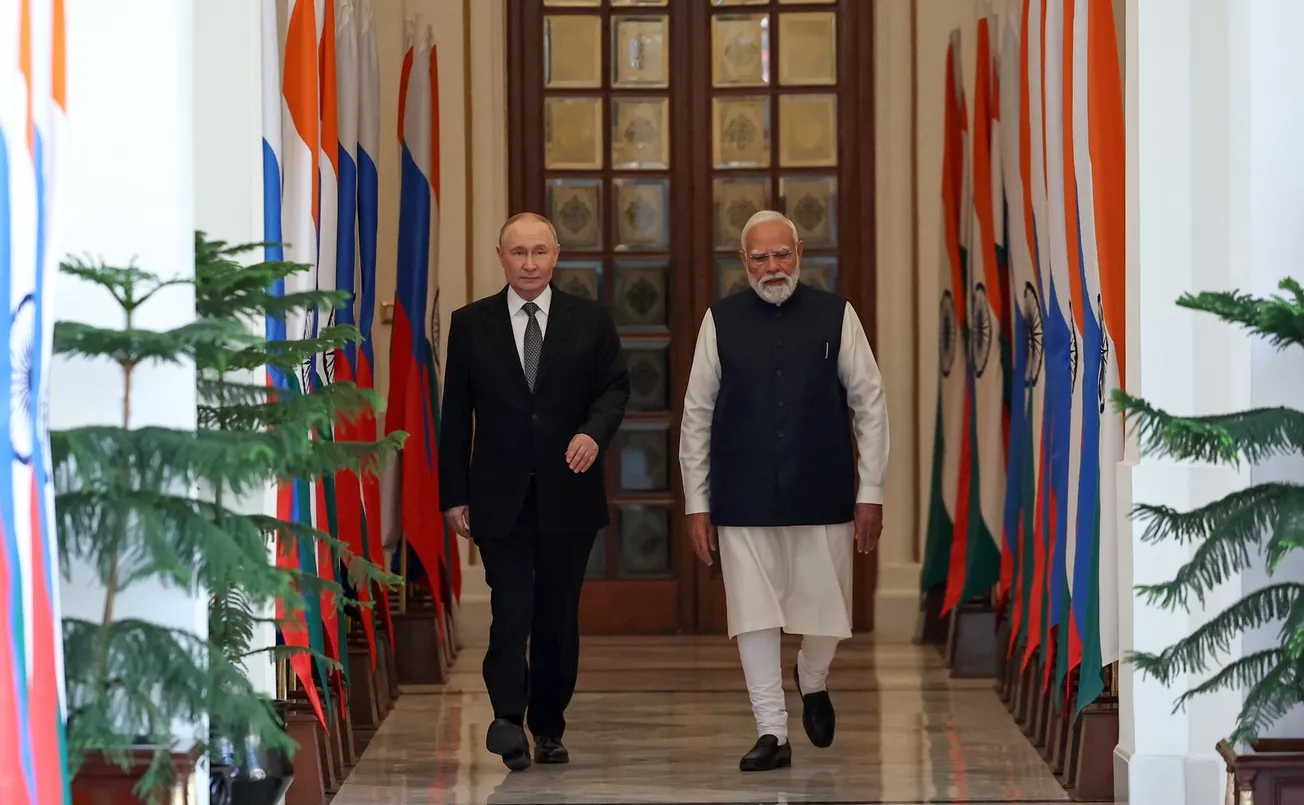
Russian President Vladimir Putin and Indian Prime Minister Narendra Modi ended two days of meetings in New Delhi on Dec. 5, announcing to the world that the two Eurasian giants would dramatically increase their economic cooperation from here to the year 2030, with agreements in strategic areas including nuclear energy, space technologies, Russian industrial investments under the Make in India program, joint work on the International North South Transportation Corridor, the Northern Sea Route, and more.
Putin told journalists: “If you glance even slightly into the past and reflect on what has occurred in India—it’s almost like a miracle. For example, few people recognize that life expectancy in India has nearly doubled during this period” since India’s independence from the United Kingdom in 1947.
Modi told gathered businessmen: “India-Russia friendship has remained steadfast like a pole star.”
Helga Zepp-LaRouche underscored the strategic significance of the Putin-Modi meetings in her opening remarks to the 131st consecutive weekly meeting of the International Peace Coalition: “We have very encouraging developments around the state visit of President Putin to India. I can only say that the importance of that visit is historic and strategic. I think when President Putin and Prime Minister Modi reiterated their deep friendship, and when Modi said he is as close friends with China and Russia, I’m absolutely sure that the soul of [former Russian] Prime Minister [Yevgeny] Primakov, wherever he may be right now, was extremely happy! Because already at the end of the 1990s, he had called for China-India-Russia coordination and partnership. If you look at those three countries, they indeed represent a majority of, not all the people, but a good majority representing the Global Majority of the world.”
Primakov had called for such a partnership, which he referred to as the “Strategic Triangle,” as a new kind of association to break the logjam of the geopolitical world order, and to set in motion a new international security and development architecture. Sometimes referred to as the “Primakov Doctrine,” R-I-C later became the basis of the BRICS—which today represents over half the global population.
Zepp-LaRouche continued: “I’m sure that the various Rumpelstiltskins in the various capitals, especially in Europe, were probably busy ripping themselves apart in anger” in response to the Putin-Modi talks. And yet, “despite all efforts by the imperial forces of the world to divide India away from Russia, putting sanctions on India, trying all kinds of things to pull India into the camp of the so-called ‘democracies’—this obviously has not functioned. And this combination means that the whole idea of a Global NATO is at least severely weakened by this renewed friendship between India and Russia.”
Contents
Strategic War Danger
- Trump Holds Tongue on Putin-Witkoff Negotiation, Notes That Time Is Not on Kiev's Side (↓)
- NATO Commander Says Alliance Can ‘Provide Dilemmas’ to Russia (↓)
- Zakharova Says, the Russia-hating Wing of EU 'Has Crossed Over to Political Madness' (↓)
- Former U.K. Ambassador to U.S.: 'Ukraine War Isn't Going To End Anytime Soon' (↓)
New World Paradigm
- Modi and Putin Sketch Out Massive Economic Agreements to 2030 (↓)
- Putin: What Has Happened in India Is Almost a Miracle (↓)
- Putin Adviser: Russia-India Economic Cooperation Is Strategic, Not Temporary (↓)
- Putin Was Emphatic That Trump Wants Peace in Ukraine (↓)
- Putin's New Investment Platform: $100 Billion for Global South Projects (↓)
Collapsing Imperial System
- Bundestag Vote Lets Merz Government Survive Until Christmas, But... (↓)
- Dmitriev to Merz: You Are Not Even in the Game (↓)
- Another Major Crypto Company Is About To Bite the Dust (↓)