Jan. 1—Thousands of farmers in many nations in Europe have taken to the streets with tractors and protest rallies in recent weeks, from Britain to Poland, France and Greece, to oppose the impossible conditions now in their nations. While particulars differ from place to place, the farmers’ “issues” all come under three common themes. First, the costs of producing food exceed revenue for family farms, given the soaring prices for electricity, fuel, chemicals, and other inputs. National governments are refusing to intervene to relieve conditions for domestic agriculture, which means independent family farming is suffering ruin, while at the same time, several governments are mobilizing for a war economy.
Secondly, trans-national corporate cartels, connected to London, Wall Street, and Amsterdam financial networks, determine both trade and where and how commodities are being produced. Thirdly, anti-science, so-called green regulations, and public opinion campaigns are brainwashing citizens and undermining modern farming.
In particular, there is fierce opposition by farmers to the European Union making an agreement with the South American trade bloc Mercosur (Common Market of the South, with five full-member nations—Argentina, Brazil, Paraguay, Uruguay, Bolivia, and seven associate members), which would give free rein to the trans-national agro/food monopolies to operate in what would be the biggest “free” (rigged) trade bloc in the world. There are a combined 730 million people in the 27 EU nations and five core nations of Mercosur. Negotiations have taken place for over more than 25 years toward this EU-Mercosur mega-free-trade pact, which is to involve all economic sectors.
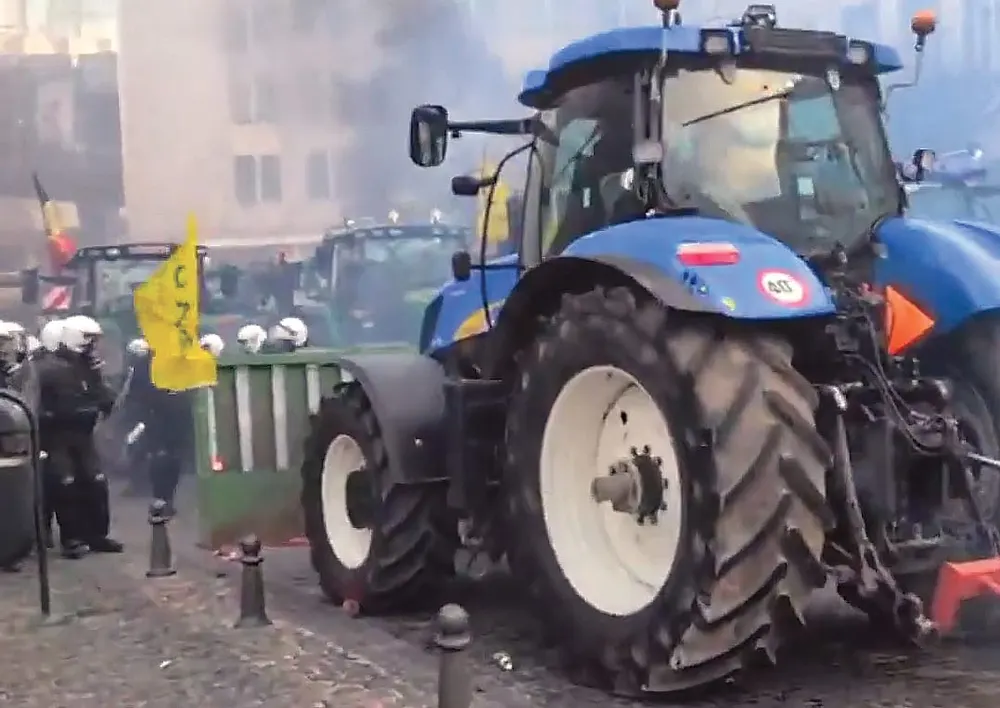
On Dec. 18, some 10,000 farmers and supporters demonstrated in Brussels against any EU-Mercosur deal, blocking central city streets at the EU heads-of-state meeting, which had Mercosur approval on the agenda. At least 165 tractors were downtown; farmers threw potatoes and eggs. The EU then postponed their intended approval until January. Only a qualified majority is needed for approval. France stands against; Spain and Germany are in favor; and Italy is hesitating. A ministerial vote is required, as well as a European Parliament vote.
If approved, the effects would replicate what the Mexican farmers are opposing under NAFTA/USMCA: The trans-national monopolies would take over even more, and drive out what is left of independent family farm and food operations. The European farmers protesting in Brussels, from Hungary to Ireland, challenged the delegates in their different banner-messages to the EU summit: why import beef, sugar, grain, beans, and more from South America, when we can produce it here?
The following is a brief rundown of some of the farm protest actions this Winter:
• Ireland. A national demonstration is set for Jan. 10 against the Mercosur-EU deal, to which farm leaders from all major sectors—cattle, sheep, dairy, and crops—are organizing for attendance. The event in Athlone, County Westmeath, will be a “national community protest,” as described by its initiating sponsor, Independent Ireland, and feature a tractor and vehicle cavalcade across the River Shannon, and an indoor arena rally.
• Greece. Farmers have protested for over a month, exposing how they cannot afford to farm, and how the government is inactive, including in animal health, in its response to the sheep pox outbreak. Communities are siding with the farmers, including soldiers serving in the national military reserve. Over the New Year holiday, farm families lined highways and streets in 50 cities and at the border with Bulgaria. On Jan. 4, there will be a nationwide meeting of farm leaders to decide their next move, since the government is stonewalling.
• Poland. With “Stop EU-Mercosur” signs on their tractors and other slogans, thousands of farmers staged coordinated protests Dec. 30, in more than 185 cities. They accuse the government of “passivity,” and also express opposition to the dumping of Ukrainian food commodities on Poland and other EU member nations, which is coordinated by the agro-financial-complex now dominating Ukraine, through such firms as Cargill, ADM, Goldman Sachs, and others.
• France. Farmers from southern districts began protesting in December against the government’s inadequate response to the outbreak of a cattle skin disease (nodular dermatitis), in which whole herds are being culled. This objection comes on top of how Paris and other governments across Europe are actively serving Big Agriculture monopolies, flirting with approving the EU-Mercosur pact, and undercutting independent farming and food processing. Farmers have blocked highways, dumped manure, and run livestock into grocery stores. Local mayors and police are demanding government attention. Carole Delga, head of the Occitania region in the south, wrote to French Prime Minister Sébastien Lecornu Dec. 14, “It is time for you to intervene to ensure, as soon as possible, a frank and sincere dialogue with the farmers.”
• Britain. On Nov. 26, “Budget Day” in the UK, thousands of farmers drove tractors into Central London, protesting the government’s new budget, which calls for farm inheritance tax rules (IHT), levying a 20% tax, after the first million pounds. This will cause a mass shutdown of farms. It is in the spirit of the landmark UK Agriculture Act 2020, which decreed that farming would henceforth be secondary to the “environment” in the UK. The huge November protest followed earlier protests at both the English and Welsh Labour Party conferences. Then, on Dec. 10, farmers from six counties came into London, handing out food donations to the homeless as they drove their tractors, lit up for Christmas, and thanking the public for standing with them.