Jan. 2—On the eve of the Christmas-New Year’s holiday, Mexican farmers led by the National Front to Save the Mexican Countryside (FNRCM) succeeded in wrestling a signed agreement from their government, on an agenda of high-level discussions to be held on the policies required to save Mexico’s independent family farmers from imminent bankruptcy. Official working groups on the various aspects of policy are to begin in the week of January 12. The farm leaders are clear that this is only a tactical victory, but one that was requisite to now taking on the fundamental issue: restoring the principle that national economic policies must put the interests of the Mexican people and producers first, and those of the big “money-boys” and their speculative cartels last.
Farmers in many countries of the West have rolled their tractors onto the streets and highways of their nations in waves of protests that are increasing in tempo. Underlying the specifics of each protest is a common demand: that their governments protect farmers from predatory finance which aims to deny farmers the ability to produce food for their nation. Recognition is spreading among farm leaders that the cause of the existential farm crisis is the dying international speculative system that dominates the West, and that that is where the changes must be made.
Mexico is no exception. Mexico’s FNRCM has not been mobilizing only against predatory finance’s cartel free-trade model, but for the nation to return to a “national agricultural policy.” It is notable that with that strategy, the FNRCM, an independent farm group formed only two-and-a-half years ago, has continued to grow in national strength and influence.
Throwing Down the Policy Gauntlet
Mexican farmers face a conundrum. They are seeking to defend themselves in a situation in which the U.S. President Donald Trump Administration’s Dec. 4, 2025 National Security Strategy has declared that it has the right and the intention to dictate the national policies of every other nation in the Western Hemisphere, such that Wall Street’s economic interests are satisfied first and foremost, including by deploying American military force. President Trump has personally threatened to order U.S. military strikes into Mexico when he so chooses, in the name of implausibly “fighting the drug cartels”—which are run out of Wall Street and its progenitor, the City of London. Furthermore, these same feudal Wall Street–British interests have already begun organizing shock troops for a “color revolution” to overthrow President Claudia Sheinbaum’s government in Mexico.
The FNRCM has therefore had to tread the narrow path of mobilizing to insist that the government meet its just demands, while not playing into the hands of those who would like to create chaos in order to topple the government. The FNRCM leadership have explained to the government that their fight for justice for farmers offers the potential for the support of a strong, productive base from which to defend the country’s sovereignty. As they point out, without Mexican farmers to produce the food the country needs, Mexico will be completely vulnerable to an economic blockade or embargo—of the sort Venezuela is now facing.
Furthermore, the farm leaders have formulated the changes in policy they are demanding for agriculture, as a first step towards restoring a physical economy-pivoted policy generally. These are not wild-eyed radical ideas coming out of nowhere, but are premised on Article 25 of Mexico’s 1917 Constitution, which establishes that the government has the responsibility to guarantee economic growth and social welfare for the people of Mexico. As they point out, most Mexican governments in the 20th Century (some more than others) sought to foster national food self-sufficiency through government credit, support for mechanization and scientific farming methods, price supports, etc., policies which came to a halt with the imposition of the 1994 “financier-profit first” North American Free Trade Agreement (NAFTA).
Therefore, a key part of their strategy is to provoke a national debate around these basic ideas of government. They expect their protests and policy initiatives to spur joint action with other economic sectors (national industry, for example) which have been equally crushed by the banker-driven free trade policies imposed on the country since 1994.
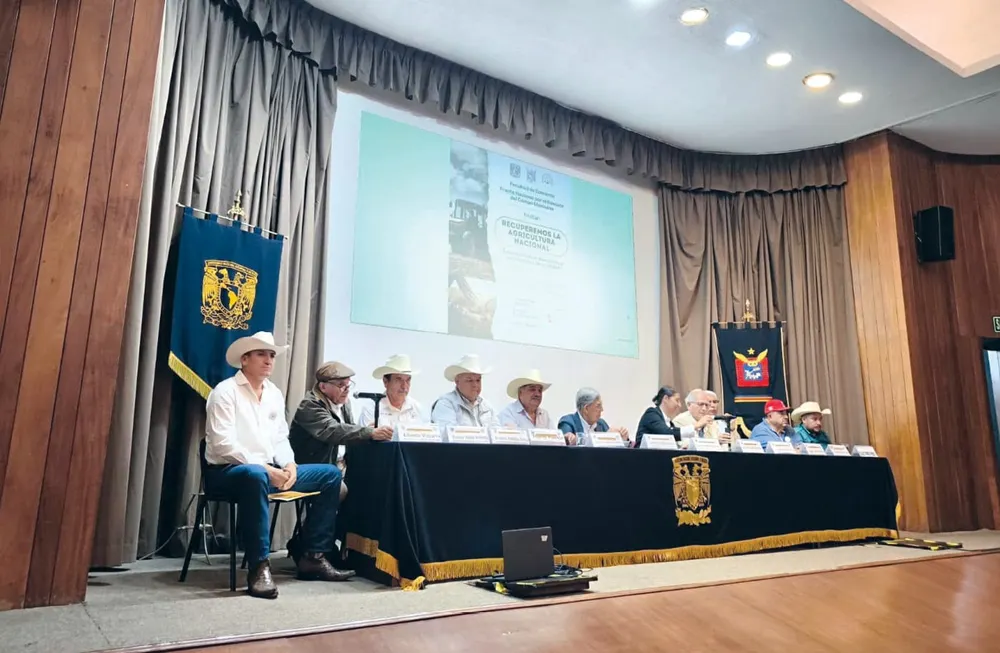
The first success in this regard was the fascinating joint forum organized jointly with the Economics Department of the National Autonomous University of Mexico (UNAM) on Sept. 25, on which EIR reported in its October 10, 2025 issue. Nationalist economists and farmers joined forces. A letter of support which the Schiller Institute had organized, signed by 18 U.S. farm leaders, was also read at the forum, adding the other crucial element required for victory: The letter identified how global bankers and food cartels are destroying farmers around the world, thus planting the seed for coordinated international farm actions.
Forcing the Government to the Table
FNRCM leaders are well-aware that the Sheinbaum government is foolishly clinging to the sinking Titanic of the current international financial system. They carried out a series of statewide, and then national protests in the second half of 2025, demanding that the government sit down with them to seriously discuss the changes in policy needed to save the farmers. The government stonewalled, with the expectation that the protests would dissipate. When the organizers called a national strike for Oct. 14, the Mexican Agriculture Ministry suddenly offered to hold talks—the day before the scheduled strike. Not dumb, the farmers replied that any discussions could be held after their show of force.
Meetings were held with Mexico’s Congress of the Union and government officials, but they listened without hearing. The FNRCM took to the streets again. Secretary of Agriculture Julio Berdegué Sacristán tried to split the movement by offering a small increase in the price farmers received for corn, which was nowhere near a parity price to cover their cost of production. Few farmers took the bait; the protest only grew.
The FNRCM called an indefinite strike on Nov. 24. By this time, they had new allies. The National Truckers Association (ANTAC) joined the farmers, adding their demand for government protection for drivers who face daily kidnapping, extortion, even murder on the highways—by organized crime networks, among others. That added huge long-haul trucks to the farmers’ tractors and crowds that were blocking key national highways and toll booths. For the first time, the FNRCM also blocked key customs booths along the U.S.-Mexico border. The strike quickly began disrupting logistics and supply chains nationally—and the protest and demands became the talk of the country.
In the midst of this strike, Alberto Vizcarra, a leader of the FNRCM presented the Mexican farmers fight for justice to the 130th weekly meeting of the International Peace Coalition. Vizcarra detailed how Wall Street’s free trade model is a looting mechanism. Under the monetarist lie that it “costs too much” for nations to maintain self-sufficiency, nations are pushed to buy cheap food from abroad—usually dumped by the large global cartels—while shifting domestic production to export crops, to bring in the money needed to pay their growing debt. He reported how these cartels have been dumping U.S.-government subsidized grains onto the Mexican market, driving Mexican farmers, whose production costs are higher, out of business.
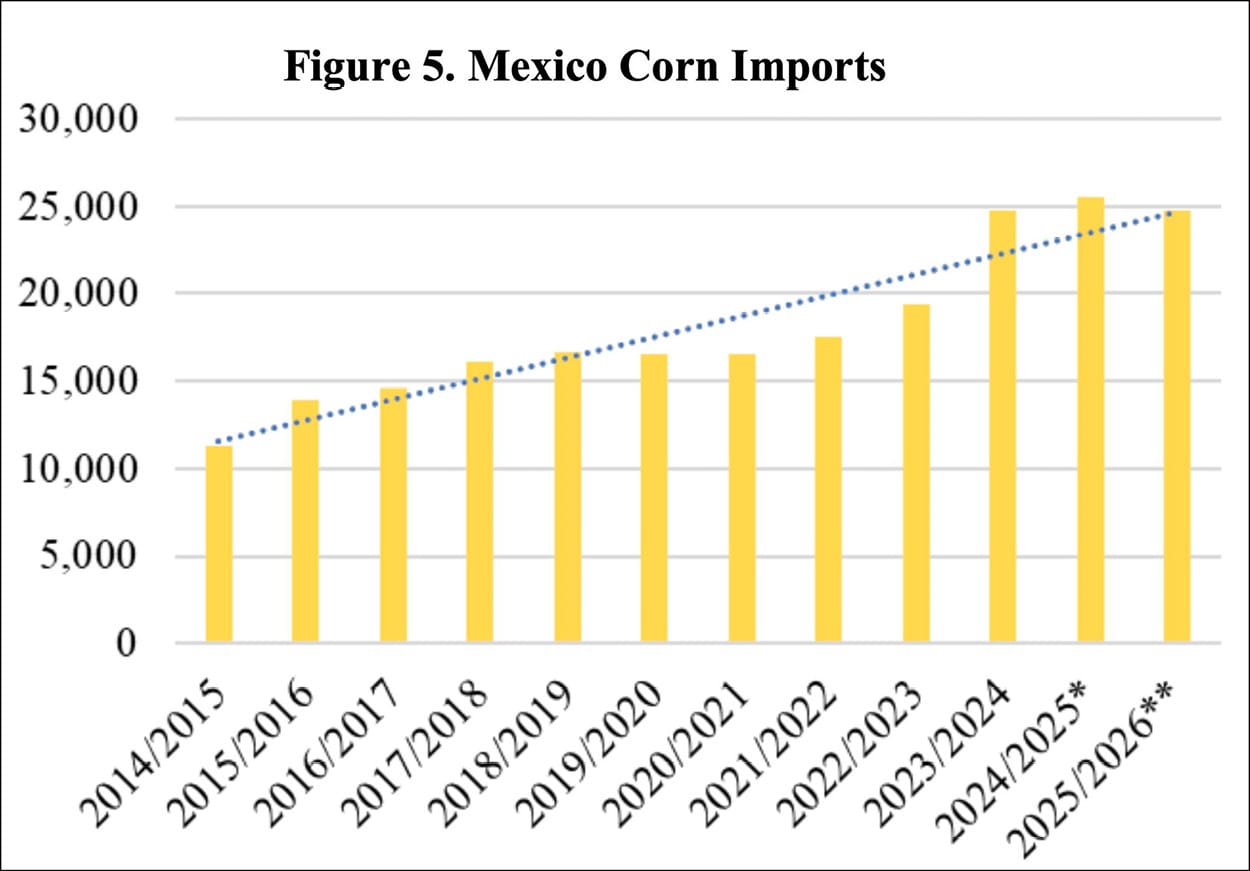
In the early 1990s, before NAFTA was imposed, Mexico was not a corn importer, only making foreign purchases year to year if its harvest was insufficient. By the end of 2025, Mexico was on course to import 28 million tons, close to half its consumption. This shift has been bankrupting domestic farmers, and draining the nation’s foreign exchange in the process.
Within days, the strike began to disrupt national logistics and supply chains, and the government promised that high-level officials from five key ministries (Agriculture, Interior, Welfare, Economics, and Treasury and Public Credit) would hold talks with the organizations. The FNRCM and ANTAC called off the indefinite strike.
Eight-point Program Issued
FNRCM, joined by leaders from ANTAC, came prepared to the scheduled Dec. 10 talks with the government, armed with an eight-point program which stated their intention to save the nation, not just themselves, “in the face of the intense offensive by the U.S. government to take over the entire national agri-food market.” The policy was reflected in the Trump administration’s National Security Strategy, the document warned, as well as “the hearings held and sponsored by the Office of the U.S. Trade Representative in early December 2025.”
The first of the eight points is a big one: the demand that basic grains be removed from the U.S.-Mexico-Canada free trade accord (USMCA, the 2020 sequel to NAFTA) during the review of the treaty which the three governments are scheduled to negotiate in 2026. “Just as the United States has imposed tariffs on imports of strategic products under the principle of national security to protect its producers and jobs, Mexico must argue that under the principle of national and food security, basic grains should be removed from the USMCA to protect domestic producers and ensure food self-sufficiency and sovereignty. This would reduce the dangerous food dependency that Mexico has fallen into,” they argue.
Point two recalls that the USMCA already provides mechanisms for “the removal of basic and strategic products,” if their inclusion is harmful to large groups of producers, affects production and national income, and drastically reduces food self-sufficiency and sovereignty.
Point four, stemming from the first, is equally explosive: “The price of basic grains must be determined based on national production conditions and not on the Chicago Mercantile Exchange.” The Chicago Merc’s prices are based on the “speculative derivatives markets … where Mexico is not competitive, leading to cheap imports displacing domestic production and producers.” The Chicago Mercantile Exchange, in fact, is the number one derivatives exchange in the world!
The premise of their points is that the farmers “demand compliance” with the Mexican Constitution’s Article 25 (which establishes the government’s responsibility to foster economic growth) and the subsequent implementing of laws which mandate the government’s role in protecting national production, inclusive of contributing “to efficient domestic price formation by reducing distortions caused by policies implemented in other countries.”
“Cheap credit is needed to boost investment and production,” as well, the farmers insist. The document elaborates how current high interest rates “have favored the banking and financial sector and have been detrimental to domestic producers and highly indebted sectors, which have been decapitalized in favor of the banks,” thereby deepening income inequality and slowing economic growth.
The document points out that the central bank’s job is to serve “economic growth, as it was in the 1940s, 1950s, and 1960s, and must not continue to act in favor of the financial sector to the detriment of domestic producers and the national economy.”
Likewise, the farmers do not accept the government’s claim that it cannot meet their demands because it faces “budgetary limits to meet national demands. A sovereign government has no financial limits,” the farmers remind their government; “it can perfectly well spend in favor of domestic production by financing itself through the central bank at low interest rates, and this would not be inflationary, as increased productivity and production would lower inflation under conditions of economic growth.”
Two final points: Governments all over the world subsidize agriculture production, and Mexico must do the same, they state. Subsidies must be “directed towards productive activity to boost investment and production,” not as now when, “governments always come in to bail out banks and not save producers” in times of crisis.
They also “propose the creation of a food reserve that would ensure a sufficient supply of basic products in the event of climate and geopolitical problems.” This will require the government to re-establish mechanisms for guaranteed purchases of basic grains and oilseeds, “at a fair price agreed upon with producers,” avoiding “intermediaries and speculative action by multinational companies which market those products,” they argue.
The Agro-Cartels Are Not Amused
However, instead of the promised meeting with officials with the power to make decisions, the delegation of FNRCM and ANTAC leaders were received Dec. 10 by a Deputy Secretary of Agriculture who had been assigned by the government to listen, but not negotiate. At the end of a tense, seven-hour meeting, the official promised he “might” circulate their document to the other ministries.
The next day, the delegation of 25 or so farmers and truckers called a press conference before the Monument to the Revolution in Mexico City, where they issued an ultimatum to the government: Either negotiate seriously by Dec. 16, or we take to the streets again, blocking national highways, customs booths along the border, and this time possibly the U.S. and Canadian embassies in Mexico City as well. We are prepared to do so through Christmas and New Year’s, “if necessary,” they announced.
At that point, Mexico’s cartel-tied farm interests became nervous about where this could go. On Dec. 16, the National Agriculture Council (CNA) directly replied to the FNRCM program. The CNA leadership serves as the lobby for the “free trade,” big corporate agribusiness interests moving in on Mexican agriculture, as they have in the United States.
It is telling that the trans-national cartel interests felt it necessary to weigh in publicly. The CNA never mentioned the name “National Front to Save the Mexican Countryside” in its statement. But it specifically attacked its proposals. “Solutions for the grain sector do not lie in trade isolation or government purchasing schemes with fixed prices that distort markets and drive up food costs,” it argued. “At the CNA we reaffirm the importance of preserving and strengthening the USMCA as a strategic instrument for economic growth, trade certainty, regional integration of the agri-food sector, job creation and the attraction of financing.” It likewise defended cartel dumping in Mexico, in the name of ensuring food “at competitive prices for the population,” insisting that the “USMCA is not the source of the profitability problems in Mexico’s grain sector.”
A tip-off of as to whose interests the CNA represents was their call for the government “to promote contract farming,” accompanied by such gems as “exchange rate hedging mechanisms” (derivatives) as the first of the three pillars they urge the government to adopt in its proposed new “National System for Agricultural Planning and Marketing.” The “contract farming” model promoted by the cartels has a more precise name: reducing independent farmers to serfs.
The FNRCM responded immediately, suggesting a public dialogue with the CNA, in the Congress or perhaps at the UNAM, on whether there is an alternative to the “pernicious axiom” of the free trade model “that ‘someone has to lose for someone else to win.’ ” They reiterated their demand that “basic grains must be removed from the trade scheme imposed by the USMCA and the speculative Chicago Mercantile Exchange, in order to restore the concept of National Agriculture with a universal policy of parity prices and national production goals, aimed at meeting domestic consumption requirements and reducing food dependency.”
It specified that “this goal requires the reestablishment of a National Rural Credit Bank capable of offering low interest rates aimed at capitalizing producers,” and stressed the urgency of using “basic grain production which currently has no market … to establish a Strategic Food Reserve.” The reserve is designed as a mechanism to provide “emergency liquidity to producers and avoid intermediaries and speculative action by large importers.” As proposed, the government would keep the farmers’ existing harvest in the reserve, for as long as, say, six months, in return for payments to the farmers based on “prices consistent with national production costs.”
International Coordination Will Be Required
The government had to back off. At 1 a.m. on Dec. 18, at the end of 7-9 hours of hardnosed talks, two separate press conferences were held, one by Agriculture Secretary Berdegué Sacristán and Deputy Interior Secretary César Yáñez Centeno, the other by FNRCM and ANTAC leaders, announcing that an agreement had been signed. The planned strike during the holidays was called off, and the government agreed that talks would begin immediately between experts on the demands of both the farmers and the truckers.
The farm leaders have no illusions that the government is ready to change course at this time, which would require standing up forcefully to Washington’s policies, which are being dictated by Wall Street. But they also know two things. One is that Mexican farmers cannot survive under the existing system, and the second is that the year that has just begun will be tumultuous internationally, in which Mexico could well enter a payments crisis that will require the government to join other nations in the battle to change the international financial system if Mexico is to survive.
For good reason, FNRCM leaders are closely following the discussions among the BRICS nations on anti-speculative mechanisms such as long-term, fixed-price contracts between nations, and the possibility of setting up a grain exchange independent of the Wall Street/City of London vultures.
This is the same situation facing farmers in other nations of the Global South, and in Europe and the United States. The time is ripe for farmers from these nations to deliberate together on a common program for the economic model needed.