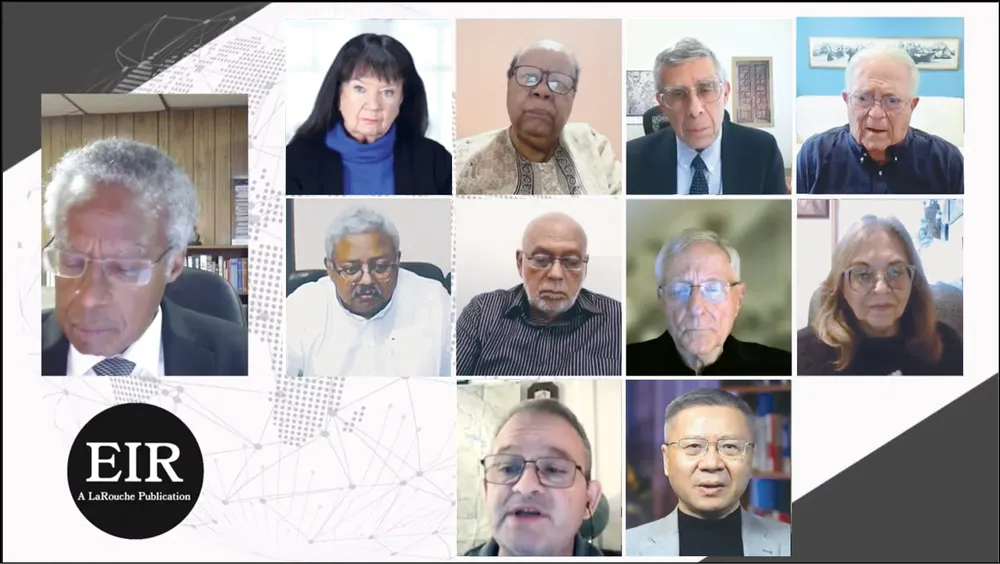
Jan. 12—EIR sponsored an Emergency Roundtable Jan. 12, featuring leading political figures from around the world, which convened online under the theme, “It’s Worse Than You Think: The Strategic Implications of the Attack on Venezuela and How To Bring the World Back from the Brink.” Ten experts, from the Americas, Eurasia and Africa, representing long experience and tested judgment in international affairs, met for nearly three hours, with a live-stream audience averaging 1200 participants, with translation, in English, French, German and Spanish.
Helga Zepp-LaRouche, Editor-in-Chief of EIR, and founder and leader of the Schiller institute, welcomed her 10 fellow panelists, saying, “We have assembled here today not to lament the unprecedented situation which can only be described as a threat to the existence of the entire human civilization, but to discuss, analyze, and catapult an international response to restore international law.”
The stern reports and evaluations that then followed provided a powerful expression of the shock and disgust around the world at the violent actions of these past weeks, and the role of the United States government in acting with abandon to discard international law.
However, as one speaker said, “we are not here to become more knowledgeable” about the crises, but to confer on galvanizing the action to change this situation. Proposals ranged from a “Declaration” to be issued, to consensus that the priority is to mobilize the forces of the Global Majority, to discussion of new “configurations” to be supported to act to restore international law and morality. Many confirmed that the UN General Assembly is still a formation of potential positive international impact.The idea was posed of a “structured international civil organization.”
Several speakers made the point that the cultural and political situation inside the United States is a priority to transform and upgrade. There is a correspondence between the violence underway inside the United States, and the international lawlessness from Washington. As one senior U.S. diplomat stated, now is the time that “America must introspect.”
Zepp-LaRouche summed up, at the conclusion of the discussion, that an organizing group will be formed to formulate priorities and move on follow-up action.
The discussion period included several exchanges on how to make this Roundtable of leading figures the basis for a global movement. The proposals discussed were for a UN General Assembly action to stop the U.S. policy; creating a movement of civil society organizations to intervene globally; activate mass movements on the model of Gandhi and Mandela and Martin Luther King; start a movement for the forgiveness of the unpayable debt; to remind Trump that he campaigned against the “Deep State,” but now appears to be run by that same Deep State.
Terming the event, “extremely productive,” Zepp-LaRouche called for everyone to reach out to good institutions and individuals. She noted—not in a religious, but in a humanitarian way—that Pope Leo XIV, on the occasion of the Jubilee Year, has backed debt relief, and called for the “coincidence of opposites” way of thinking of Nicholas of Cusa (15th Century), which provides one path for organizing. The necessary elimination of the debt bubble must be controlled—an uncontrolled collapse could cause chaos. We should get this discussion to world leaders and institutions.
Extraordinary Panel
The discussants were truly an extraordinary gathering of expertise and morality, amounting to a Council of Elders. The moderator was Dennis Speed of the Schiller Institute. Presentations were made by the following speakers, in the order given, proceeding after the opening by Zepp-LaRouche: (1) Hon. Naledi Pandor, former South African Minister of International Relations and Cooperation; (2) Zhang Weiwei, Professor of International Relations at Fudan University in Shanghai; (3) Chas Freeman, former U.S. Ambassador; (4) Dmitri Trenin, Director and Academic Supervisor of the Institute of World Military Economy and Strategy at the HSE University in Moscow; (5) H.E. Donald Ramotar, former President of Guyana; (6) Hans-Christof Graf von Sponeck, former UN Assistant Secretary General; (7) María de los Ángeles Huerta, former Mexican Congresswoman; (6) Namit Verma, Indian author and security analyst; (9) Dennis Small, EIR Ibero-America Editor; and (10) Lt. Col. Ralph Bosshard (ret., Swiss Army), former military adviser to the OSCE secretary general.
Archived video of the roundtable is available, and upcoming issues of the weekly EIR will publish selections from the transcript. The following are selected highlights.
Zepp-LaRouche pointed to President Donald Trump’s recent declaration that he is not bound by international law, but only by his own mind, allowing the “might makes right” actions he is following. Trump’s call for increasing the U.S. defense budget from $1 trillion to $1.5 trillion, together with the military buildup across Europe, demonstrates that we are on a path to global nuclear war. She insisted that we are the only species capable of reason, and thus we can and must act to change this disastrous course. She reviewed her own proposal of “Ten Principles of a New International Security and Development Architecture” and noted that these ideas were contained also in the four global Initiatives of Chinese President Xi Jinping.