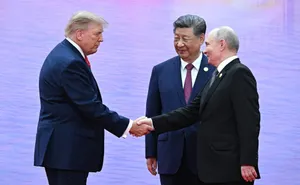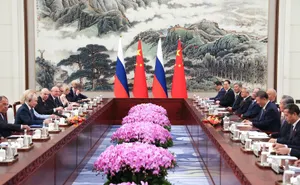
In an interview with Italian independent journalist Clara Statello on Tuesday, EIR Strategic Alert co-editor and Schiller Institute representative Claudio Celani said that the attack on the Kerch bridge had been aimed at torpedoing the coming Xi-Trump-Putin summit.
Two hours later, the London Times quoted a Ukrainian military source, saying exactly that: “‘We planned this as a symbolic gesture before the meeting of Trump, Putin and Xi, to show that Putin is weak’, an officer involved in the mission told The Times.”
The interview with Celani was planned to be about Germany, but the events of the day changed the subject. Celani explained the importance of the Shenzhen summit, rejecting the narrative of a “New Yalta.” This is bunk, spread by those who have no idea of reality, he said. It cannot be a New Yalta, because at least one of the participants—perhaps the most important one, Xi Jinping—has a totally different idea. He is not pursuing a share of influence in a world divided into blocs, but he aims at building a “world governance” based on improving the principles of peaceful coexistence, cooperation among independent and sovereign nations, consistent with the UN Charter but improved with the factor of economic development and an adequate role played by the “Global South.” Celani reported on the Schiller Institute delegation at the recent Global Governance summit in Xiong An, and advertised the next IPC meeting, which is dedicated to the Three Powers Summit.
As to the attack against the bridge, Celani noticed that among the several classes of weapons used, the Dutch RUTA rocket/drone was used, which is produced in the Netherlands by the Destinus company. Destinus, in turn, is owned by the German Rheinmetall. This represents an escalation with respect to other weapons which are produced in Ukraine, and makes the discussion of whether the Europeans are “co-belligerent” or “belligerent” a sophistical distinction.