If you are already a subscriber to EIR publications, you should be proud. If you haven’t yet subscribed, you should wise up quickly and become a subscriber. In either case, it would be a good idea if you purchased a subscription for your congressman, your senator, and your mayor. Your neighbor probably needs one, too.
Why? Because EIR, the flagship publication of the political movement founded by Lyndon LaRouche over 50 years ago, is today at the center of shaping a solution to the global strategic crisis, and it is increasingly recognized as such by world leaders and statesmen.
Take the case of China’s Fudan University, one of the country’s leading educational institutions affiliated with the Ministry of Education, which today wrote that “the world-renowned magazine Executive Intelligence Review (EIR) … [founded] in 1974 by American economist and political activist Lyndon LaRouche … is an information journal focusing on global strategic analysis and policy research. It analyzes major international issues from a cross-regional and interdisciplinary perspective, providing policymakers, experts, scholars, and readers concerned with the common future of humanity with an analytical framework independent of mainstream Western narratives.” It added that EIR provides “in-depth reports, situation assessments, and strategic dialogues,” and that “after 50 years of development, EIR has become a strategic information reference platform with significant international influence.”
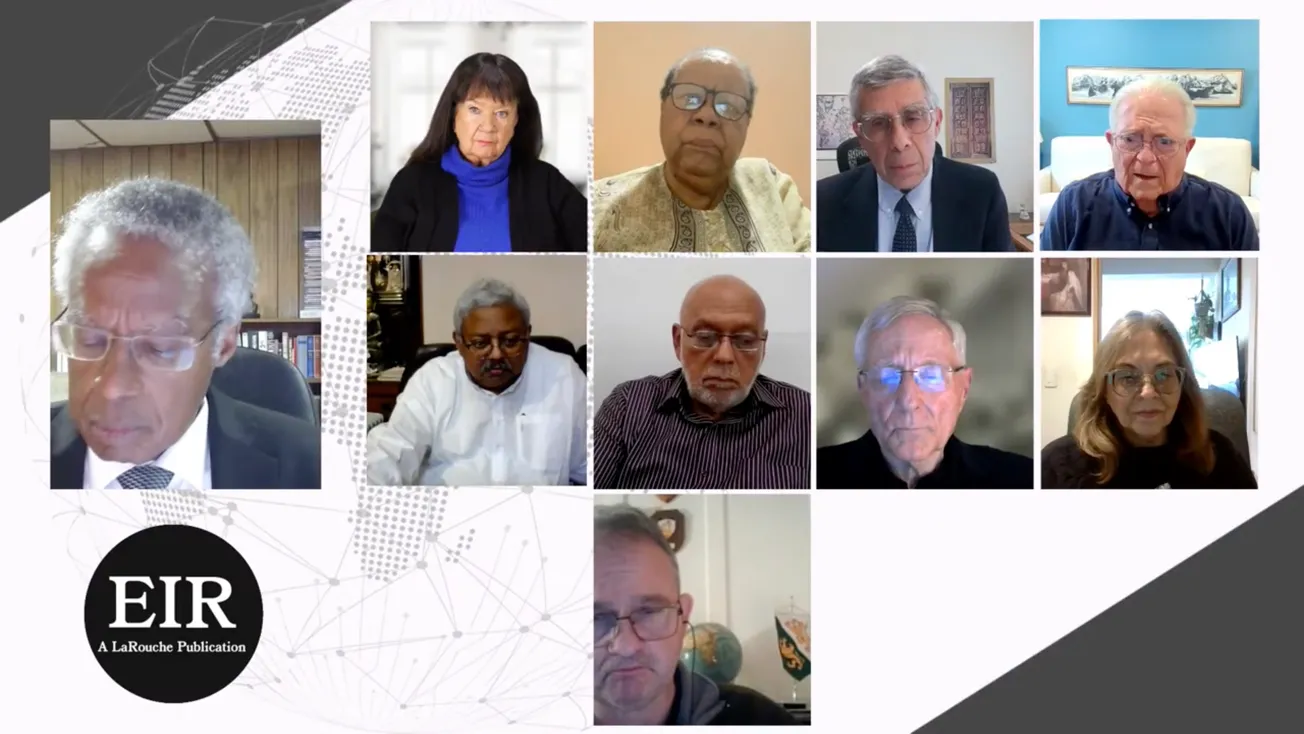
The occasion of Fudan’s commentary was its coverage of EIR’s Jan. 12 emergency international roundtable meeting, “It’s Worse Than You Think: The Implications of the Attack on Venezuela and How To Bring the World Back from the Brink.” “Nearly 20 senior political and strategic experts from the Americas, Eurasia, and Africa participated, engaging in in-depth discussions.… Professor Zhang Weiwei, a member of the National High-End Think Tank Council and Dean of the China Institute at Fudan University, attended the online meeting as the Chinese representative and delivered a speech.”
That EIR Emergency Roundtable was also the central subject taken up at the weekly meeting of the International Peace Coalition, in order to further mobilize forces into immediate political action, worldwide.
“The world has entered a new phase shift where openly it is now ‘might makes right’ and international law is buried,” Schiller Institute founder Helga Zepp-LaRouche told the IPC meeting. “That remains the fundamental threat and dimension of the strategic situation.”
Zepp-LaRouche took particular note of recent comments by Russian President Vladimir Putin, “who received 30 new ambassadors to accept their accreditation. He said that the strategic situation has severely worsened, and he also referred to the same topic we had discussed on Monday [at the EIR Roundtable]; namely, that if the principle of international law is being replaced by the idea that might makes right, then we are in a situation of the law of the jungle.”
She went on to call for an “unprecedented mobilization” equal to the crisis at hand. “We want to aim to, on the one side, demand from governments an immediate return to international law. We will approach all the governments on the planet with that demand. We also want to build an international civil society organization, because it is very clear that when you have a strategic crisis where the institutions have failed, governments are not able to stop the genocide, they are not able to bring these crises under control, then it is very clear that we need something new.
“We need a new security and development architecture, and that can only come into reality if we get a much higher degree of mobilization of world citizens, because republics only function if you have state citizens who are demanding from their governments that they adhere to their responsibilities. We have the task in front of us to create such an international movement of state citizens with the slogan, ‘World citizens of the world, unite!’”