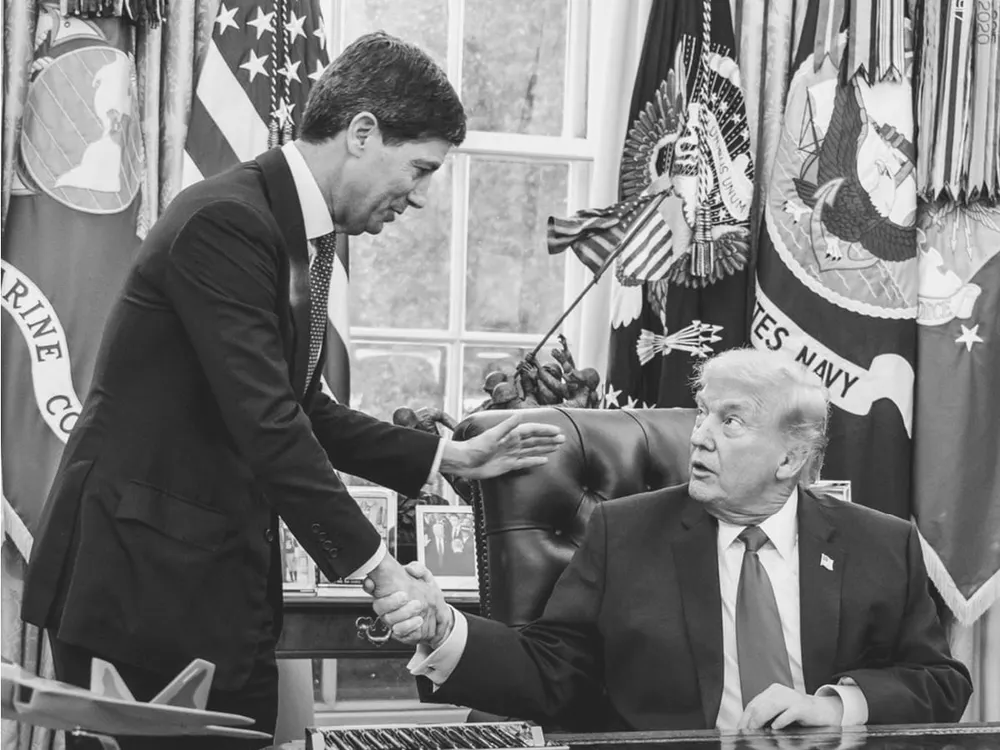
Feb. 5—The nomination of Kevin Warsh as successor to Jerome Powell at the head of the U.S. Federal Reserve Bank will keep the central bank where it has been up until now—under the power of Wall Street. During the 2008 financial crisis, Warsh was the liaison between the Fed and Wall Street and a leading hawk in the push for bailing out Wall Street banks “at any cost.” Those anti-Trump media that welcome him as a non-MAGA follower have missed the point.
That point being, that the Wall Street faction steering the U.S. President Donald Trump administration’s financial policy is proceeding with the blueprint laid out by Stephen Miran, head of the Board of Economic Advisors to the President, to bring the debt under control through a sharp devaluation of the dollar. It is expected that Warsh will cut Fed rates accordingly, from the current 3.50-3.75% down to potentially zero or negative, in order to reduce government debt service and boost exports, while Washington forces its international partners, the foremost being China, to revalue its currency. However, this can create shocks which the financial system might not be able to absorb.
The current financial system has relied on an ever-growing flow of central bank liquidity into the various speculative bubbles (stocks, bonds, commodities market, real estate, credit card, etc.). This “Everything Bubble,” according to rough estimates, now amounts to two quadrillion dollars!
One pillar of such a Ponzi scheme has been Japan’s “carry trade.” Using the differential between central bank rates in Japan (zero or even negative) and the U.S., capital has flown out of Japan into U.S. bonds, profiting from the relatively higher yields of the latter. That may end, under the economic policy announced by the new government in Japan. As we warned last November, a Japanese “stimulus” program could potentially rock the boat of the global financial system, by pushing Japanese rates up and thus curbing the carry trade.
The government of Prime Minister Sanae Takaichi, shortly after she took office on Oct. 21, 2025, announced such a stimulus program, and then, on Jan. 26, 2026, called for snap elections, to secure voters’ support for the program. In the meantime, Japanese bond yields had shot up—including an unheard-of quarter-point jump in one day, sending bond yields up worldwide, with such other effects as a 900-point drop in the Dow Jones average on Dec. 20, 2025. The global financial system, burdened by a multi-quadrillion-dollar financial bubble, which is already overstretched, can hardly bear such shocks.
Japan’s initial draft budget for Fiscal Year 2026 is about ¥122.3 trillion (ca. $780 billion), a record high, and up from the ¥115 trillion for 2025. Key major allocations include about ¥39 trillion for social welfare and ¥9 trillion for defense, plus tax cuts and some money for “investments.”
Independent from the merits or demerits of the budget, market reaction shows once more that such moves in Japan can determine the fate of sovereign governments.