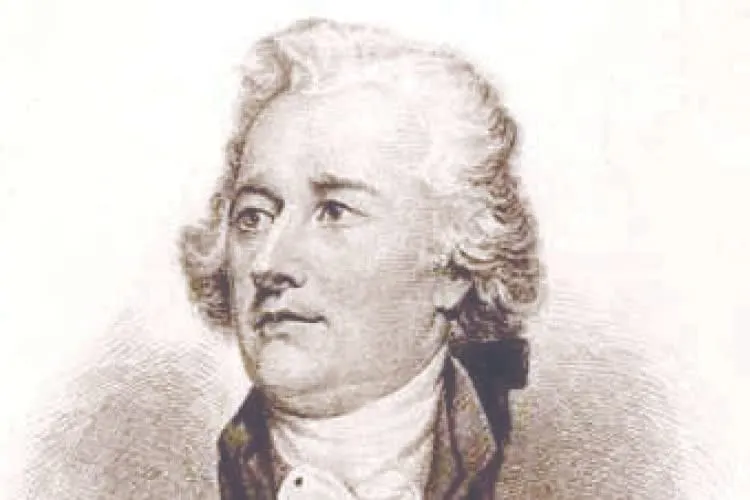
Feb. 5—While the world globalist elite has crowned Mark Carney, Prime Minister of Canada, as the new leader of the liberal world, following his January speech at Davos, many in the so-called sovereignist camp in Western nations are praising another figure at the World Economic Forum, U.S. Trade Representative Jamieson Greer, for his address claiming a resurgence of the American System of Political Economy under U.S. President Donald Trump. Greer is convinced that the current administration has resumed the policy inaugurated by Alexander Hamilton, first Treasury Secretary of the United States, and continued by Henry Carey (top economic advisor to President Lincoln), Friedrich List, and President Franklin Roosevelt, based on the use of tariffs to build America’s industrial and financial power.
In reality, as EIR Economics Editor Paul Gallagher demonstrated in a presentation at the weekly Manhattan Project telecast of The LaRouche Organization, Jan. 24, Hamilton used tariffs in selected sectors, in a mix that included government incentives, and above all, credit for manufactures and infrastructure; but Hamilton never used tariffs as a weapon against any single nation.
Interestingly, the question of credit, which was central to Hamilton’s proposals (he wrote three reports to Congress on the issue), was not even mentioned by Greer in his speech. This is consistent with the monetarist financial policy of President Trump’s administration, and with the use of tariffs as a means to make money and reduce government debt.
One year later, we can say that that policy has failed. Although tariffs did generate revenues amounting to some $250 billion, a study published on Jan. 19 by the Kiel Institut für Weltwirtschaft, shows that that money did not flow from abroad into the United States; to the contrary, 96% of it was paid by American consumers and producers. Foreign exporters hit by the tariffs raised their prices to include the new penalty, or just exported fewer products.
But were the conditions created to allow U.S. manufacturers to replace those imports, which had become more expensive? Were industrial jobs created? Not quite. Manufacturing employment sank for 11 of the 12 months of 2025. Manufacturing activity ended the year at its lowest monthly level: Global demand for U.S. products (new orders) was declining, all the while that global manufacturing production was increasing.
But what has grown is debt: government debt, corporate debt, household debt and banking debt—although the latter is hidden behind “assets.” At this point, 20% of the government budget goes to pay debt service. Corporate debt increased by several billion dollars in one year, while household debt in Q3 2025 was at $18.9 trillion, an increase of $642 billion year-on-year. That amounts to the entire budget of a major industrialized country such as Germany.
And now, the cherry on the cake: Total U.S. bank balance sheets (aggregate assets) were about $24.54 trillion as of Q1 2025, compared to about $24.1 trillion at the end of 2024, an increase of roughly $440 billion in early 2025. Since asset values are inflated, when the two-quadrillion-dollar global financial bubble bursts, they will turn into the largest aggregate loss in history.
As Paul Gallagher indicated in his presentation, there is no way to prevent the collapse of this system, and, ironically, the solution is to implement the real American System policy, starting with a national bank and Glass-Steagall bank separation system, in order to generate credit for a recovery program.