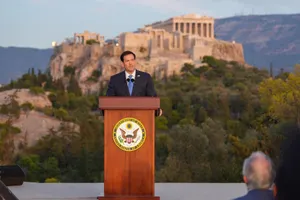
Feb. 5—While President Donald Trump’s administration pursues a policy of depreciation of the U.S. dollar, it is now demanding that China—and other countries—prop it up by revaluing their own currencies. Thus, the U.S. Treasury, in its semi-annual foreign exchange market report of Jan. 29, called on the Chinese authorities to allow the renminbi (RMB) to “strengthen in a timely and orderly manner.”
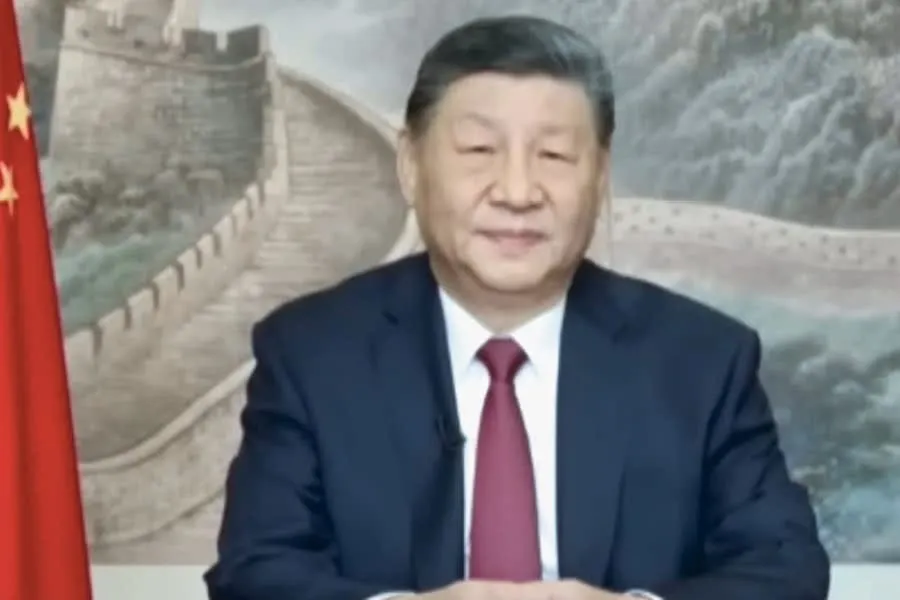
There has been no direct reply from Beijing on the matter, but two days later, the widely read CPC theoretical journal, Qiushi, published a speech that had been given by President Xi Jinping in 2024, indicating China’s intent to allow the RMB to begin to serve as a reserve currency. In that speech and in comments in a seminar following it, President Xi laid out the principles that he felt must form the basis of making China a “strong financial nation,” beginning with the subordination of the financial system to the real economy.
The financial system must “serve the real economy,” Xi wrote. “If it indulges in self-circulation and self-expansion, finance will become water without a source and a tree without roots, inevitably leading to a crisis sooner or later. My country’s financial system must uphold its duty to serve the real economy and promote high-quality development, and must never deviate from the real economy for speculative purposes.” (The difference between that viewpoint and the speculative financialization that plagues the trans-Atlantic world could scarcely be greater, cf. above.)
Xi went on to underline the Confucian principles of advantage coupled with righteousness: “To promote high-quality financial development and build a strong financial nation, we must adhere to the combination of the rule of law and the rule of virtue, vigorously promote the excellent traditional Chinese culture, and actively cultivate a financial culture with Chinese characteristics.”
While the Western media, in particular, have largely ignored the fundamental principles that Xi outlined, which cohere with those laid out by economist Lyndon LaRouche, they have fixated on one single point he made, namely that China “should have a strong currency, widely used in international trade investment, and foreign exchange markets, holding the status of a global reserve currency.” The Financial Times remarked, perhaps with some trepidation, that the speech “marked Xi’s clearest definition yet of his goal of a strong currency, as well as the broader financial foundations Beijing will need to support it.”
The issue of the RMB becoming a reserve currency has been discussed for quite some time, and it has come to play a major role as one in trade with many of its partners. However, the Chinese currency is not traded on world markets, and thus does not fully fit the bill of a reserve currency, according to today’s commonly accepted practices. In Xi’s comments, he indicated that China was not quite prepared at this point for such a step. “Although my country is already a major financial power,” he stated, “first in the world in terms of bank size and foreign exchange reserves, second in the world in bond and stock market size, and among the top in terms of insurance scales, it is generally large but not strong. Building a strong financial nation requires long-term efforts and sustained commitment.”
The statement of the Chinese President in 2024 was barely noticed at that time, yet it clearly indicated a statement of intent, which only now is being fully digested by the Western financial community.