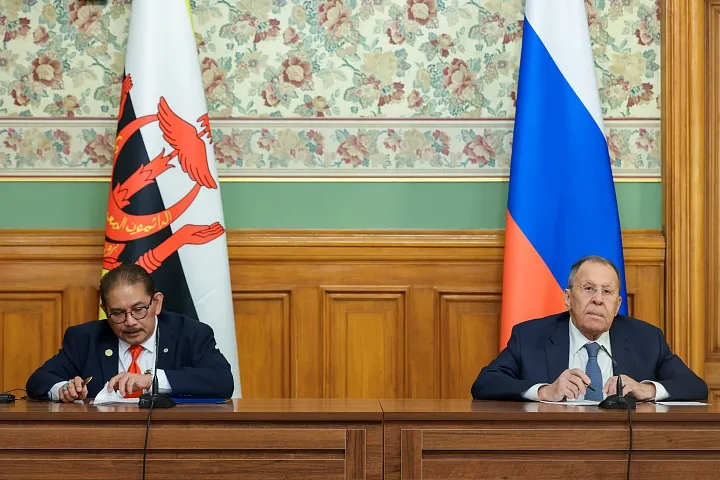
Russian Foreign Minister Sergey Lavrov has warned that while U.S. President Donald Trump says that the war on Iran is necessary to prevent Iran from building nuclear weapons, it may have the opposite effect. Lavrov noted during a March 3 joint press conference with Second Minister of Foreign Affairs of Brunei Darussalam Erywan Yusof, that White House envoy Steve Witkoff said on TV earlier that day the U.S. launched the war because Iran considered its right to enrichment “inalienable.”
“According to him, he and Jared Kushner concluded that, given this position, the negotiations would not yield results and that it was necessary to end the process and consider alternative approaches,” Lavrov said. “But no one has ever challenged the fundamental right to uranium enrichment as a principle applicable to all states without exception that are parties to the Treaty on the Non-Proliferation of Nuclear Weapons.”
“The right to the peaceful uses of nuclear energy, including uranium enrichment for civilian purposes, is inalienable and was not disputed in the Joint Comprehensive Plan of Action (JCPOA) aimed at resolving the Iranian nuclear issue,” he added. “This right is grounded in the UN Charter, the Treaty on the Non-Proliferation of Nuclear Weapons, and the IAEA principles.” The process established in the JCPOA should be applied in the current situation as well. “However, expecting Iran to be the only country in the world to relinquish a right that belongs to all other states is not a realistic position,” Lavrov said.
Later, in response to a follow-up question, Lavrov warned that the threat to global nuclear security is escalating. “As I mentioned earlier, the stated rationale for the aggressive action against Iran was the belief that Tehran was pursuing nuclear weapons. Yet, following the 12-day war in June 2025, the United States declared that all components and all work on such a weapon had been destroyed,” he said. “But, if this war ... was truly launched to deprive Iran of its inalienable right to enrich uranium for peaceful purposes (a right enjoyed by virtually every other country in the world), then I can assure you that, if that logic prevails, we will see powerful forces and influential movements emerge inside Iran arguing that they should do precisely what the United States claims it wants to prevent—acquire a nuclear bomb. Because the United States does not attack nuclear-armed states.
“People often cite the example of Muammar Qaddafi. He voluntarily gave up his nuclear weapons program. And some of our interlocutors in the Global South are quick to remind us of that fact. They say: Qaddafi abandoned his program, and look what happened to him. Those who didn’t? They aren’t being attacked.
“This war, which has now been unleashed against Iran, could very well become the catalyst for a movement in favor of developing nuclear weapons, and not just in Iran. Such a movement would almost certainly emerge in the Arab countries neighbouring the Islamic Republic. So, the declared noble goal of preventing nuclear proliferation could, paradoxically, set in motion the very opposite trend.”