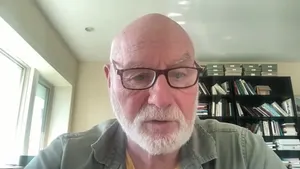
March 18—As the files on convicted child sex offender Jeffrey Epstein continue to be released, bit by bit, public attention has been largely focused on the salacious aspects of the revelations they contain, and what they tell us about the moral depravity of the ruling oligarchy in the Anglosphere—what has now become known as the “Epstein Class.” But Epstein was no mere procurer for the ruling elites. To understand his real role, it is necessary to take a closer look at the father of his business associate and erstwhile concubine, Ghislaine Maxwell. That father was Robert Maxwell.
Robert Maxwell (born Ján Ludvík Hyman Binyamin Hoch, June 10, 1923, in Slatinské Doly, Czechoslovakia) was a wealthy publisher, Member of the British Parliament, convicted fraudster, and intelligence operative with connections to numerous governments. His dealings were quite murky, and he was suspected of being a double or triple agent. After his mysterious death at sea off the Canary Islands in November 1991, he was given a high-profile funeral in Israel, attended by Israeli Prime Minister Yitzhak Shamir, Israeli President Chaim Herzog, and at least six serving and former heads of Israeli intelligence.
Maxwell and Israel’s Nukes
Israel’s notorious “Samson Option” has been for the past half-century a form of blackmail in the Middle East for British geopolitical aims. The name refers to Israel’s presumed doctrine of massive retaliation with nuclear weapons as a last resort if the state faces an existential threat, such as invasion or destruction. The name derives from the biblical figure Samson, who, in his final act, brought down the pillars of a Philistine temple, killing himself and thousands of enemies.
Perhaps betraying his suspected role in Israel’s nuclear weapons program, Robert Maxwell commissioned a stained-glass installation of Samson at the Gates of Gaza for his estate in Oxford. The piece is widely believed to portray Maxwell himself as Samson. Maxwell allegedly penetrated U.S. nuclear research on behalf of Israeli intelligence, under the cover of the scientific publishing of Pergamon Press, which he co-founded with a British spy, Paul Rosbaud. Rosbaud had earlier penetrated the nuclear program of the Nazis.
Perhaps the career of “Captain Bob”—Maxwell’s nickname referencing his earlier career in the British military—was more associated with British intelligence rather than the Mossad, given the interest of the British in using the Israeli nuclear weapons program as the ultimate hand grenade, intending blow up Israel and its neighbors, to secure their geopolitical interests.
Simultaneously, Maxwell cultivated a vapid, nihilistic socialite class who would carry their sins of the bedroom to the board room, and to the war room. His daughter Ghislaine—from whose namesake super-yacht, the Lady Ghislaine, Robert Maxwell allegedly plunged to his death—passed her father’s torch to Jeffrey Epstein. In this article we will focus on the roles of Maxwell and Epstein in organizing scientific circles for the British design for their post–World War II model of domination through the “empires of the mind.”[1] British geopolitical control during the Cold War period was accomplished through psychological warfare, with the fear of nuclear weapons as one of the key elements for both geopolitical and societal control.
Here, we will focus specifically on the interest, by both Maxwell and Epstein, in cybernetics, which has, since its inception, overlapped the development and deployment of nuclear weapons. Cybernetics was one of the key operations launched by Lord Bertrand Russell, as part of the empires of the mind. Through his work on nuclear disarmament, Russell portrayed himself as a peacenik, when in reality, he had called for a preemptive nuclear strike on the Soviet Union. Russell and his acolytes dreamed of a cybernetic control grid to manage the population through control of information flows to accomplish the geopolitical agenda of the City of London.
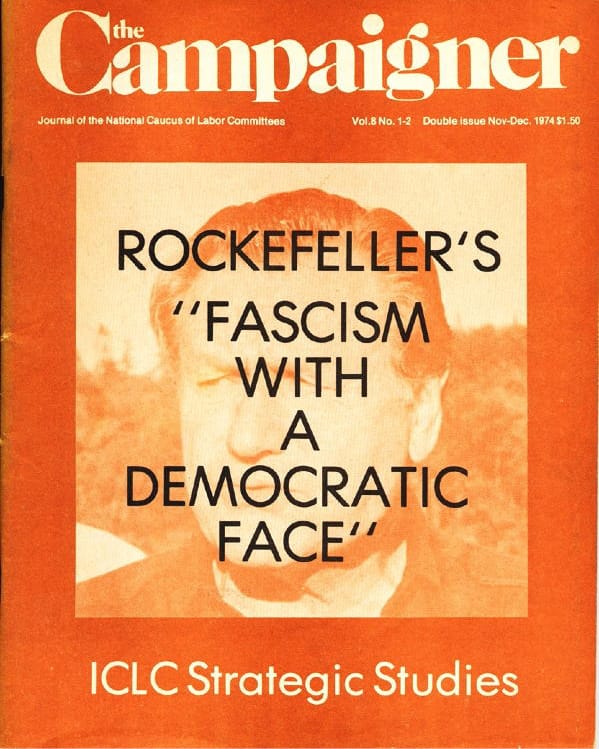
However, as you read the following, it is important to stress that nuclear blackmail is only part of the broader psychological warfare for the Cold War. This issue of the integrated nature of nuclear weapons and psychological warfare was best identified by Lyndon LaRouche in 1974, where he stated:
The uninformed man-in-the-street mistakenly believes that contemporary U.S. military strategy is obviously premised on the techniques for delivering and targeting thermonuclear missiles. Thermonuclear warfare capability is, in fact, a very high order of secondary consideration in present imperialist strategic doctrine, but for reasons which ought to be obvious, it is not and could not be the most fundamental aspect of that doctrine. The cornerstone of all contemporary imperialist strategic doctrine, including thermonuclear doctrine, is psychological warfare. It could not be otherwise [emphasis added].
—Lyndon LaRouche, in the 1974 piece titled, “Rockefeller’s ‘Fascism with a Democratic Face,’ ” under the subsection of “Psychological Warfare.”
Consider that U.S. Cyber Command (CYBERCOM) was first established under the umbrella of U.S. Strategic Command (STRATCOM). Today, CYBERCOM is an integral part of the communication grid of the Pentagon, and is part of STRATCOM’s Nuclear Command, Control and Communications (NC3). Yet, one of the self-described “Four Horsemen” of officers who set up the command, Jen Easterly, is more known for her role in aggressively promoting censorship and “narrative management” at the Cybersecurity and Infrastructure Security Agency (CISA). (See EIR, October 17, 2025, Tony Blair’s Digital Dystopia Targets You.) Easterly’s background at the Pentagon was in psychological warfare through cybernetic means—“psyber” warfare, if you will.
Robert Maxwell and ‘The Griffin’
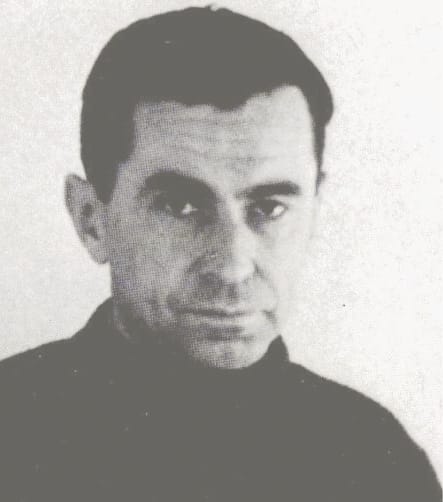
The Guardian describes Paul Rosbaud, known as “The Griffin”: “…one of Britain’s longest-serving and best-placed spies [who] smuggled scientific documents about Hitler’s nuclear weapons programme out of Nazi Germany [which] are concealed, it is alleged, within the secret service’s archives.”
Through his placement in Germany’s preeminent scientific publishing house, Springer Verlag, Paul Rosbaud had access to some of the most prominent names of Germany’s scientific cadre in the nuclear field, such as Otto Hahn and Lise Meitner—the latter of whom was assisted by Rosbaud in escaping Nazi persecution. The Guardian then goes on to discuss Rosbaud’s post-war career and his intersection with Robert Maxwell:
At the end of the war, when Rosbaud came to London, he continued to work as a scientist and later went into business with Robert Maxwell, an army captain who had been press officer in Berlin for the Foreign Office and who was starting out his career as a publisher. It was Rosbaud who came up with the name Pergamon Press for Maxwell’s company, though a furious row permanently ended their partnership soon afterwards.
It should be noted that, according to Ghislaine’s recent testimony, Robert Maxwell was not just simply a press officer for the British Foreign Office, but “actually did become what was part of intelligence back in the war.” Ghislaine continued: “And his job was to interrogate German scientists and prisoners of war.”
It is unclear whether Maxwell’s work with the British Foreign Office in Germany was related to the Nazi nuclear weapons program, and whether he worked with Rosbaud on that portfolio during the war. However, though his relationship with Rosbaud at Pergamon Press was allegedly brief after the war, it was through his work in scientific journals that Maxwell began his foray into what appears to be intelligence work in the nuclear program of the United States, highly likely under the umbrella of British intelligence.
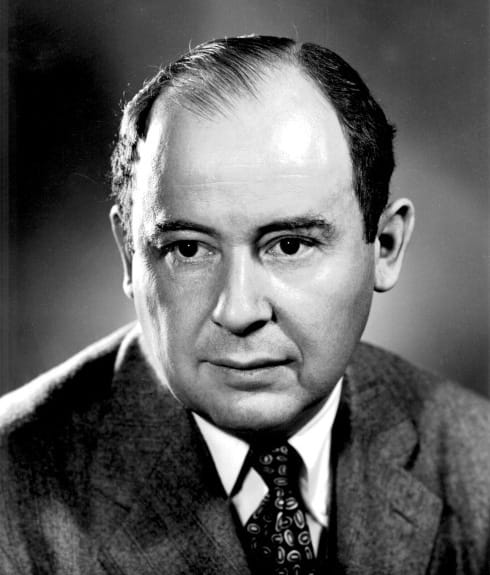
Established in 1951, Pergamon was home to 40 journals by 1959, 150 by 1965, and over 400 journals at the time of Maxwell’s death in 1991. Under the banner of Pergamon, Maxwell began reaching out to U.S. nuclear scientists at the highest level, according to his dossier compiled by the FBI. The FBI seems to have been alerted to Robert Maxwell’s activities in America when he began calling American nuclear scientists and inquiring into forming an Anglo-American “Journal of Nuclear Energy” in 1953. One of the scientists whom he did contact was cybernetics pioneer John von Neumann, one of the designers for the detonation system for the Fat Man plutonium nuclear bomb.
It may be assumed that his intelligence work in U.S. nuclear science would contribute to Israel’s nuclear program and its “Samson Option,” discussed in Seymour Hersh’s book of the same name. This would also begin his liaison with the key names of Bertrand Russell’s Cybernetics Project, and also lead Maxwell to his alleged espionage in the National Laboratories of Sandia and Los Alamos—the home of Fat Man.
PROMIS and Nuclear Espionage in Santa Fe
After years of penetration into the environs of the Los Alamos and Sandia National Laboratories, Robert Maxwell furthered his alleged espionage operation through his sponsorship of the Santa Fe Institute (SFI), to which the Maxwell Foundation donated $300,000 in 1990. More will be said below about other work at SFI, which further developed cybernetics concepts for psychological warfare that became part of the palette for “color revolutions” after the fall of the Soviet Union.
The Santa Fe Institute was located near the National Laboratories engaged in nuclear research, and Maxwell was suspected of using the PROMIS software for monitoring or stealing nuclear secrets. PROMIS (Prosecutors Management Information System) had been developed by Inslaw, Inc., and has long been believed to be spyware for the intelligence community. Inslaw’s president and founder, Bill Hamilton, who previously had a career with the National Security Agency, claimed that the PROMIS software had been stolen, reportedly by Rafi Eitan, an Israeli counterterrorism official, and then passed to Robert Maxwell, who marketed the software internationally, both for profit and to obtain a “back door” for surveillance of whatever government or private entities purchased and used it.
In a statement in the context of legal proceedings regarding the theft of PROMIS, Hamilton indicates Maxwell’s role in potential surveillance related to the New Mexico nuclear research:
Judge Hogan should also be made aware that the FBI office in New Mexico conducted a foreign counterintelligence investigation of Robert Maxwell in 1984 for selling PROMIS in New Mexico, which is the headquarters for the two main U.S. intelligence agencies on nuclear warfare, the Sandia and Los Alamos National Laboratories. Although the copy of the FBI Investigative Report that Inslaw obtained under the Freedom of Information Act was heavily redacted by the government for national security reasons, the text that is still able to be read reveals that the FBI investigation was based on a complaint from two employees of the Sandia National Laboratory. (Source: Gideon’s Spies: The Secret History of the Mossad by Gordon Thomas.)
In a 1994 letterrequesting information regarding declassifying information related to Maxwell’s alleged theft of PROMIS, Bill Hamilton said:
It is not unreasonable, therefore, to infer that the FBI office in Albuquerque opened a foreign counterintelligence investigation of Maxwell and Pergamon International because Maxwell sold PROMIS to one or more U.S. defense installations in New Mexico and because the FBI may have been concerned that a foreign nation intended to use the PROMIS software as an electronic Trojan Horse for penetrating the computerized data base(s) of the targeted defense installation(s).
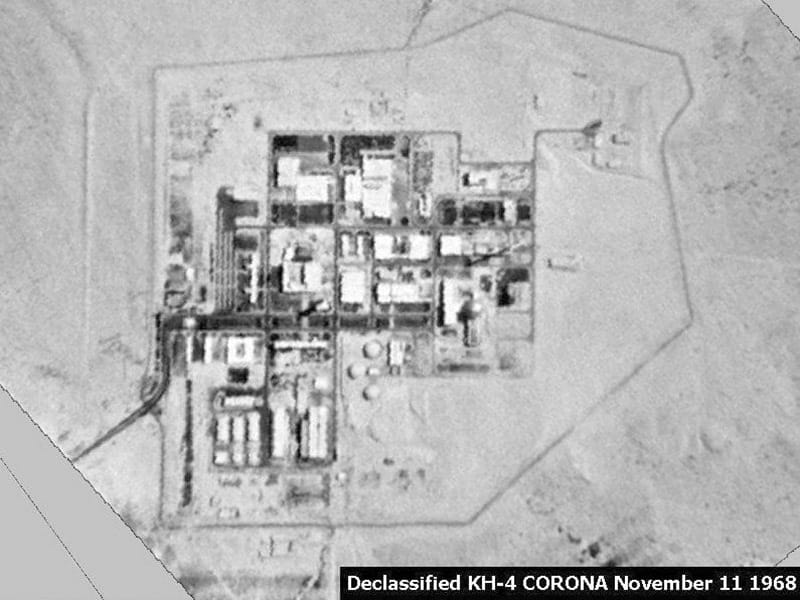
Further indicating Maxwell’s suspected role in nuclear espionage is his role in the Mordechai Vanunu affair. Vanunu was a technician who had worked at the Negev Nuclear Research Center, south of Dimona, Israel. Vanunu then became a whistleblower regarding Israel’s secret nuclear weapons program, citing his opposition to weapons of mass destruction. In 1986, Vanunu went to the British press, sharing his photos of Dimona with the Sunday Mirror, which was owned by Robert Maxwell. Vanunu was subsequently lured out of London to Italy, allegedly by the Mossad, where he was drugged and abducted to face a trial held behind closed doors in Israel. Ari Ben-Menashe, a self-described Mossad agent, suggested in 1991 that Maxwell had tipped off the Israeli Embassy in London about Vanunu in 1986.
Santa Fe Institute: Color Revolutions and the Emergence of ‘Psyberwarfare’
While Robert Maxwell was suspected of nuclear weapons espionage at Los Alamos and Sandia since the 1950s, his later sponsorship of SFI, in the years before his death, suggests an interest in their research on other forms of warfare: color revolutions. SFI further developed cybernetic concepts in the field they called “Complex Adaptive Systems.” We will return to that matter, but it is necessary to situate it in its historical development of cybernetics.
John von Neumann was part of the Manhattan Project at Los Alamos, but he is more well-known as one of the fathers of cybernetics—together with Bertrand Russell’s child protégé, Norbert Wiener. During the Cold War, von Neumann and Wiener would play their part in devising the initial cybernetic blueprints on behalf of Russell for the City of London’s shift from the physical presence in their former colonies, to the new model of the empires of the mind—cemented by the “special relationship” of UK-U.S.A. intelligence sharing and covert operations.
Von Neumann and Wiener would be part of Russell’s Unity of the Sciences project that brought many scientific fields together through cybernetics—mathematics, physics, economics, sociology and anthropology—to discuss how to persuade people that their minds were simply digital or binary structures, only capable of avoiding pain and pursuing pleasure. The Josiah Macy Jr. Foundation sponsored a series of conferences between 1946 and 1953 where early plans for a cybernetic control grid for society would be presented. Articles by Wiener, von Neumann, and many others in Russell’s cybernetics project would appear in journals published by Maxwell’s Pergamon Press. Others of Russell’s acolytes, such as Marvin Minsky and Noam Chomsky, would build upon cybernetics in their pursuit of language models for artificial intelligence (AI), through their work at MIT.
The development of these cybernetic models would also be funded by the Defense Advanced Research Projects Agency (DARPA), and were tested on the battlefield in counterinsurgency settings in Vietnam, Malaya, and other former European colonies. Under Lt. Gen. William P. Yarborough’s Continental United States Intelligence (CONUS INTEL) project, these cyber-surveillance operations that were used in counterinsurgency operations overseas, were then brought back to the U.S. for use against the insurgencies—activists in the antiwar and civil rights movements—which prompted the launching of the 1975 Church Committee hearings into abuses by the intelligence agencies. AI models were being developed even then to make predictive programming models, which could act to change or avert social unrest or neutralize targets, such as those developed by William Godel of the Advanced Research Projects Agency, which later became DARPA. Reportedly, Wiener became an activist himself as he became disillusioned that his cybernetic ideas had been weaponized against society, instead of helping it.
Turning the Cybernetics Arsenal Against the American People
We have seen how technologies and modalities that were developed, under military sponsorship, to be used against an adversary, wound up being deployed against the American people. This is a pattern which would be repeated as the world entered the Digital Age.
Many years after Pergamon Press had published the initial works of the founders of cybernetics, Maxwell funded the operations of SFI —just a short drive from the National Labs at Sandia and Los Alamos, where he had years earlier cultivated contacts with those scientists, such as John von Neumann, who played a key role in developing Fat Man, the atomic bomb dropped on Nagasaki, Japan, on August 9, 1945. Founded in 1984, SFI would reiterate concepts of cybernetics and information theory to create the field of Complex Adaptive Systems (CAS), as developed by SFI’s co-founder Murray Gell-Mann. Maxwell’s donation of $300,000 in 1990 ensured the continued functioning of the SFI, which would see its government funding dry up as the Soviet Union disintegrated along with SFI’s Cold War relevance.
However, in the period following the fall of the Soviet Union, it would appear that the Santa Fe Institute’s CAS was being modified for use in hybrid warfare and color revolutions. According to an article by Amund Osflaten:
…articles in Military Thought [a journal published by the Russian Ministry of Defense] contain similar references to a covert threat from the West, constituted by non-military and irregular military means. For example, an article from 2014 described the origin, development and threat from so-called ‘color revolutions’… the Santa Fe Institute, for example, a multi-disciplinary research institute specializing in chaos theory and complexity in systems, is mentioned as one of the sources for this new set of technologies.
SFI’s clients included the Pentagon and CIA, among others. Its Complex Adaptive Systems—rooted in cybernetics, as Murray Gell-Man said—would be used for “regime-change” operations, ultimately aimed at nations on the periphery of nuclear armed Russia, China, and India, and those of their collaborators on other continents that are today associated with BRICS. This work at SFI may give context to Ghislaine Maxwell’s statement on her father: “He had an interest—he believed that … knowledge is what would prevent war.” Perhaps preventing war meant toppling disobedient governments, their allies, and expunging any cultural or national identity.

Robert Maxwell’s operations in Santa Fe would also be assisted by his daughter Christine, who, after her father donated to SFI, would join its board. She had been an editor of Pergamon Press since 1975, and subsequently went on to head the West Coast offices of her father’s science publication empire. In 1995, Christine and her twin sister, Isabel, founded Magellan, one of the early internet search engines of Silicon Valley. However, the twins’ interest in the digital realm would not be limited to such a benign activity as web searches.
Following Magellan’s acquisition by Excite, Christine was one of the co-founders in 1996 of the “information on demand” firm, Chiliad, together with Paul McOwen, who left his post at the University of Massachusetts Amherst’s Center for Intelligent Information Retrieval—AI and Information Access that year. Bloomberg also lists Allan Wade as one of the co-founders of Chiliad. Wade retired in 2005 as the chief information officer in a dual-hat role for both the CIA and the Office of the Director of National Intelligence (ODNI). The year before Wade’s retirement, Chiliad notably acquired the contract for the FBI’s Investigative Data Warehouse, which was one of the key surveillance posts under the Patriot Act.
It is likely that SFI’s work on color revolutions internationally was imported and aimed at Americans, as the neocons began to exploit the 9/11/2001 terrorist attacks as a pretext for the implementation of new counterinsurgency measures, and their long-desired “surveillance state.” This echoed the way that the early work of cybernetics was directed at the American public under the operations of Gen. William Yarborough.
Epstein Takes Over Maxwell’s SFI and Cybernetic Portfolio
Soon after Robert Maxwell contributed to SFI, he met his end in the waters near the Canary Islands, off the deck of the Lady Ghislaine. However, by then Ghislaine had begun her relationship with Jeffrey Epstein, who appears to have been vetted and cleared of having moral standards by the same intelligence circles who ran Maxwell’s operation. Two years later, in 1993, Epstein bought his Zorro Ranch in Stanley, New Mexico, just outside both Sandia and Los Alamos, and continued the funding mechanism for SFI that was begun by Robert Maxwell. New York Magazine suggests that “He had it [Zorro Ranch] built because of the month or so he found himself spending there, talking elementary particle physics with his friend Murray Gell-Mann, a Nobel Prize–winning physicist and co-chair of the science board at the Santa Fe Institute.”
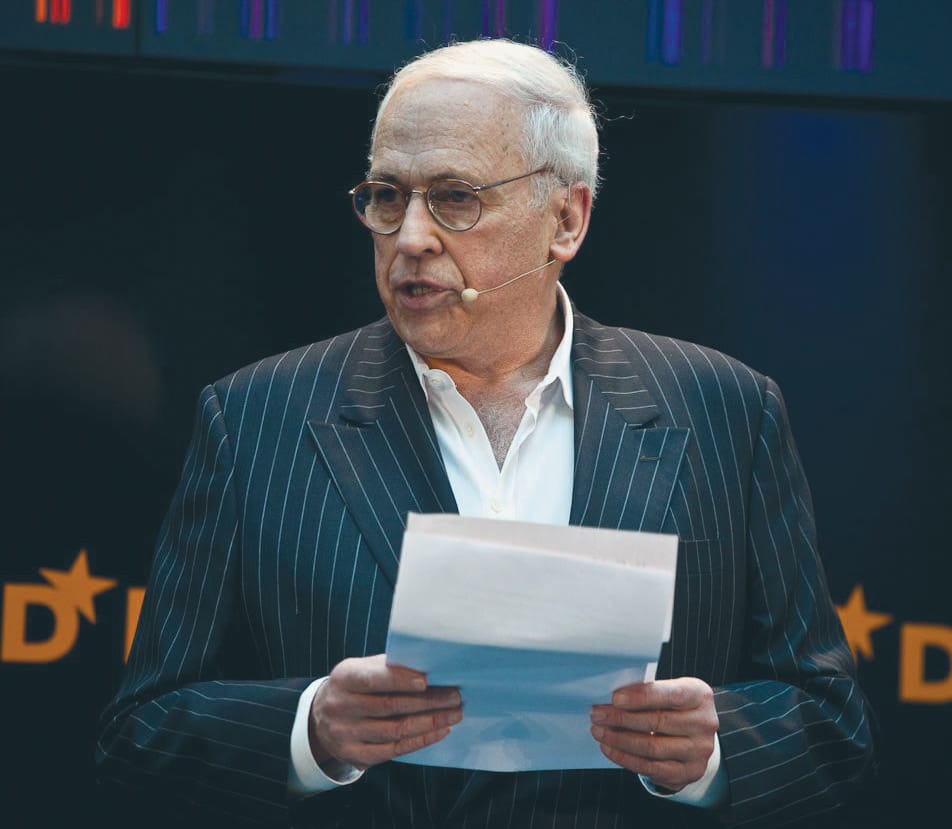
Regarding Maxwell’s role as a gate-keeper in scientific literature, through Pergamon, it appears that John Brockman would step in to fill that void after Maxwell’s death. Brockman was the literary agent for Murray Gell-Mann, among many others, and became a similar science gate-keeper through his Edge Foundation. One of Brockman’s clients, Evgeny Morozov, said that Brockman was “no mere literary agent,” and described him as:
…a true “organic intellectual” of the digital revolution, shaping trends rather than responding to them. Would the MIT Media Lab, TED Conferences, and Wired have the clout and the intellectual orientation that they have now without the extensive network cultivated by Brockman over decades? I, for one, very much doubt it.
Brockman’s Edge Foundation was funded with Epstein’s money and his financial backers in the City of London. Various reports indicate this funding neared a million dollars or more, with years where Epstein’s money was the Edge Foundation’s sole source of funding. As indicated by Morozov, Brockman’s operation was a nexus for the Silicon Valley crowd, and he worked with Stewart on initiatives like the Whole Earth ’Lectronic Link (WELL). Brand’s WELL is seen as the precursor to today’s social media platforms.
Brockman was described as Epstein’s “intellectual enabler,” and worked with Epstein to resuscitate cybernetics—calling for an explicit revival of the Macy Conferences, which he called the Brockman Conferences:
The agenda of the Second Brockman Conference is to explore a plan to update the highly influential Macy Conferences of the 1940s and 1950s….
A result of this dazzling array of new ideas was the creation of The Macy Conferences of the 1940s and 1950s. The original participants wanted to create a new social science for their time and, in so doing, asked people in various disciplines to talk and interact with each other. Participants included a who’s who of cutting edge scientific intellectuals: H. Ross Ashby, Gregory Bateson, Julian H. Bigelow, Warren McCulloch, Margaret Mead, F.S.C. Northrop, Walter Pitts, Arturo Rosenblueth, John von Neumann, Claude Shannon, Heinz von Foerster, W. Grey Walter, Norbert Wiener, and J.Z. Young.
In an email to Epstein, Brockman discusses his view that cybernetics never went away, but was the basis for artificial intelligence today:
Cybernetics never went away: it came to be everything, and that it’s time for an update from the field. In so doing, this is not looking through a rear-view mirror. Wiener’s cybernetic idea is crucial to understanding what’s happening in AI today and where it’s going; and his warnings and admonitions about AI are now very real again…. Artificial intelligence is today’s story—the story behind all other stories. It is the Second Coming and the Apocalypse at the same time: good AI versus evil AI.
Postscript: The Battlefield Is the Mind
Lyndon LaRouche often related that his work on the science of the human mind, and its applications, was sparked by the need to refute Wiener, von Neumann, and cybernetics.
It is ironic that a global oligarchy that hates human creativity, has always understood its central role better than most people. Before degenerates like Maxwell and Epstein came along, Aristotle and others served as the gatekeepers of thought. Socrates was railroaded and killed millennia before Lyndon LaRouche was targeted and jailed in a similar corrupt proceeding. While promoting Pergamon Press, and those who pursued areas of research that served their aims, that oligarchy tried to crush the scientific work of the LaRouche movement.
Defeating what today is known as the Epstein Class will require all of us to abandon simple pragmatic views, and to recommit to mastering and advancing profound scientific and philosophical concepts.
Notes
- While this phrase may be best known from Winston Churchill’s 1943 address at Harvard University, implementation was often carried out by British Fabian circles, including Bertrand Russell, George Orwell, H.G. Welles, and Aldous and Julian Huxley. It refers to the idea that imperial prerogatives would henceforth be enforced through psychological manipulation, rather than physical power.