
October 30—According to the usual naysayers, those who compose the narratives passed on to the “left” and the “right” of a hopelessly divided country, the election in Israel on Oct. 27 produced another “stalemate,” driven by heightened and dangerous polarization, likely to result in weeks of uncertainty and despair. This was expressed in the headline of an article by American-Israeli journalist Dahlia Scheindlin in The Guardian, “A Bitter Night in Israel … and We Are More Divided Than Ever.” She wrote that the outcome of the election reflects the “trauma and despair” of the Israeli population.
Scheindlin’s article expressed a common theme of those who were hoping that Prime Minister Benjamin “Bibi” Netanyahu would be rejected by an Israeli public coming to its senses, but instead are coming to terms instead with a fear that this election is following the pattern of recent elections. For example, that of the “national unity” government cobbled together by Netanyahu under similar circumstances in the 2021 election, which fell on June 6, 2022, leading to the fifth national election in four years. The government which emerged from the November 1, 2022, election was a coalition headed by Netanyahu, whose Likud Party won 30 of the 61 seats needed to form a government.
By the end of December of that year, he had pulled together a coalition of 64 members of the Knesset, which enabled him to serve as Prime Minister until this week’s election. It included genocidal extremists such as Itamar Ben-Gvir and Bezalel Smotrich, who openly advocate ethnic cleansing of Palestinians, including killing children, describing them as “animals” and “beasts.” Netanyahu personally reasserted his inner beastman in the days before Tuesday’s election, vowing to “destroy” the West Bank city of Hebron after alleged Hamas gunmen murdered two Israeli soldiers at a military checkpoint, and reiterating his pledge to “overthrow the regime” in Iran, “to finish the job.”
The murderous policies of Netanyahu’s “Greater Israel” fanatics have been condemned by the International Court of Justice, which found on Jan. 26, 2024 that it was “plausible” to conclude that a genocide might be underway, and by the Independent International Commission of Inquiry of the United Nations Human Rights Council, which in September 2025 concluded that Israel was committing genocide in Gaza.
The contempt displayed by Netanyahu and his war criminal cohorts toward those who dare to speak out against them has unified much of the world against his government, making Israel an international pariah state. Thanks in part to exposure in social media of the killing and scorched-earth destruction of Gaza, the usual defiant strategy of accusing those exposing the crimes of the Zionists of being “anti-Semites” no longer works. It has reached the point where the Zionist “Epstein Class” billionaires in the United States, who contribute tens of millions of dollars to the “Lobby”—aka the American-Israel Public Affairs Committee (AIPAC) to maintain control of the U.S. Congress and the Executive branch—announced last week that they will no longer endorse candidates, as their endorsement is now a liability for those candidates.
Where Is the ‘Opposition’ in Israel?
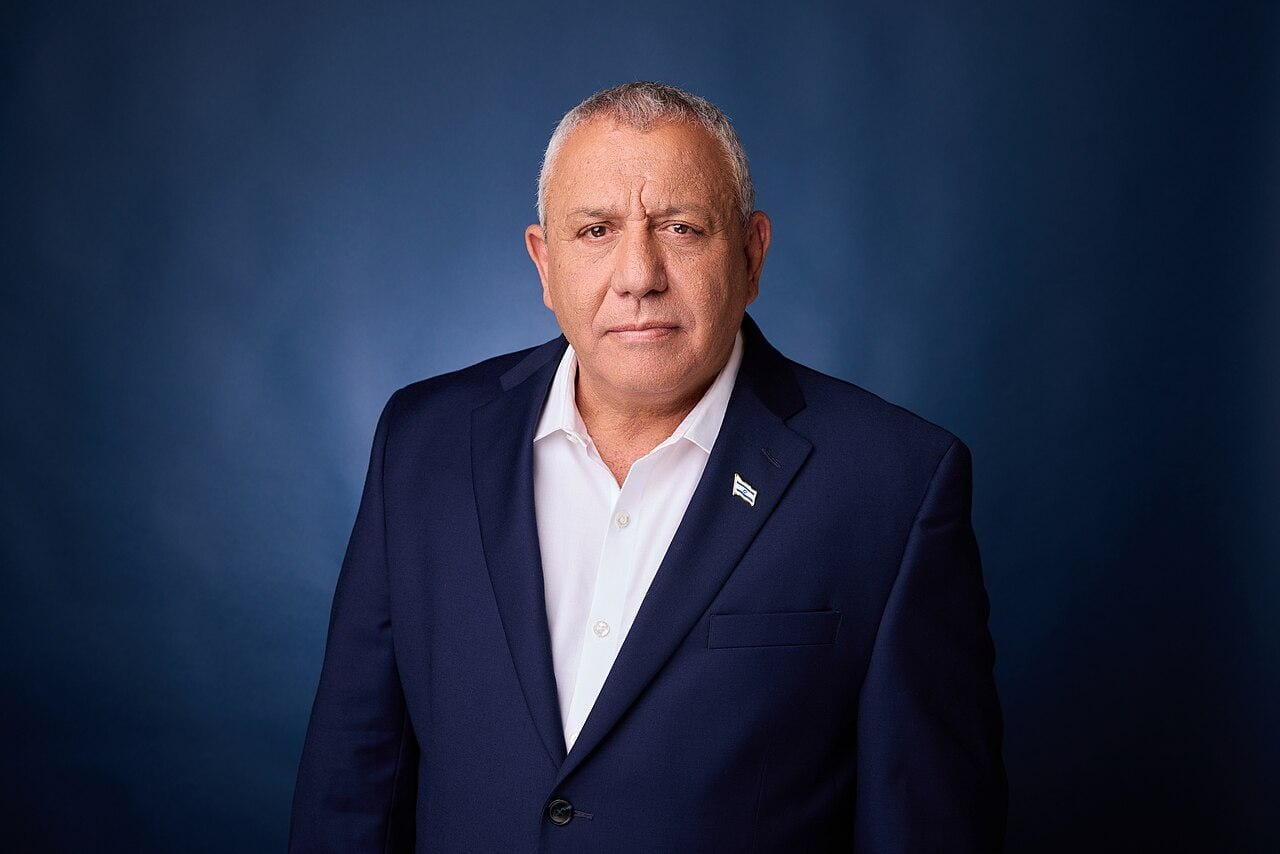
With 100% of the votes counted, neither of the two main blocs has reached the 61 Knesset seats needed for a majority to form a government. Netanyahu’s coalition is credited with 53 seats, with 27 of those being members of his Likud Party. In the last election, Netanyahu’s bloc totaled 68 seats, meaning Tuesday’s result represents a dramatic drop. Yet he is proclaiming victory! Unless the leader of the opposition bloc, former Israel Defense Forces (IDF) chief Gadi Eisenkot, can attract members of Israel’s parliament, the Knesset (MKs) to his coalition, Netanyahu will preside over a caretaker government. This not only keeps him out of jail, but provides him with the opportunity to launch a new strike against Iran, and to continue the assault against Palestinians in Gaza and the West Bank. Eisenkot’s Yesha party won 21 seats and, combined with the other parties in the bloc, stands at 48 seats.
It is a legitimate question to ask, given the spiraling disasters heaped upon Israel by Netanyahu’s pursuit of permanent war since the Hamas attack of October 7, 2023—which includes growing numbers of casualties of soldiers, social and economic dislocation, and international recognition that Zionism is a racist, supremacist doctrine of apartheid which demands annexation of land occupied since the 1967 war, on which more than five million Palestinians live, many in refugee camps for multiple generations, deprived of basic human rights—why did the opposition fail to defeat Netanyahu and his Greater Israel fanatics in the election? Why did they not effectively make the case that the bloody Hamas attack of October 7 occurred despite multiple warnings, some delivered directly to Netanyahu, that the attack was in preparation, yet Bibi, “Mr. Security,” did not act to prevent it? Why was so little said by opposition figures about the genocide committed by the IDF and related security forces in front of the world?
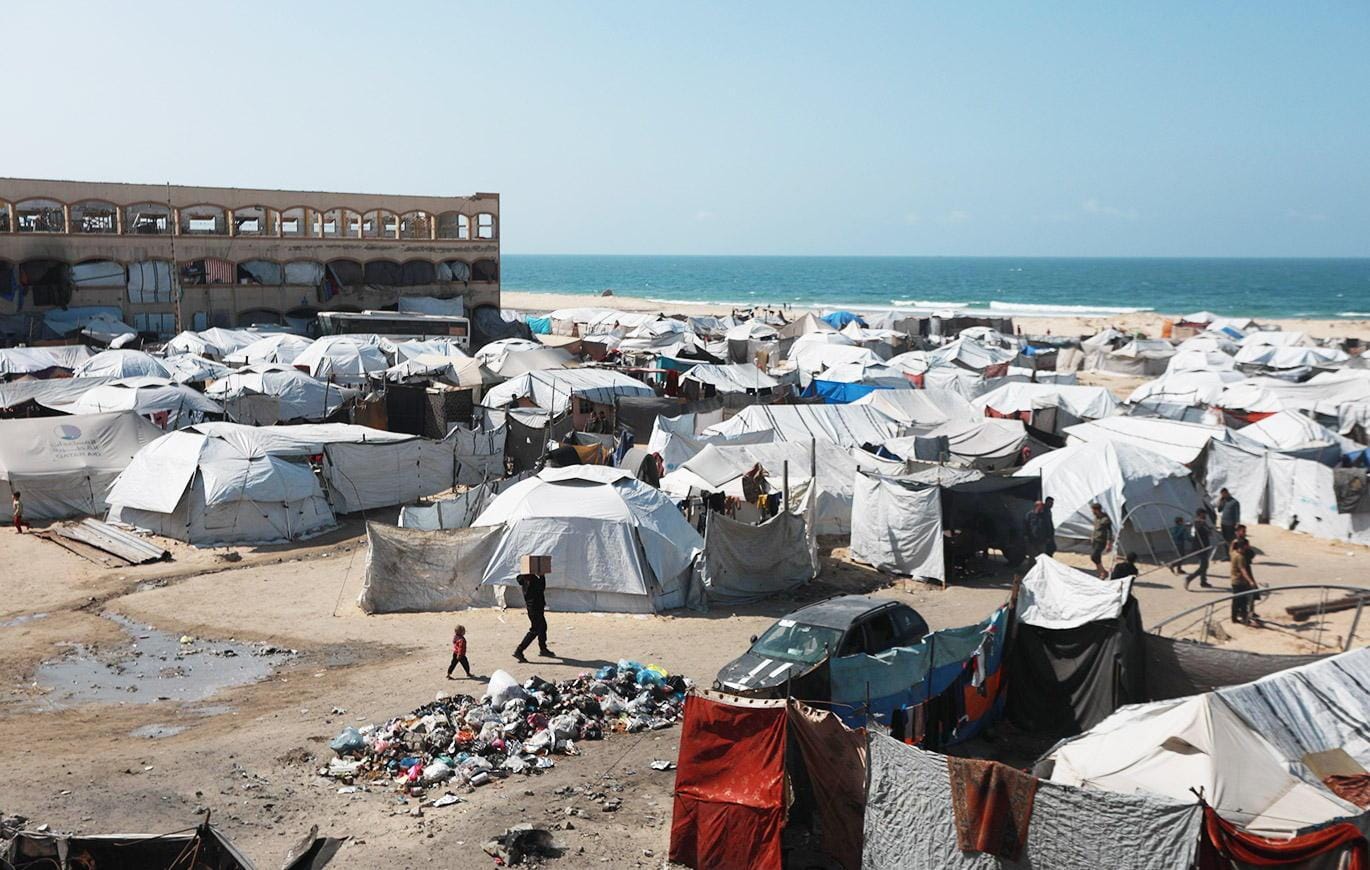
The simple explanation is that the “opposition” of the opposition bloc was to Netanyahu personally, and not directed against his policies. The opposition leaders included veterans of the IDF and security services, several of whom, such as Eisenkot and former Prime Minister Naftali Bennett, acknowledged during the campaign that they were running because Netanyahu had been unsuccessful in his wars and they would be more efficient in providing security for the Zionist state. They abide within the security framework which is the original sin underlying Israel’s security doctrine, “The Iron Wall” of Revisionist Zionist Ze’ev Jabotinsky (1880-1940), who argued that, as a colonial enterprise, the only assurance of acceptance of Zionist rule over the Palestinian majority was effective use of military force, an “iron wall” which would convince the Arab-Palestinian population that they must accept the subservience of second-class citizenship.[[1]] The short-hand for this in IDF/security circles today is that “if force has not been successful in crushing opposition to Zionism, apply more force.”
Victimization and the Siege Mentality
The Iron Wall security doctrine goes hand-in-hand with the ability to convince the majority of Israeli citizens that anti-Semitism remains a threat to Israel’s security, and the only defense against another Holocaust, which is lurking in the shadows, is an aggressive security policy of overwhelming force, to defend against Palestinians in Israel and the Occupied Territories, hostile Arab neighboring states, and the world-at-large. Military superiority is not enough, unless the leaders are prepared to use it, as in the “mowing the lawn” approach to the Palestinians, and the multiple wars, such as in Iraq, Syria, Lebanon, and now Iran, embraced by the Greater Israel Zionists.
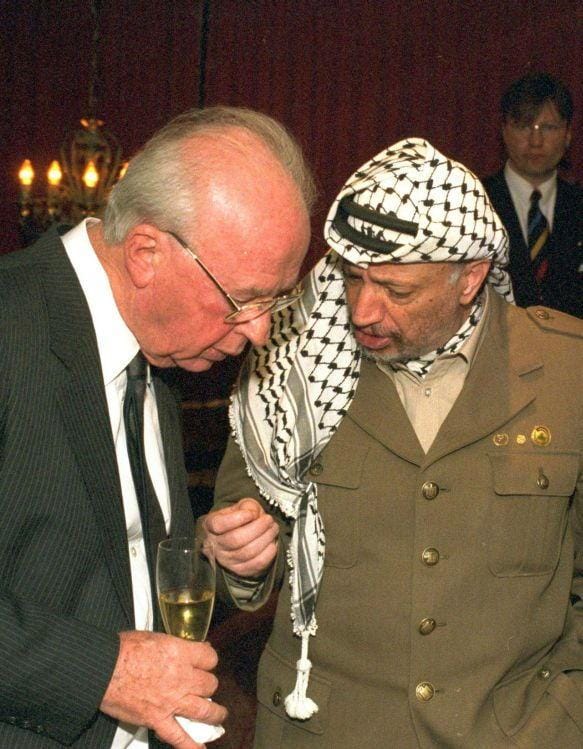
The most serious effort to overcome this mentality was made by Prime Minister Yitzhak Rabin in his second term as Prime Minister, with the Oslo peace process, from July 1992 until his assassination on November 4, 1995. Rabin, in an uneasy partnership with PLO Chairman Yasser Arafat, proposed “trading land for peace,” and made a commitment to mutual recognition and economic cooperation for the benefit of both sides. When challenged by Netanyahu and his proxies over a handshake with Arafat on the White House lawn during the ceremony celebrating the signing of the Oslo Accord, Rabin said “You don’t make peace with friends. You make it with very unsavory enemies.”
That the Oslo process was changing Israel was clear from the size and enthusiasm of the crowd addressed by Rabin in Tel Aviv on the night of his assassination. Despite his hesitancy to endorse a two-state solution, with full rights for the Palestinians, Rabin demonstrated his awareness of the necessity to break with the axioms of the past. He stated this explicitly in a toast at the White House, when he said he was tipping his glass to “those with the courage to change axioms.”
Despite a constant verbal assault from Netanyahu and his extremist allies against the Oslo Accord and himself personally, Rabin spoke of the importance of being open to what Arafat had called “the peace of the brave.” He waged an ongoing battle to change the axioms during the tense period of negotiations to realize the goals of Oslo. “I enter this course because I believe that the risks of peace are preferred to the grim certainties that await every nation in war,” he said. On another occasion, he stated, “Israel’s future does not lie in permanent occupation. Our future lies in peace, in partnership, and in the recognition that this land must be shared.”
In a message which could have been addressed to Eisenkot thirty years later, he said, “I want to tell the youth of Israel: Do not be afraid of peace. Do not be afraid of taking risks for peace, because peace is the only future worth fighting for.” As to how to do this, he offered this advice: “We must think differently, look at things in a different way. Peace requires a world of new concepts, new definitions.”
In response, Netanyahu accused Rabin’s government of being “removed from Jewish tradition … and Jewish values.” Rabin was murdered by a young man from the settlers movement, stoked by the violent hatred of Netanyahu for Oslo. The Oslo process was buried with Rabin, as his successors lacked his commitment to challenge the security state. In the absence of courageous leadership, and made fearful by the constant warnings of a new Holocaust waiting to happen, the general population may not like Netanyahu, but polling shows that they support the suppression of Palestinian rights, and most accept the mass killings of Palestinian civilians as necessary for their security.
The Israeli Arab Exception
Ironically, the record voter turnout of Arab citizens of Israel has not gone unnoticed by Jewish proponents of peace. More than 80% of the 1.1 million Arab citizens eligible to vote turned out, resulting in the election of 19 members of the Arab parties to the Knesset. Were the opposition bloc of Eisenkot willing to ally with the Arab party Members of the Knesset, they would surpass the 60 votes needed to form a government.
Senior commentator Gideon Levy of Haaretz highlighted this in his column on October 29, headlined “Israel’s Future Depends on Its Arab Citizens: It’s Bibi or Tibi,” referring to a leader of a party in the Arab opposition bloc, Ahmad Tibi. Levy wrote, “Eighty years after the Nakba and the establishment of the Jewish state, Israel’s Palestinians may determine its fate. Is there greater historical justice than that?”
This theme is taken up by prominent Israeli peace activists, such as Avraham “Avrum” Burg, the former Speaker of the Knesset. Burg urges Eisenkot to invite the Arab parties to join his bloc. The Arab parties’ showing, he writes, “is remarkable, and a fifth of Israel’s democratic public will be hard to ignore. Equal citizenship demands that Arab votes count like any others…. Eisenkot will have to decide whether he merely wants to replace the government, or also to change the rules of the game that made replacing it so hard.” A similar theme is presented by Gershon Baskin, an Israeli columnist, social and political activist, in a post in The Times of Israel he describes as a “fantasy,” titled “The Israel We Could Have,” if Eisenkot would welcome the Arab parties into his coalition.
So far, Eisenkot has ruled out a coalition with the Arab parties.
The leaders of the main Arab parties have expressed a willingness to join a coalition. The record turnout by Arab voters, which gave 730,000+ votes to the Arab parties, reflects an affirmation to overcome past blocks. Ahmad Tibi, a leader of the Ta’al party, said that the opposition bloc could form a government “if it wants to, if it is brave enough to.” We are ready, he added, “if there is a hand extended on the other side.” Tibi is a Member of the Knesset, is a physician, and served as an advisor to Yasser Arafat.
Yousef Jabareen of the Joint List had a similar response. Jabareen served in the Knesset from 2015 to 2021. “It’s either continued racism and continued exclusion and continued supremacy—or a true Jewish-Arab partnership.” Such comments show that the oft-stated excuse from Zionist figures who say that “the Arabs never miss an opportunity to miss an opportunity” no longer applies, and the kind of partnership envisioned by the authors of Oslo is now possible.
One possible indication of a potential fissure in the otherwise rigid exclusion of Arab parties is that on October 29, Yair Golan, leader of the Democrats and part of Eisenkot’s Change Bloc, met with Mansour Abbas of the Arab Ra’am (Joint List).
A Strategy for Peace
Prime Minister Rabin and his Foreign Minister Shimon Peres, who allied with his former rival Rabin to push through the Oslo Accords, both recognized that peace required more than a signature on a document. Peres, in particular, was part of a network which was familiar with the ideas of Lyndon LaRouche. From 1975 on, LaRouche advocated economic cooperation as the basis for a lasting peace in Southwest Asia. Following the opening for economic cooperation in the economic annexes of the Oslo Accords, LaRouche expounded on the Oasis Plan—a joint major water infrastructure project he first presented in 1975—in a speech delivered at the Institute of Oriental Studies in Moscow in April 1994.[[2]] LaRouche’s approach was consistent from 1975, when he first presented his proposal for replacing the International Monetary Fund with an International Development Bank, to generate funds for infrastructure development.
In support of this approach, to promote physical economic policies of mutual benefit as a basis of peaceful cooperation, LaRouche met with numerous representatives from Israel and Palestinian and Arab officials. That LaRouche’s initiative was under consideration was reflected in a statement from Rabin on the prospects for peace: “Practically the only way to dry the swamp of radical Islam is through economic development and an improved standard of living.” Rabin’s widow, Leah, confirmed to me that Rabin recognized the importance of LaRouche’s advocacy of economic cooperation in achieving peace, but lamented that Netanyahu’s opposition to Oslo, combined with the refusal of the London-centered banks to provide credit for development, made it impossible to proceed.
The potential exists today to overcome the obstacles to peace, with the emergence of a new strategic and development architecture in the Global South. A government in Israel of Israeli Arabs and Jews could provide a powerful force in that direction. What is necessary is the courage of leaders to burst through to change the axioms and obliterate the self-defeating narratives.
Notes
[[1]]: The background to the continuing failure of Israel’s defense doctrine to provide security is examined in the author’s report on Jabotinsky’s Iron Wall.
[[2]]: “The Oasis Plan: Development Is the Key to Peace in the Middle East.”