
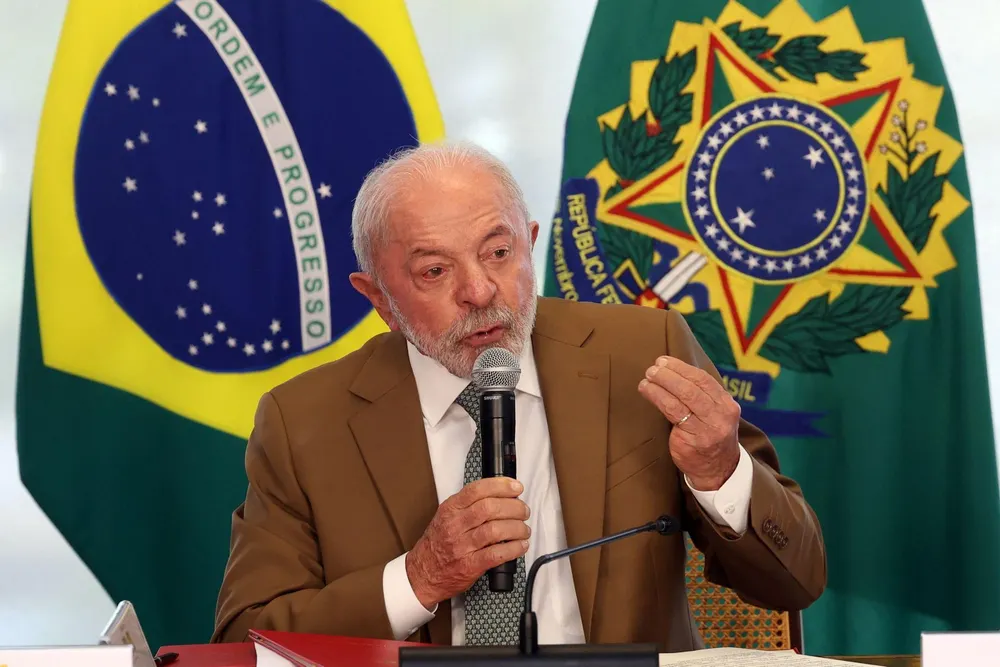
Nov. 13—Brazilian President Luiz Inácio Lula da Silva, who will begin his unprecedented fourth term in office on Jan. 5, 2027, faces economic and political challenges for that term that are even greater than the obstacles he overcame to stage a comeback victory in the second-round presidential election on Oct. 25, 2026. Lula is already being hit with financial warfare and demands from both outside and inside the country, insisting that he cut government spending and further privatize major state sector holdings, in order to generate “market confidence”—policies which he vehemently ran against and which the Brazilian population abhors. He is being threatened that, above all, he cannot lower Brazil’s outrageously high benchmark interest rate, the Selic, which today stands at 13.75%.
Such stratospheric interest rates make lending for development, and necessary spending on social projects, impossible. They will also make governing impossible—and the City of London and Wall Street know it.
There are, however, grounds for optimism in the outcome of this war, because Lula is a fighter; because he is committed to ending poverty, feeding the population, and educating the youth of Brazil; and because he is an ardent advocate for the same policies for the BRICS and the entire Global South, to put an end to 500 years of colonialism.
But lowering interest rates is not going to happen without a fight—a big fight. Here’s why.
The Government Budget
Many Brazilian politicians and analysts have rightly pointed to Brazil’s 13.5-14% benchmark interest rate, combined with the country’s large and growing public debt bubble, as the central obstacles to Brazil’s economic development. In fact, interest payments on the public debt siphoned off 16.9% of the total government budget of 5.98 trillion reals (about $1.01 trillion dollars) in 2025, and are projected to rise in 2026 by 200 billion reals and make up 19.3% of the total budget. At the same time, Brazil’s total public debt rose from 10.02 trillion reals in 2025 to 11.2 trillion reals in 2026—an 11% increase in just one year. With interest payments gobbling up almost a fifth of the budget (and rising), this has translated into cuts in crucial social payments, such as social security, which dropped by 11% from 2025 to 2026, and Lula’s signature Bolsa Familia program, which provides financial aid to poor families and whose share of the total budget has dropped.
The bottom line is that Brazil’s primary budget deficit (which excludes interest payments from the calculation) is close to zero, and the entirety of the growing nominal deficit is due to interest payments. This in turn requires the government to borrow more money to cover the deficit, which means even larger interest payments the next year.
Call it “bankers’ arithmetic”: the more you pay, the more you owe—which necessarily ends with a financial blowout. This is nothing other than a modern form of indentured servitude to the international creditor banks, which also makes it impossible to generate needed credit for productive activity, rather than speculation.
Table 1 provides the basic figures for 2025 and 2026.
Sources: Banco do Brasil, IMF.
There have been many well-meaning calls by Brazilian supporters of Lula to lower interest rates, either abruptly or gradually, but most of them fail to identify the underlying reason that interest rates are so high, and they therefore haven’t proposed a workable policy that can actually succeed in lowering interest rates and fostering the country’s productive economic development.
Why are Brazilian interest rates so spectacularly high, making its actual (inflation-adjusted) interest rate of 9.5% the highest in the world among major tracked economies? The reason has nothing to do with domestic policies, efforts to fight inflation, fiscal restraint, and other sophistry so common in university economics courses.
Meet the International Carry Trade
Brazil has been forced to adopt stratospheric interest rates to facilitate the ongoing looting of Brazil by the international carry trade, a form of derivatives speculation in which an “investor” borrows money at a low interest rate (e.g., in Japanese yen, Swiss francs, or the U.S. dollar) and then places those funds into a different asset (e.g., Brazilian government debt) or currency (e.g., reals) that offers a higher rate of return. In the case of Brazil, this operation “captures the massive spread between low global funding rates and Brazil’s double-digit benchmark interest rate,” as Forbes magazine bluntly described it in a June 2026 article.
For example, if the speculator borrows dollars (the institutional benchmark borrowing rate in U.S. dollars for carry trades is currently 3.88% annualized, according to the Federal Reserve), and then places those funds in Brazilian public debt paying 13.5%, the speculator makes a cool margin, or “carry,” of nearly 10% annualized rate—stolen out of the pocket of the Brazilian people. The entire operation depends on having an international floating rate system (which was established after August 1971) and unlimited free convertibility of the real with the dollar, euro, and other international currencies.
In 2026, the total interest payments on Brazil’s public debt will total about 1.2 trillion reals. Some have argued that this wealth doesn’t actually leave Brazil, because 90-95% of the public debt is held domestically, not by foreign debt holders. This argument is either foolish, or intentionally misleading. Over half of that domestically held debt is in the hands of the major Brazilian banks, investment funds, and other financial institutions which are themselves an integral part of the carry trade feeding chain.
The actual size of the international carry trade is not publicly documented. According to the Bank for International Settlements (BIS), it may total $1 trillion per year—or more—but exact numbers cannot be found, because “the carry trade depends on off-balance-sheet derivatives, hidden FX [foreign exchange—ed.] swaps, and unrecorded corporate flows,” according to Markets.com. Furthermore, the true size of the speculative profit is an order of magnitude greater still. According to the BIS, most institutional carry traders use public FX swaps and forwards, or margin accounts, in order to use a small amount of capital to leverage a much larger notional position—ten times as much is common in the carry trade. This means that under conditions of a crash or forced “unwinding” of the carry trade, reverse leverage will take hold and bring down the whole house of cards.
Who will be hit the hardest? Market estimates published by Central Bank Watch, Forbes, and others, list the five largest carry trade destinations: Brazil is second in the world, with about 20% of the global total. Only the United States itself has a larger share, as Table 2 indicates.
Note: JPY (Japanese Yen); CHF (Swiss Franc); EUR (Euro); USD (U.S. Dollar).
Sources: CentralBank.Watch; Forbes.
Who are the major players in this carry trade? In the case of Brazil, complex government regulations “keep the play restricted to heavy-duty institutional funds,” Forbes has reported. Those major players in Brazil are the same ones that dominate internationally: Goldman Sachs, JPMorgan Chase, Deutsche Bank, UBS, and other major international banks, according to the BIS. The intermediaries are global wealth asset managers such as VanEck (U.S.), Aberdeen (UK) and Vontobel (Switzerland). And the major institutional players inside Brazil, according to Forbes, are the privately owned Itaú Unibanco (Brazil’s largest bank by assets) and the state-owned Banco do Brasil (the second largest by assets).
A Policy Solution
How can Brazil lower domestic interest rates, when it is up against this powerful global financial apparatus? Some in Brazil have argued that the government can negotiate with “the markets” by agreeing to cut the government budget in exchange for a gradual lowering of interest rates. Others recognize that lower interest rates could lead to international financial warfare, in the form of capital flight through a “reverse carry trade,” but they argue that Brazil has $350 billion in foreign exchange reserves which can serve as a buffer to defend the currency, if needed.
These are illusory. Given the free convertibility of the currency and the total dependence of the Brazilian banking system on the City of London and Wall Street, $350 billion can—and will—be drained out of Brazil in 24-48 hours time. Furthermore, the trans-Atlantic financial system has no margin for negotiation, even if it were so inclined: it is drowning under $2.4 quadrillion in unpayable financial assets, and it is rapidly shifting into a global Schachtian system of dramatic military buildup for war, combined with accelerated looting of the nations of the Global South to try to keep the bubble aloft.
Based on that strategic reality, we present here a proposal for the required steps for Brazil to successfully sharply reduce its interest rates—and maintain sovereignty and development for the nation. We do so at this time for two reasons: first, so that Brazilian authorities will have fully studied and prepared to adopt the necessary measures, as quickly as the strategic correlation of forces permits; and second, as a warning to circles in the North, including Wall Street and the City of London, of what they are forcing Brazil and other nations to do, simply to survive. Perhaps a rethink is in order, before it is too late.
In that regard, we urge readers to refer back to the central argument presented by Lyndon LaRouche in his Oct. 4, 1998, “People First!” (see below).
Step 1: On a selected Friday night, after the financial markets have closed, say at 8 p.m., the Brazilian government should announce that, by executive decree and in fulfillment of the requirements of the 1988 Constitution—which calls in its Preamble for “liberty, security, well being, development, equality and justice” for all—full exchange controls and capital controls have been put in place as of that moment. A run on the Brazilian currency and financial system will no longer be possible.
Step 2: That Saturday morning, the executive should announce that henceforth the new benchmark interest rate in Brazil will be 2%, and that all domestic and foreign, private, and public lending institutions will be obligated to adjust their rates accordingly. Violations will lead to summary removal of a bank’s charter to do business in Brazil. Likewise, the outstanding public debt will be exchanged for new notes bearing a 2% interest rate—a unilateral sovereign debt reorganization which, after all, is far preferable for all parties concerned to the disorderly default that is otherwise sure to happen. That will save the government nearly 1.3 trillion reals per year—funds that can finally be applied to productive purposes.
Step 3: On Sunday, the government should officially launch Brazil’s active participation, along with Peru and China, in the construction of a bi-oceanic rail corridor to connect Brazil’s Atlantic ports (such as Ilhéus and Santos) with Peru’s Chancay Port on the Pacific. This great infrastructure project will open up the interior of South America to high-tech industrialization, including downstream feeder projects, which will constitute the locomotive for growth for the whole continent.
Step 4: On Monday, when the banks reopen, they will be instructed to lend to productive enterprises and activities triggered by the great infrastructure projects, and to crucial social welfare projects which complement Bolsa Familia. Banks that refuse to do so and insist on speculative ventures will be placed in receivership, because their actions are a threat to the constitutionally mandated well-being of the Brazilian population.
Step 5: There is a high probability that, by Tuesday, Wall Street and the City of London will attempt to retaliate with tariff warfare, economic sanctions, and even threats to expel Brazil from SWIFT and the Western financial system altogether—i.e., the system which has facilitated Brazil’s debt looting for decades, if not centuries. In response—and even earlier—the Brazilian government should activate discussions with other nations of the BRICS and the Global South in general that are facing similar financial warfare and blackmail, to adopt common measures leading to the creation of a new financial system that is free from the speculative cancer which has swallowed up the dollar system.
Step 6: That new system will require a new common currency, or a unit for investment and trade purposes, which uses exchange and capital controls to establish a firewall, entirely separating it from the bankrupt, speculative dollar system, while returning to a fixed-exchange-rate system among its participating national currencies, which will not be replaced, and the new investment unit. If the United States chooses to return to sanity and its own founding economic policies (those of Alexander Hamilton, John Quincy Adams, Abraham Lincoln, Franklin Roosevelt, and LaRouche), with measures such as a return to Glass-Steagall, then it will be welcomed into the fold as an ally in this new system.
To be able to actually implement this Step 6, the required features of such a new system are described in our earlier “LaRouche Essentials for the Transition to a New International Financial System”:
A) Total separation between the new common currency and participating national currencies, on the one side, and the predatory, toxic dollar on the other, i.e., no free convertibility between them. Exchange and capital controls become essential tools to achieve that result. For the United States, this means a return to Glass-Steagall, with its strict separation between productive credit and speculative activity.
B) A fixed exchange-rate relationship between and among those participating national currencies and the new common currency. Floating exchange rates have been a tool of financial speculation since August 1971, and they are anathema to long-term trade and investment cooperation among sovereign nations.
C) Productive credit must be issued in that new common currency to finance great development projects, with a heavy emphasis on science and advanced technologies, in and among participating nations, to quickly boost the physical economies and thereby provide the only possible solid backing for the value and stability of the new currency. Think Alexander Hamilton.
And think BRICS and China’s Belt and Road Initiative.
People First!
by Lyndon LaRouche, Jr.
Oct. 4, 1988
The following brief excerpt is taken from the opening of Lyndon LaRouche’s Oct. 4, 1988 essay, “People First!”
Very soon, the doomed, present international financial system will disintegrate. It can not be managed, or repaired; its doom is certain, and soon. We are already in the final phase of its destruction. This destruction will occur either in a rational way, through merciful, pre-emptive actions by individual governments, or in the most tragic way, spontaneously, and chaotically. Either way, the present financial system is doomed to disappear, very soon.
Under these circumstances, the continued existence of the U.S.A., as of other nations, depends absolutely upon the alacrity with which the government responds with certain required, immediate measures of emergency action.
If the measures specified here are taken, this nation will assuredly survive the crisis, and that most successfully. If the political will to adopt and implement such emergency measures, immediately, is lacking, the nation will be torn apart by the chaos caused by its stubborn refusal to change the present system. If the present posture of clinging to the self-doomed dogmas of “free trade” and “globalization” is not overturned, chaos is already inevitable; in that case, this nation will not survive in a recognizable form….
When that disintegration of the world’s present financial system occurs, the U.S. and other governments, if they are sane, will each consider themselves obliged to take certain, instant, autonomously sovereign, and drastic emergency actions. The immediate purpose of these actions, is to maintain the social stability and general welfare of the nation and its entire population. The rule governing these actions, is: “People first! All the people!”