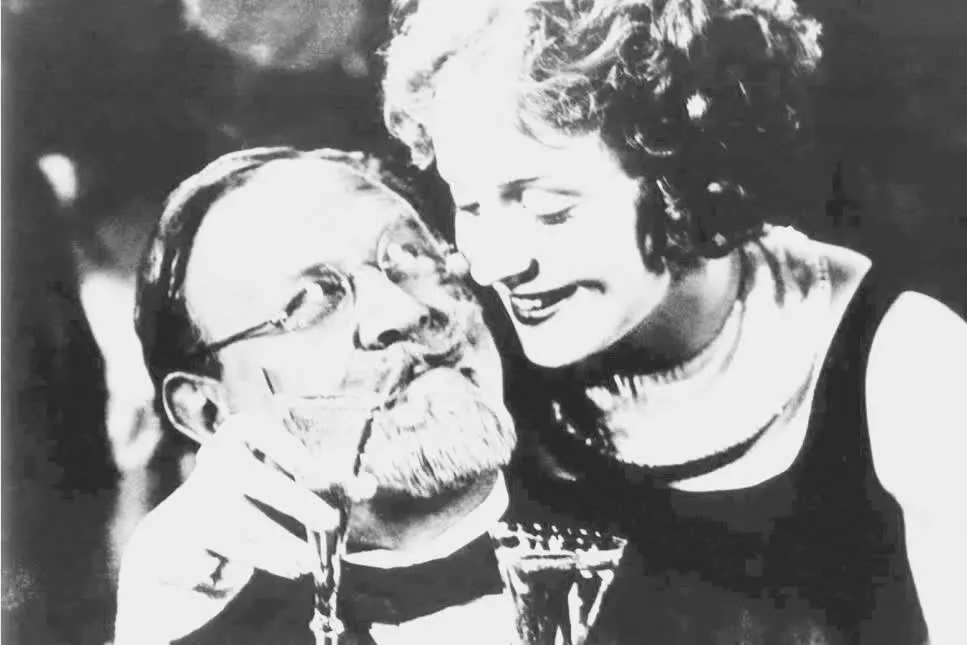
Feb. 20—In a recent colloquium of the Schiller Institute, it was suggested that the Der blaue Engel (The Blue Angel), a classic German film, may offer useful insights into understanding the public reaction to the global scandals around the recently released files on the late famed pedophile and spy, Jeffrey Epstein. These scandals have illuminated the extreme degeneracy of the ruling oligarchy in North America and Europe, and may provide the impetus to finally replace it with persons more favorably disposed toward a new global security and development architecture, of the sort advocated by Schiller Institute founder Helga Zepp-LaRouche.
Der blaue Engel was made in 1930 and directed by Josef von Sternberg. It starred Marlene Dietrich (whom it made famous), Emil Jannings, and Kurt Gerron. It depicts a stuffy and priggish university professor who enters a disreputable nightclub called The Blue Angel in order to discipline some students whom he suspects of patronizing it, but instead becomes infatuated with a cabaret singer named Lola Lola, who eventually seduces, degrades, and humiliates him.
Like Cabaret, a famous movie from the 1970s, Der blaue Engel highlights a libertine subculture within the Weimar Republic in Germany, an expression of the cultural pessimism which created a fertile environment for the rise of fascism, and should serve as a warning to the denizens of today’s Anglosphere. The plot of the film is based on episodes extracted from a 1905 novel by Heinrich Mann entitled Professor Unrat, which was regarded as a critique of Obrigkeitshörigkeit, a mindset or behavior characterized by blind obedience to authority. But libertinism is not the antidote to Obrigkeitshörigkeit, rather just its flip side.
The Film Music
The film was made simultaneously in German and English. (The English version was soon forgotten, due to the difficulties that the German actors had with English pronunciation.) It is regarded as the first German film with a soundtrack, and a milestone event for sound in movies worldwide, due in part to its sophisticated use of music.
The soundtrack opens with a sort of overture based on the aria “Ein Mädchen oder Weibchen,” [roughly, A Girl or Little Woman/Wife] sung in Mozart’s opera, The Magic Flute, by the character Papageno, who yearns to find a lover. The melody recurs throughout the film, played by a carillon clock in the town when it rings the time, including at the end of the film when it tolls the professor’s death.
In Mozart’s opera, Papageno is the likeable but immature Vogelfänger (bird-catcher), and at the beginning of Der blaue Engel the professor imitates birdsong as he tries to teach a melody to his pet songbird, only to discover that the bird is dead in its cage. As the story progresses and the professor declines psychologically, he twice imitates the sound of a chicken, once at the instigation of his bride during the reception following his wedding to Lola Lola, and later during his breakdown on stage at the Blue Angel when he discovers her infidelity. The dialogue among those who witness his breakdown includes the German idiom, Er hat einen Vogel (“he has a bird”), which means that one is a crazy person, a birdbrain.
The German public would know this melody in another context as well: It was expropriated from Mozart’s aria by an author in Prussia who wrote a new text titled “Üb’ immer Treu und Redlichkeit” (“Always practice loyalty and honesty”), and it was sung in classrooms in public schools, as a stern lecture on the importance of moral propriety. It contrasts with the earthier text sung by Papageno in the opera (“If no one grants me love, Then the flame must consume me! But if a woman’s mouth kisses me, I am already healthy again”). The tension between two settings of this melody corresponds to the conflict experienced by the professor, between his straight-laced, puritanical morality and his helplessly lustful obsession with the chanteuse.
The Professor’s Decline and Fall
Professor Rath, mocked by his students as “Unrath” (“garbage”), has a Kantian problem: His sense of morality is limited to simply “don’t do bad things.” The German philosopher Immanuel Kant perceived a conflict in the human condition between Pflict (“duty”) and Neigung (“inclination”), which meant that morality requires a constant struggle to rein in one’s natural inclination to be bad. Friedrich Schiller, the namesake of the Schiller Institute, corrected Kant’s error by proposing that a person’s emotions can be educated toward becoming a “beautiful soul,” a mature individual in whom duty and inclination perfectly coincide, and there is no longer any inclination to be bad.
Professor Rath, who is not a beautiful soul, has no positive, joyful sense of morality. Unable to inspire his pupils, he attempts to maintain order in his classroom by bullying them. He is defenseless against the somewhat sleazy allure of Lola Lola, because he has no sense of what love really is, and his baser instincts deceive him into thinking he loves her. He imagines that he can change her, help her to leave behind her tawdry profession, but she has no intention of doing so, and is in fact far more secure in her identity than he is in his. Soon he is reduced to going from table to table in nightclubs, selling naughty postcards with photos of his wife. She is a stranger to monogamy, and when the inevitable infidelity occurs, the professor melts down and self-destructs.
Enter Epstein
The recent revelations in the declassified Epstein Files have ripped the mask of propriety from the ruling elites of the Anglosphere, showing them to be consumed by perverse appetites that make the denizens of the Blue Angel look saintly by comparison. How, then, will the ordinary citizen respond? Without a connection to a better, more beautiful culture, one that can produce Schiller’s “beautiful souls,” there is a grave danger that the salacious nature of these revelations will seize upon the vulnerable sensibilities of the citizenry, many of whom are already addicted to “scandal porn.” People who are morally underdeveloped are like children, who may respond to a Kantian “no” by simply becoming more slyly determined to do whatever is being forbidden. We are now discovering that some of those who have been most sanctimonious about shouting “no” in public were whispering “yes” behind closed doors.
It is for this reason that Schiller Institute founder Helga Zepp-LaRouche has insisted for decades that a new renaissance of Classical culture is necessary, based on a dialogue of civilizations in which each nation looks to the revival of its best artistic and cultural traditions, and offers them to the rest of world in the pursuit of common ground. Schiller wrote in his poem, “The Artists”: Only through beauty’s morning-gate dost thou penetrate the land of Knowledge.
It is through beauty, Schiller argued, that the emotions are educated, bringing people to real maturity and enabling them to react to something like the Epstein scandals, not with morbid fascination, but with a fresh impetus to create a society whose citizens are not slaves to their baser instincts, but free to trust that their inclinations will not contradict their duty to humanity. This provides a unique way out of the bipolar trap of libertinism/Obrigkeitshörigkeit.
On March 2, the Schiller Institute will host an online conference which will address the nature of the new renaissance which is so urgently needed, and discuss the best ways to bring it into existence.