On two parallel tracks, momentum builds for reason and peace, even as the carnage and danger continue in Southwest Asia, and on other fronts of needless conflict. There are the beginnings of a wave of action by “world citizens”—activists in their respective nations, crucially in the United States, to rein in the madness in Washington. At the same time there are notable moves on the diplomacy track, including by heads of state.
Congress resumed in the United States on April 14, after a momentous Easter/Passover recess, during which time the White House madness reached new extremes. During the two-week period of Holy Week and Easter, President Donald Trump issued multiple threats, not only to destroy all infrastructure in Iran, but also to obliterate its entire culture. He castigated Pope Leo XIV and others for opposing him, including members of his own political party. Moreover, he claimed divine approval, and cultlike, members of his government followed suit. All the while, he exults in plans for glory-projects—from a new Trump triumphal arch in Washington, to a glitzy White House ballroom.
Now is the time to stop the madness. What is the next move? As a statement April 13 from Diane Sare, independent candidate for U.S. President stated, “Stop the Iran War Now! Yes, the President is nuts, but Congress has the power of the purse—don’t let them change the subject.”
Today there is skirmishing in both the Senate and House of Representatives on what to do. There is no apparent move to “un-fund” the warfare, which was what was done against the Vietnam War in 1973, leading to ending the warfare. The talk today is that resolutions against the Iran war will be brought for a vote by the end of the week under the War Powers Act. Such votes have failed three times in the Senate so far, and in the House were scuttled by groups including by leading Democrats. But we are sailing on new seas.
Calls and messages directly to the offices of Congress can force the issue of stopping the war, and for making peace. Note that on April 13, an open letter to Congressional leadership was released by top medical experts, with 200 signers, demanding action to rein in Trump on grounds that his mental health deterioration is an immediate threat to U.S. and world security. Today, a bill was filed in the House of Representatives to establish a non-partisan commission to review Trump’s fitness for office, given his erratic behavior, according to Section 4 of the 25th Amendment of the Constitution, which sets out how to deal with a President’s potential incapacity to function in office.
On the diplomatic track, there are currently significant moves coming out of Beijing and Moscow. Russian Foreign Minister Sergey Lavrov is in Beijing for two days, working with Chinese Foreign Minister Wang Yi. They have discussed President Xi Jinping’s proposal for a Global Security Initiative, and President Vladimir Putin’s call for a Greater Eurasian Partnership.
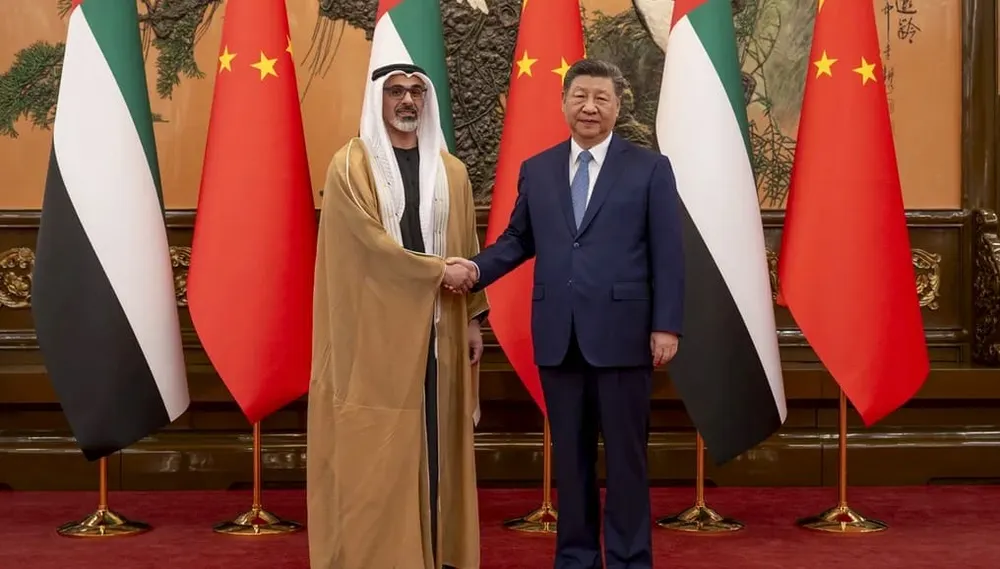
Today President Xi hosted Crown Prince Khaled bin Mohamed Al Nahyan of Abu Dhabi, the capital of the seven emirates of the United Arab Emirates, conferring on strategic and economic matters. Xi issued a four-point approach to resolve the immediate crisis with the United States-Israel and Iran. The points are: 1) adherence to the principle of peaceful coexistence; 2) respect for national sovereignty; 3) adherence to the principle of international rule of law; and, 4) coordinating development and security.
President Xi also hosted Prime Minister of Spain Pedro Sánchez, likewise discussing economic and strategic matters. Xi made a point of calling for collaboration to prevent the “regression into the law of the jungle.”
In addition, in Beijing, a top diplomatic advisor to Brazil’s President Lula da Silva, Ibrahim Abdul Hak Neto, met with China’s special envoy for the Middle East Zhai Jun. They agreed to pursue diplomatic means, not military, to solve the regional security crisis in the Iran situation.
In Moscow, President Vladimir Putin is hosting Indonesian President Prabowo Subianto this week. Energy and other shortages are worsening in Indonesia—home to 287 million people. Of the 25% of world oil and gas coming from the Persian Gulf, 80% of it goes to East Asia. Jakarta has resorted to contingency measures ranging from work-from-home, to increasing use of bio-fuels. Putin and Subianto not only made emergency plans for energy, but also for fertilizer and other supplies, and for a floating nuclear power plant program, and space collaboration.
This approach is completely in line with the spirit of action to do what is right, as exemplified by Pope Leo XIV, who is now on a four-nation tour in Africa, and who spoke out on April 13 about having no fear of the Trump Administration. On Sunday, April 12, President Trump denounced the Pope in many ways, including being “WEAK on Crime, and terrible for Foreign Policy,” because, in part, the Pope on Saturday said at a peace vigil in Vatican City, that there must be an end to war, and also suggested that a “delusion of omnipotence” is driving the U.S.-Israeli war-making.
In response to Trump’s attack, Pope Leo XIV said on April 13, en route to Algeria: “I have no fear of the Trump Administration, nor speaking out loudly about the message of the Gospel. That’s what I believe in. I am called to do what the church is called to do.”
Now is the time for action for reason and peace. Calls and directives to the U.S. Congress and other access points to end the madness can succeed. We can’t miss this world-changing opportunity. Confer with others at the next International Peace Coalition, April 17.


