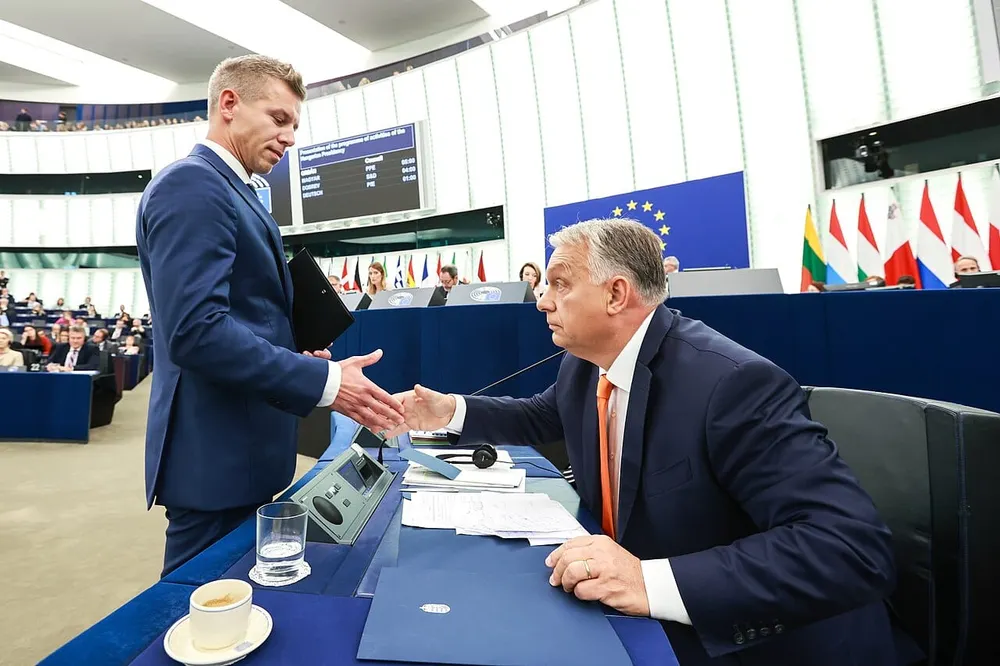
Opposition leader Peter Magyar won the April 12 national elections in Hungary with an unexpectedly large margin over Prime Minister Viktor Orbán. Magyar now has two-thirds of Parliament (138 out of 199 seats) and could change the Constitution. EU Commission President Ursula von der Leyen did not hide her satisfaction with the election of a pro-EU candidate. “Today, Europe is Hungarian,” she tweeted. “To the people of Hungary ... You have chosen Europe.”
It is now expected that Hungary’s veto on major issues, such as Ukraine’s membership in the EU and the €90 billion fund for Kiev, will fall. According to independent conservative journalist Jan Mainka, “Hungary’s veto is, of course, now moot. But it won’t be lifted automatically; it will likely be part of a larger deal.” While many attribute Peter Magyar’s victory to a massive deployment of Soros’s forces, Mainka told EIR that Orbán’s closeness to both Trump and Netanyahu gave him the kiss of death. Orbán “relied too heavily on foreign policy to score points. And the few foreign policy initiatives he had planned actually backfired.”
Andrea Szego, sociology professor at the Budapest College of Management, had pointed to the bad economic and social situation in Hungary in an interview with EIR before the vote. She was nevertheless surprised by the large margin of victory for Magyar. While not ruling out a “Trump-Netanyahu” negative factor for Orbán, she emphasized that “it was a coordinated action of all organs of the Soros apparatus on a high level.” “Facebook, TikTok, by their algorithm, transferring preferably Magyar’s messages to the younger generation also played a big role,” she told EIR.
Certainly, “What Trump and Netanyahu make is putting the world into fire. Trump is not popular in Hungary,” Szego said. “The rebellious-jacobin mood of the people, especially among young people, was so much intensified that the appearance of a Trump delegate besides Orbán was counterproductive.” Vice President JD Vance had appeared in Hungary recently to campaign for Orbán. “The Hungarian election was one of the scenes of geopolitics determining future lines of events,” was her conclusion.