The following is an edited transcript of the April 1, 2026, weekly Schiller Institute dialogue with Schiller Institute founder and leader Helga Zepp-LaRouche. Subheads have been added. The video is available here.
Harley Schlanger: Hello, and welcome to our weekly dialogue with Helga Zepp-LaRouche. She’s the founder of the Schiller Institute and the convener of the International Peace Coalition. Today is April 1, 2006. I’m Harley Schlanger and I’ll be your host. Helga, as I was preparing earlier today for our discussion, I was notified that there are some sources, including [former CIA analyst] Larry Johnson, who are saying that President Donald Trump may announce tonight the departure of U.S. forces from the fighting in Iran. And Larry [Johnson] was suggesting that Trump may say that it’s been highly successful and ahead of schedule and therefore we can pull out. Have you heard about this, and what would it mean if Trump made such an announcement?
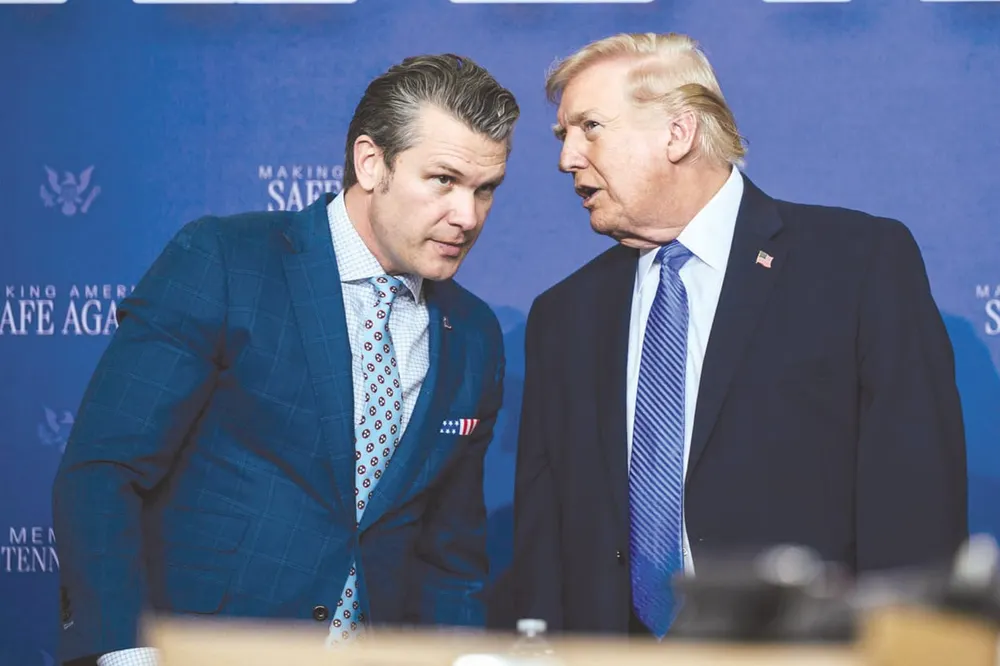
Helga Zepp-LaRouche: Actually, I watched part of the live press conference President Trump just gave, and he indeed hinted in this direction, as in an earlier report, saying that even if the Strait of Hormuz remains closed, he will possibly pull out. Now, obviously, given the fact that he has said these things several times before, and then used it as a deception to attack, I would not take that word as the Bible right now. Even [reference to] the Bible these days is a questionable proposition. But I think that he is in a real bind, because almost five weeks into the war, all his objectives have not been met. There was no regime change, despite the fact that he is claiming that there was regime change, simply because some of the old leadership has been killed. But the new leadership is very much part of the same government structure and the same government form. So, it’s clearly not the case; there was no regime change. As a matter of fact, the only thing he has accomplished is that some of the older, maybe more moderate leaders have been removed, and now there are younger people in place who are much less willing to accept these policies coming from the West, and the United States in particular.
Also, the defense of Iran is not defeated. The nuclear [weapons] program probably will now go forward, and as a matter of fact, there are some people who say that Iran either already has nuclear weapons or is within days of having them. So, that objective clearly backfired; it accomplished the opposite of what [the goal] was said to have been. And naturally, the ballistic missiles are also still there, and we are looking at a possible resolution of the situation which would go more in the direction of the demands by Iran.
I believe that Trump may think he can maintain that posture, but it will not be believed by the Global Majority, it will not be believed by the American population, as you can see by the opposition growing inside the United States. So, I think it’s a pretty desperate attempt by Trump to somehow control the narrative when all the realities on the ground are speaking in a completely different direction.
Schlanger: Here are two questions from our viewers: One, “What would you propose as an exit strategy to make sure the war is not escalated or prolonged?” And secondly, “What is the chance that President Trump, who seems to be under the control of the unipolar warhawks, would accept the proposal that you would make?”
Sitting Atop a Volcano
Zepp-LaRouche: We are in an unbelievable world shift. And it goes much beyond just the situation on the ground in Southwest Asia, because the effect of this is, on top of the many strategic changes going on before this—the emergence of the BRICS, the Ukraine war, the condition of the EU—already before this recent development in Southwest Asia, the world was in an epochal change. That epochal change is now here, and I don’t think it will be possible to patch things together in any shape or form as it was before. The situation is dangerous, incredibly dangerous. There is still the potential that the war could escalate in the Middle East, because it may not be that even if Trump wants to withdraw—which is not certain—but even if the United States withdraws, it is not clear if the Israeli government will accept that. I mean, they have been the ones who wanted to escalate the whole time.
So, we are still sitting on the top of a volcano which could erupt into a global nuclear war. But also, the fact that Trump attacked the allies the way he did, that he basically said the United States may withdraw from NATO—which I don’t think would be the worst thing in the world; as a matter of fact, NATO should have been dissolved in 1991 when the Warsaw Pact was dissolved. But I think it opens the possibility for a completely new design. And what we are proposing in this situation is a very, very forward-looking vision of a complete reordering, especially Southwest Asia, but also beyond….
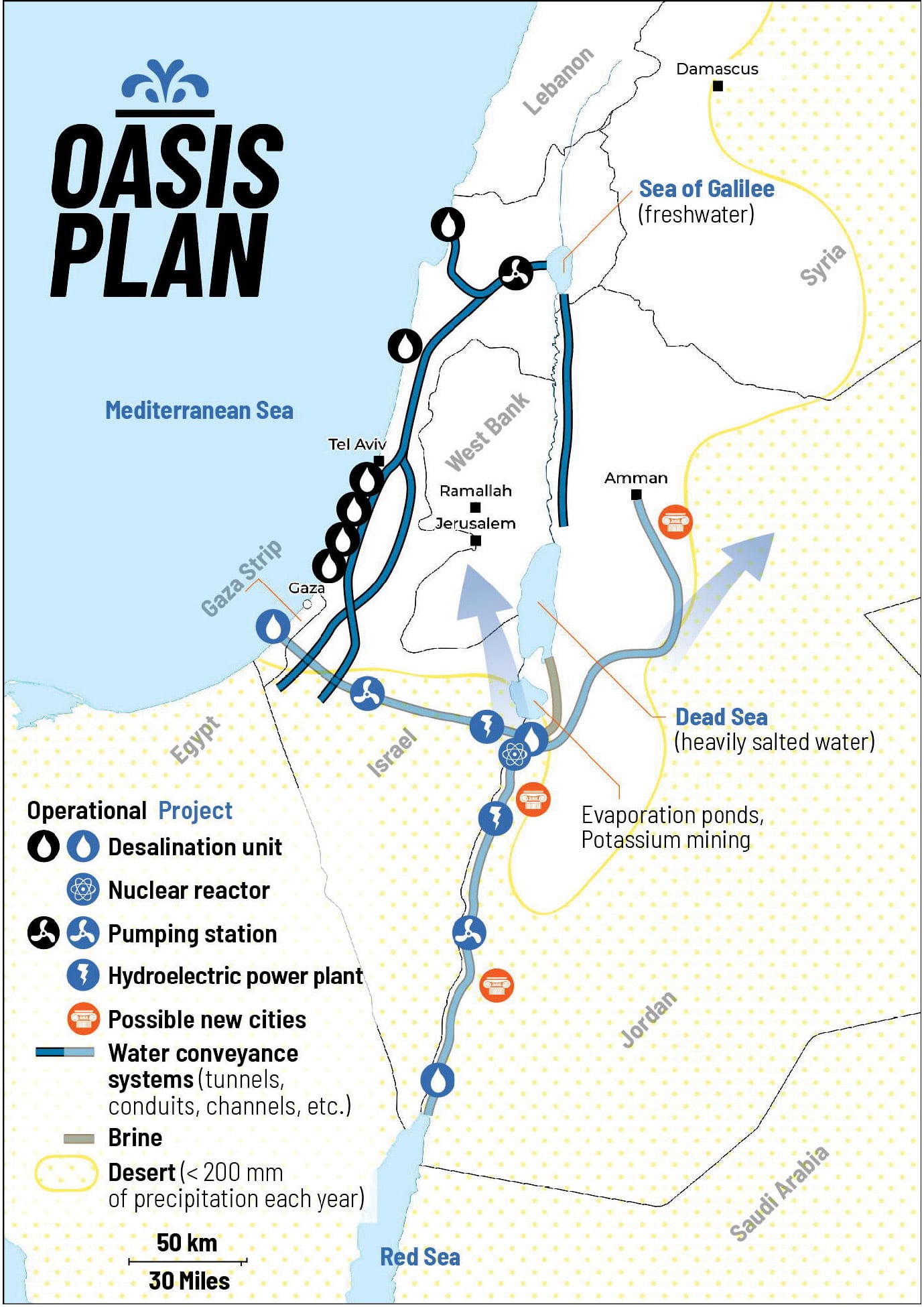
What we want to put on the agenda as an alternative to the present chaotic development is the idea of what I would call the Extended Oasis Plan for Southwest Asia. If you take the entire region, from India to the Mediterranean, and from the Caucasus in the north to the Gulf in the south, if you look at that territory—and please take out a map and look at it—it includes countries like Afghanistan, Iraq, Syria, Yemen, Lebanon, naturally Israel, Palestine, and it reaches into Türkiye and into Africa up to Egypt. We propose to take that entire region and develop water as a resource, because almost all of this territory is desert. Now, China has proven that it can transform deserts, with modern technologies, into forests, into farmland, into orchards.
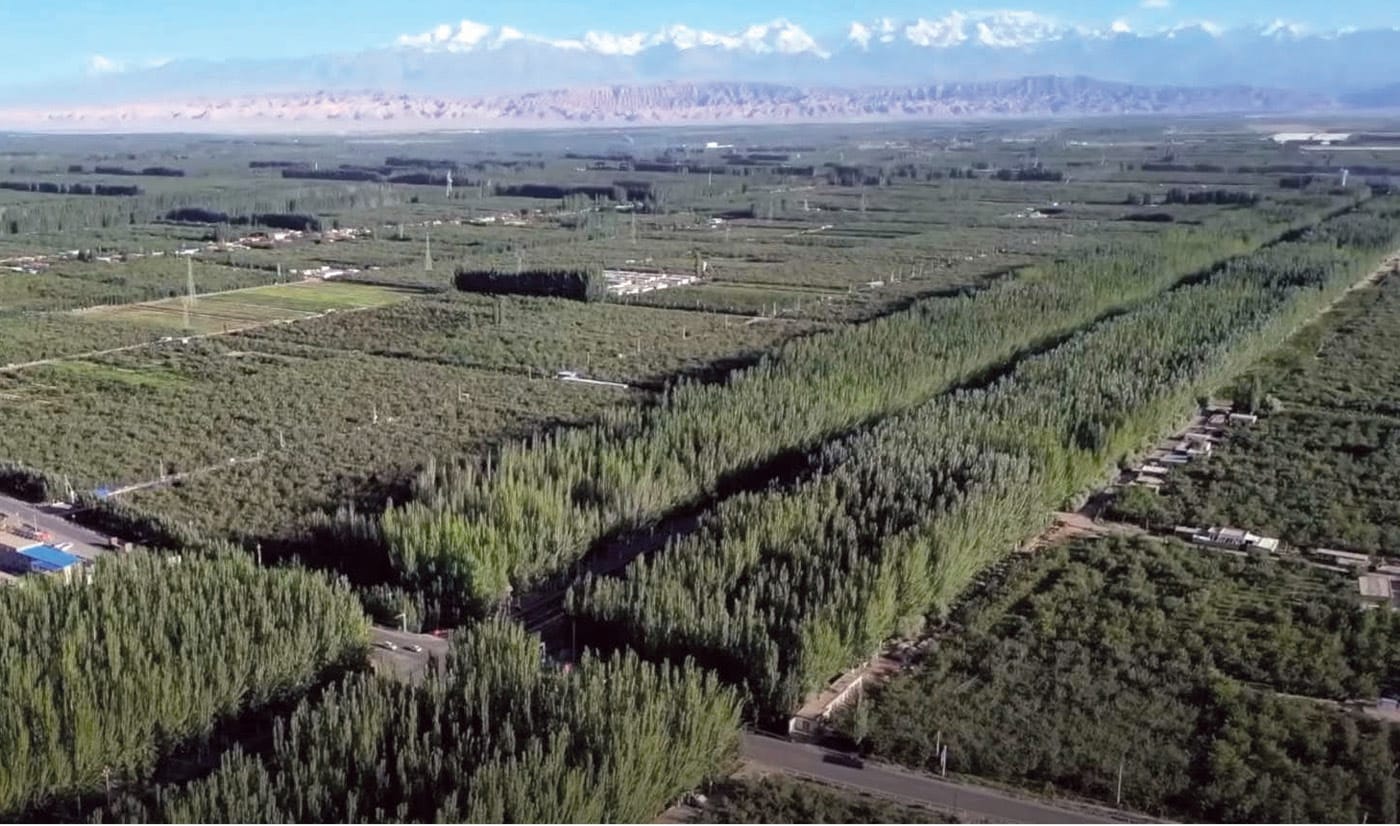
China has done that in Xinjiang, and also in the Northeast, where territories of large size, almost like Germany, have been transformed from totally dry desert dirt into flourishing forests and orchards and tourist areas, and people are now relatively wealthy, where they were poor before. You could do that by building canals from the Mediterranean to the Dead Sea, then desalinate large amounts of ocean water to develop systems of irrigation. You could also use other technologies. There are now underground lakes being found due to new technologies. How to find such reservoirs, underground reservoirs, the technology for this has improved a lot—and you can access these aquifers. There is also ionization of the atmosphere [to induce cloud formation and rainfall].
If you do that, you can actually transform this entire region and connect together corridors which already exist as part of the Belt and Road Initiative, like the CPEC corridor, the [International] North-South Transport Corridor from St. Petersburg, which eventually will go all the way to India. You can develop similar corridors, branching out all the way to Egypt, to Türkiye, connecting Asia with Africa and Europe, and basically take the same approach that existed 2,000 years ago with the ancient Silk Road. It was a hub of production, trade, exchange of goods, of technologies, not only silk and paper but [of knowledge on] how to produce these things.
I think that if such a vision is put on the table, you could replace the present dynamic of destruction, where the destruction of desalination plants has become part of this war. Instead, you could do the opposite. You could build more of these plants in order to conquer the desert and make life beautiful for future generations….
Now, if President Trump wants to be a successful peace President, then he should be part of it. I mean, it’s one thing to basically do what he’s doing right now, but I don’t think that that will really work, and will probably fail even before the midterm elections. But if he would decide to basically welcome such a perspective, I think his chances would increase rapidly.
A Restructuring of the Global Order
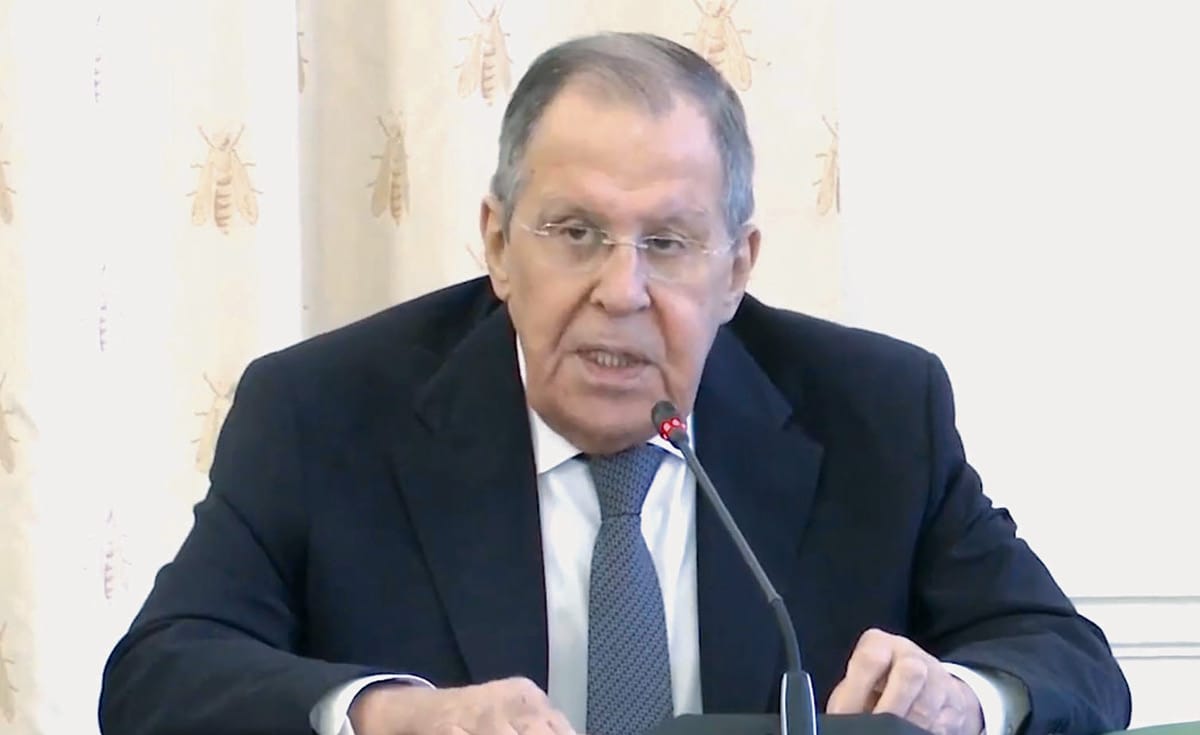
Schlanger: Now, there’s one leader who seems to be keyed in on this kind of process. [Russian Foreign Minister] Sergey Lavrov issued a statement at the Russian International Affairs Council yesterday, and I’d like to hear your comments on it. He said, “We are in the midst of a restructuring of the global order, which we hope will lead to the establishment of a sustainable and just multipolar world. But for now, this transformation looks more like a breakdown in every sense of the word.” What’s your response to what Minister Lavrov said?
Zepp-LaRouche: That is obviously a very accurate description, because NATO is de facto non-existent. If the United States pulls out of it, or at least puts it into question the way Trump has been doing, it de facto is dead. Likewise, the European Union is completely divided. You had, fortunately, the Prime Minister of Spain, Pedro Sánchez, basically completely condemning this war and denying American warplanes access to Spanish airspace and also use of its air bases. In the meantime, France and Italy have done likewise. Germany, unfortunately, has not done that. Ramstein Air Base is being used as the key nodal point for any orders given from the United States affecting the Middle East. Nevertheless, even Chancellor [Friedrich] Merz has said that this is “not our war,” which has obviously angered President Trump quite a bit. But the unity of the European Union is definitely gone. I think that the rift between the so-called collective West—which is not collective anymore at all, as I just said—with the Global Majority is huge, because diplomacy is dead.
President Trump has declared international law to be non-existent or, for him, not relevant anymore. Naturally, if the President of the United States says that, then that unfortunately has an effect, that it [international law] is dead. [U.S.] diplomacy is totally discredited, because twice, [U.S. Special Envoy Steve] Witkoff and [Trump’s son-in-law Jared] Kushner pretended to negotiate, and the time during negotiations was used by the United States to prepare an attack. So international law is out, diplomacy is out, negotiations are not credible anymore. All the foundations of what you would call the post-war, post–Second World War order, or the post–Cold War order, clearly are in shambles. I can only agree with Lavrov that that is the case, and what the new order looks like is clearly not yet defined.
However, our conception is to have not only what I outlined for Southwest Asia, but also what we have called for over the past four years, a new [global] security and development architecture. Since the special military operation in Ukraine started, I have called for a new security and development architecture which must take into account the interests of every single country on the planet, or else it will not function. And that idea is gaining ground, because people realize that when you have a disintegration of the old system, you definitely have to have a new approach. And I think what we have proposed is, from all private institutions, the most advanced conception on the table. The only government which has done something similar is China, because President Xi Jinping has proposed four global initiatives, where the Global Governance Initiative is, I would say, the closest to what we are talking about in terms of a new security and development architecture, which indeed must be universally applied for every country. So, I think that that is the only way out, and the more quickly these kinds of things are being seriously discussed, the better for world peace.
The Failing United States
Schlanger: Well, it’s clear from a series of reports that have come out in the last few days that this is an urgent issue, the question of the fragility of the world economy. The U.S. Bureau of Labor Statistics, for example, in their latest report, showed that job hiring in the United States is at the lowest level since April 2020. And the promise that the tariffs would end the [U.S.] trade deficit turns out not to be true. The trade deficit has increased almost every single month since the tariffs were introduced.
So, given the potential, if the war is ended, to move in a positive direction, do you have any indication, is there anyone in Washington who’s aware of this and offering an alternative program? And, whether or not the proposals that you’ve made for a new development architecture are being taken up in the U.S. Congress?

Zepp-LaRouche: No, not that I’m aware of. There is, however, a growing opposition developing. The most important is the independent presidential campaign of Diane Sare. She is a LaRouche independent candidate; she speaks for the policies developed by Lyndon LaRouche. And around her is developing a whole group of independent candidates, and they will have a major event on April 15, so you should look out for that.
Very important also was a press conference given at the National Press Club by a group of resistance people from the VIPS (the Veteran Intelligence Professionals for Sanity), such as [former Senior CIA Analyst] Ray McGovern, various other people like those from the Eisenhower Media Network, such as [U.S. Air Force Command Chief Master Sergeant (ret.)] Dennis Fritz and [U.S. Army Lt. Col. (ret.)] Anthony Aguilar, and others as well. They had a press conference which was five-and-a-half hours. It’s quite worthwhile to look into that. And naturally we have representatives from The LaRouche Organization and EIR that have been discussing this with different offices in the Congress—so there is a lot of ferment.
And actually, the recent “No Kings” demonstrations were also where you had a mixture of people. You had Democrats, you had disappointed MAGA people—so there is a clear recognition that Trump is not sticking to his promises; he’s doing, as a matter of fact, the opposite; he’s doing almost everything that the people he pretended to go against were fighting for. So, a lot of people are completely disappointed in Trump.
This is a moment where the country is in total turmoil, the whole world is in total turmoil; but it is these moments in history where ideas are more important than established mechanisms and supposed money. Because money is a very fragile thing these days: The oil price goes to $200 per barrel, then money changes its value very rapidly. In any case, in periods like this, when you have an order breaking down, ideas are the most important currency. So, that is why what we are proposing right now, while many people may think this is a completely utopian idea, that it will never work, I’m actually quite confident that what we are proposing is so much in cohesion with the will of the majority of the world population that I think it has a chance to become reality.
Schlanger: You mentioned Europe and the confusion and destabilization there. The European Commission reacted to the problems from the oil price and so on by calling for a cutback in the use of oil and gas as part of an overall austerity policy. When do you think the Europeans are going to realize the foolish pathway they’re on, including relations with Russia, relations with the Global South? And isn’t it possible that Europe could reverse that and look to Africa, for example, and your idea of the Oasis Plan as a way out of this?
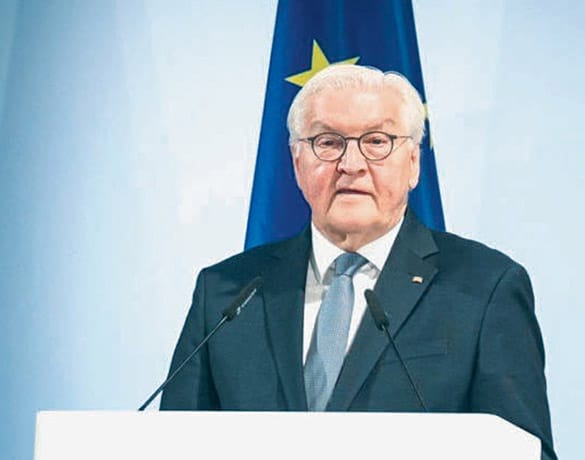
Zepp-LaRouche: The President of Germany, [Frank-Walter] Steinmeier, made a speech on the 75th anniversary of the existence of the Foreign Ministry, where he denounced the war against Iran as a violation of international law and completely illegitimate. That’s a good thing, because whenever somebody finally says something reasonable, I support it. Unfortunately, Steinmeier in the same speech also said that security in Europe will only be possible by opposing Russia. That is a foolish idea, and the governments right now, who are still sort of halfway in this Coalition of the Willing—that is the British, German, and French governments—their support is really very low. I mean, it’s in the mid-20s percent in some cases, or in the low teens or the mid-teens. That means that the majority of the populations do not support these governments. And I think we could see a dramatic change.
In France, for example, you have a lot of sovereignist organizations forming a unity, and they are not right on every point, but at least they are not on this war policy against the BRICS. Then, in Germany, the majority of the people are not satisfied with the government. We had two elections where the Social Democrats almost got smashed completely. The Social Democracy is about to vanish. It’s a shame, because they had a function in German politics. But they have three more state elections this year, and if they keep doing what their present leadership is doing, it could very well be that they don’t make the 5% [the level of popular support in the election required for a party to be in the parliament—ed]. They barely made it in the Baden-Württemberg election, and they lost badly in Rheinland Palatinate. They could lose significantly in the upcoming elections in the East. That would mean the coalition of Merz could also break apart this year, and then the AfD [Alternative for Germany] would probably gain. And while I’m not supporting everything they are doing, at least in some respects they are not as hawkish as the present Merz government.
Things could move dramatically in this direction, and we are planning to put the alternative on the table in a very powerful way, that is, the European participation in the Extended Oasis Plan for the Middle East, and joint ventures between the BRICS countries—especially China—and European nations in the development of Africa; and, as I said, the participation in the build up of the Middle East.
So, there is a way out, and if you agree that right now, we need a complete change in policy, then contact us and work with us, because we need your support, and you cannot sit on the fence in a moment of history like the present one.