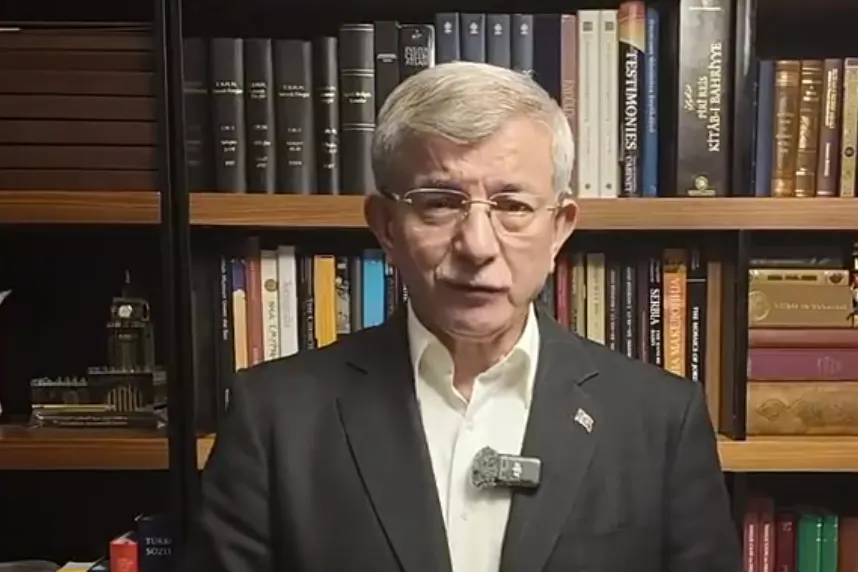
Ahmet Davutoğlu, former Prime Minister (2014-2016) and Foreign Minister (2009-2014) of Türkiye, argued in an April 17 Project Syndicate commentary (republished in Arab News on April 22) that bilateral U.S.-Iran bargaining cannot resolve the regional crisis, and that only “a comprehensive regional framework” can produce sustainable peace. Davutoğlu put forward this proposal when he spoke at the May 15 EIR Emergency Roundtable on “The Iran War and the ‘Controlled Disintegration’ of the World Economy.”
Davutoğlu identifies four converging fault lines that bilateral negotiations cannot address in isolation: the Strait of Hormuz, Iran’s nuclear program, the absence of a regional security architecture covering missiles and proxy warfare, and the unresolved Israeli-Palestinian conflict. “Progress on any one front is unlikely without parallel movement on the others,” he writes.
His proposals:
• On Hormuz: A coalition of trusted intermediaries such as Türkiye, Pakistan, Malaysia, and Indonesia to administer the strait under a UN Security Council mandate, with the U.S. committing to end military operations against Iran and Iran guaranteeing maritime security.
• On nuclear arrangements: A reciprocal model based on the 2010 Tehran Agreement (which Davutoğlu helped mediate, along with Brazil and the IAEA): Iran would deposit enriched uranium in Türkiye in exchange for fuel for civilian use, reaffirm its commitment not to pursue nuclear weapons, and have its right to peaceful nuclear energy formally recognized by the U.S. Over time, the region would move toward freedom from nuclear weapons “including those held by Israel.”
• On regional security architecture: A multilayered structure—an inner layer of confidence-building between Iran and the Gulf states facilitated by Türkiye, Pakistan, Malaysia, and Indonesia; and an outer regional security forum including Türkiye, Pakistan, Egypt, Iraq, Syria, Jordan, Lebanon, Yemen, the Gulf states, and Iran—evolving toward “a Middle Eastern equivalent of the 1975 Helsinki Accords.” He cites the 1990 Treaty on Conventional Armed Forces in Europe as evidence that even deeply divided regions can agree on limits to military capabilities once mutual vulnerability is acknowledged.
• On Palestine: Israel would be offered integration into the architecture—full diplomatic normalization and formal guarantees—in exchange for recognizing Palestinian statehood and ending military operations in Lebanon. Davutoğlu calls the denial of Palestinian self-determination “a fundamental driver of Middle Eastern instability” and rejects the Abraham Accords path as one that “merely fueled resentment.”
Davutoğlu closes by posing the choices of U.S. President Donald Trump: continue “a war that lacks strategic clarity” or “seize the opportunity to deliver a diplomatic breakthrough.” The former prime minister’s vocabulary—"comprehensive regional framework,” “new security architecture,” “Helsinki Accords equivalent”—converges with the “new security and development architecture” that Helga Zepp-LaRouche and EIR have for several years argued is the necessary alternative to controlled disintegration. His call for a revival of the Alliance of Civilizations, launched by Türkiye and Spain in 2005 and institutionalized within the UN, also coheres with Zepp-LaRouche’s proposals for a coincidence of opposites. His appearance at today’s Roundtable marks a significant moment of public alignment between major-power foreign-policy thinking and those programs.