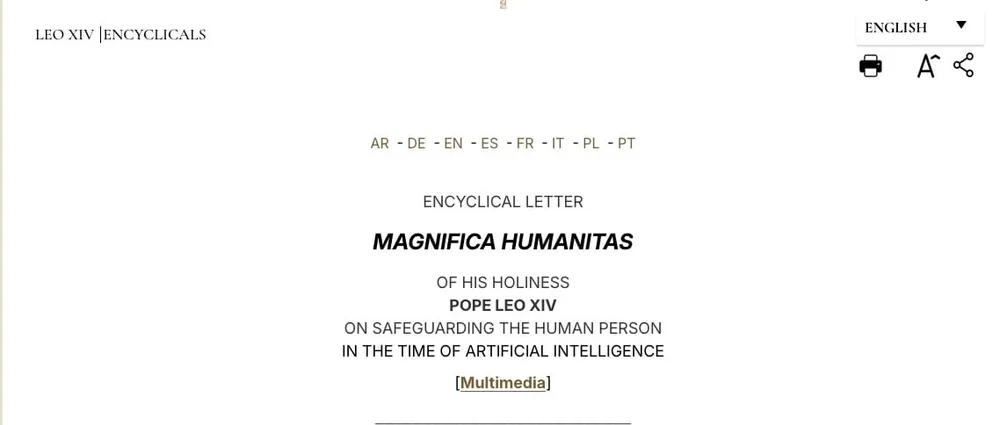
Pope Leo XIV today released his first encyclical, Magnifica Humanitas ("Magnificent Humanity"), a 42,300-word letter addressed “to all people of good will” on the protection of the human person in the age of artificial intelligence. The Pope signed the document on May 15, the 135th anniversary of his namesake Leo XIII’s Rerum Novarum, the founding text of modern Catholic social teaching. The parallel is deliberate: where Leo XIII confronted the dislocations of the Industrial Revolution, Leo XIV intends to confront those of the AI revolution.
The encyclical’s central economic argument is that “the pursuit of greater profits cannot justify choices that systematically sacrifice jobs,” and that “a society that guarantees employment to only a small fraction of the population, despite having a high level of technical development, risks exposing many to forced inactivity”—producing “a paradox of material progress and anthropological regression that undermines the foundations of a just and stable social peace.” On weapons, Leo writes that “the growing ease with which autonomous weapons systems can be deployed makes war more ‘feasible’ and less subject to human control,” demanding “the most rigorous ethical constraints” and insisting that humans, not machines, retain responsibility for the use of force. Other sections address the protection of children from AI-generated content, the regulation of the private companies driving AI development, and a personal papal apology for the Vatican’s historical failure to condemn slavery.
In a notable gesture, Leo presented the encyclical alongside Christopher Olah, co-founder of Anthropic, praising Olah for working with the Vatican “to find a way for humanity in this time of artificial intelligence.” Olah, in turn, told the audience that AI companies operate under “a set of incentives and constraints that can sometimes conflict with doing the right thing,” and that “we need moral voices that the incentives cannot bend.” Anthropic has demonstrated, more than most U.S. AI firms, that it takes the ethical dimension of the technology seriously. In February, as EIR reported, the company refused to lift restrictions on military and intelligence uses of its models under Pentagon pressure from Defense Secretary Pete Hegseth, while OpenAI rushed to accept the conditions. The firm has also published a public “constitution” setting out the principles that govern its work on its AI tool Claude.