Searching for an Exit?
by: Harley Schlanger
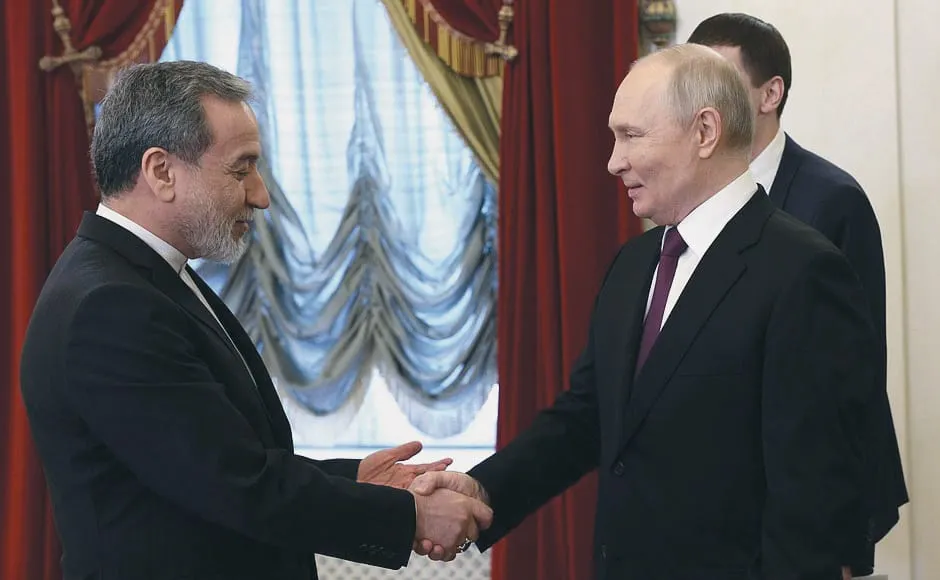
A diplomatic mission undertaken on April 27 by the Foreign Minister of the Islamic Republic of Iran, Abbas Araghchi, to break the stalemate in negotiations to end the war launched by the U.S. and Israel against Iran, appears to have been rejected by U.S. President Trump, in remarks he made the day after Araghchi met with Russian President Putin. Prior to meeting with Putin in St. Petersburg, Aragchi met with diplomats in Pakistan and Oman, who have been intermediaries in the talks.
Araghchi presented a scaled down proposal of steps to end the fighting: end the war, reopen the Strait of Hormuz, and postpone talks to resolve the nuclear issue. This proposal appears to have the backing of Putin. Prior to their meeting, Putin said that Russia sees how “courageously and heroically the people of Iran are fighting for their independence and for their sovereignty.” He added that Moscow hoped that “guided by their new leader, the people of Iran will endure this challenging period of hardship....We will do everything in your interests, in the interests of people of the region, so that peace gets achieved as soon as possible,” he said.
PUTIN, TRUMP PHONE CALL
Following the Putin-Araghchi talks, the Russian President initiated a 90-minute call to President Trump, which was described by Russian officials as a “friendly, frank and businesslike discussion.” However, a post by Trump on April 28 showed that despite the talk of the need for an “exit strategy,” he remained unmoved by Araghchi’s initiative. He posted an AI-image of himself with a machine gun with the caption, “NO MORE MR. NICE GUY.” Later that day, in comments reported by Axios, Trump reportedly said that the U.S.-imposed blockade of the Strait will continue, with resumption of military action if Iran does not submit.
In his usual resort to undiplomatic language, he summarilly dismissed Araghchi’s initiative, saying “The blockade is somewhat more effective than the bombing. They are choking like a stuffed pig. And it is going to be worse for them.” He concluded by repeating that he would not allow Iran to have a nuclear weapon, despite his insistence that the U.S. and Israel have “obliterated” Iran’s peaceful nuclear program.
The prospect of a renewed assault on Iran comes despite reports that the reduction of oil and natural gas shipments through the Strait has already unleashed a global food emergency. The oil price surged after Trump’s threat to renew the war, reaching at one point $125 per barrel. Fertilizer prices have doubled, as fertilzer production requires natural gas. The U.N. estimates that the reduction of fertilizer availability due to the war threatens the food supply for forty-five million people.
In further comments on the discussion with Putin, Trump said he would prefer that the Russian leader concentrate on a ceasefire in the war with Ukraine, which continues.
KING CHARLES REASSERTS THE “SPECIAL RELATIONSHIP”