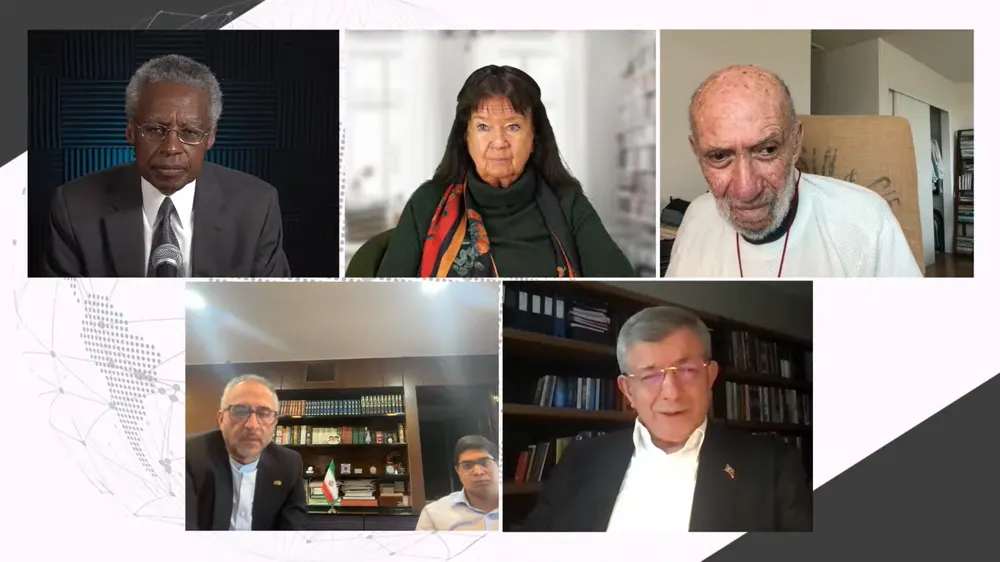
The May 15 EIR Emergency Roundtable on “The Iran War and the ‘Controlled Disintegration’ of the World Economy” produced a substantive convergence that may, if pursued, alter the trajectory of current history. Former Turkish Prime Minister (2014-2016) and Foreign Minister (2009-2014) Ahmet Davutoğlu set out the proposal he laid out in Project Syndicate last month for a new security architecture for the Middle East, including proposals on Hormuz, Iran’s nuclear program, regional security, and the Palestinian people. He framed the moment as a political earthquake shaking the world and stressed that what the world most needs now is predictability—a quality not particularly associated with the current U.S. President.
In the dialogue that followed, Schiller Institute founder Helga Zepp-LaRouche intervened to ask Davutoğlu whether he would personally contact the mediator nations he had proposed—Türkiye, Pakistan, Malaysia, Indonesia—and put before them not only his own new security architecture but Lyndon LaRouche’s Oasis Plan for economic development in the region, funded by sources such as the Gulf states’ sovereign wealth funds. Davutoğlu agreed, and developed the point further: combining his geostrategic vision with the economic-development perspective put forward by Helga Zepp-LaRouche, he said, is the right approach—the best path to peace, in his words, runs through economic interdependence.
Princeton’s Professor Richard Falk endorsed that combination. The morality of the entire world, he observed, is being tested at this moment; the answer cannot be containment or attrition, but a substantive cooperation that goes beyond diplomacy.
Zepp-LaRouche identified a concrete opening: China currently holds the rotating presidency of the UN Security Council and has set the revitalization of the UN Charter as one of its three principal priorities during that presidency. That, she proposed, is an immediate venue in which the combined Davutoğlu-Oasis Plan framework could be advanced. The Roundtable’s three-way convergence gives the proposal a constituency it has not previously had.
It happens that the man whose temperament Davutoğlu obliquely critiqued has himself offered, on an earlier occasion, the most direct formulation of what the proposed convergence would amount to. At a Mar-a-Lago press conference in January 2025, U.S. President Donald Trump observed: “If you think about it, the United States and China could solve most of the problems of the world.” Having just returned from Beijing—where he and President Xi adopted “constructive strategic stability” as the guiding framework for U.S.-China relations over the next three years—Trump could now put that observation to the test.
Whether he does so will depend, in part, on whether the constituency that converged at the EIR Roundtable on May 15 can carry the combined architecture forward: into China’s UN Security Council presidency this month, into the September state visit by China’s President Xi Jinping to Washington, and into the meetings of the BRICS heads of state later in the year.