
The formal 60-day window that the War Powers Act allowed for a President to wage a war before Congressional approval is required expired on May 1. While the Trump administration has shown a certain degree of hesitation around its expiration, given the mounting opposition within his own Republican Party to another illegal “forever war,” Trump appears prepared to charge ahead without approval.
The President released a letter to Congress on May 1, formally informing them that the April 7 ceasefire with Iran “terminated” the war, thereby relieving him of any requisite approval. “On April 7, 2026, I ordered a 2-week ceasefire. The ceasefire has since been extended. There has been no exchange of fire between United States Forces and Iran since April 7, 2026. The hostilities that began on February 28, 2026, have terminated,” the letter read, reported The Hill.
“Despite the success of United States operations against the Iranian regime and continued efforts to secure a lasting peace, the threat posed by Iran to the United States and our Armed Forces remains significant,” Trump wrote. “Accordingly, the Department of War continues to update its force posture in the AoR [Area of Responsibility] in select countries, as necessary and appropriate, to address Iranian and Iranian proxy forces’ threats and to protect the United States and its allies and partners.”
When asked by reporters on May 1 why the administration did not seek approval from the Congress, despite this being legally required under the War Powers Act, Trump replied: “Nobody has ever gotten it before; they consider it totally unconstitutional.”
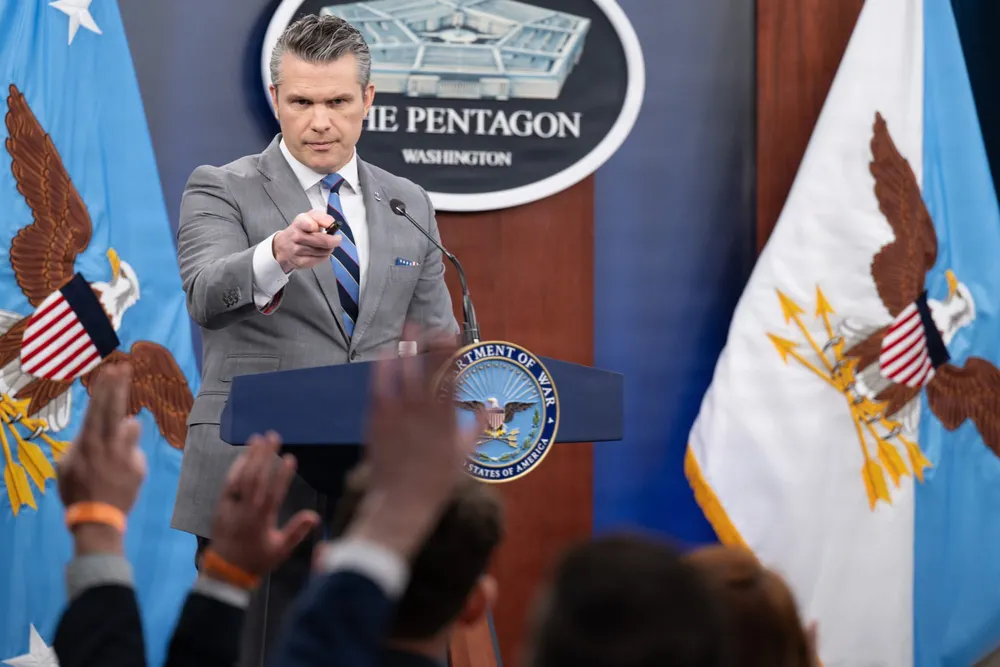
This has been a consistent thread coming from the Trump administration over the recent days. Secretary of “War” Pete Hegseth told Senators during an April 30 Senate Armed Services Committee hearing that the 60-day clock in the War Powers Act can “pause or stop” during a ceasefire. “We are in a ceasefire right now, which our understanding means the 60-day clock pauses or stops in a ceasefire,” Hegseth told Sen. Tim Kaine (D-VA) during the hearing.
“I do not believe the statute would support that,” Kaine pushed back. “I think the 60 days runs maybe tomorrow, and it’s going to pose a really important legal question for the administration there.” Senator Kaine later told reporters that Hegseth had “advanced a very novel argument that I’ve never heard before” and “certainly has no legal support.” “That answer showed they know they’ve got a 60-day problem, and they’re trying to come up with a rationale to get around it,” Kaine added.
It remains to be seen how many Republicans will accept Trump’s creative legal explanations. House Speaker Mike Johnson appeared unconcerned. He told NBC News that Congress doesn’t need to act because the U.S. is “not at war.” “It sounds like there’s some wiggle room he provided there for himself,” Sen. Todd Young (R-IN) told reporters, reported Axios. “Presumably, they will communicate that in a formal way,” Young added. “They have, in a very careful way, followed the War Powers Act so far.” And Sen. Josh Hawley (R-MO) said: “I imagine the administration will send us some sort of formal notification saying, ‘Here’s where we think we are under the War Powers. Either we want 30 more days, or we don’t think we need additional time because of X, Y, Z.’”