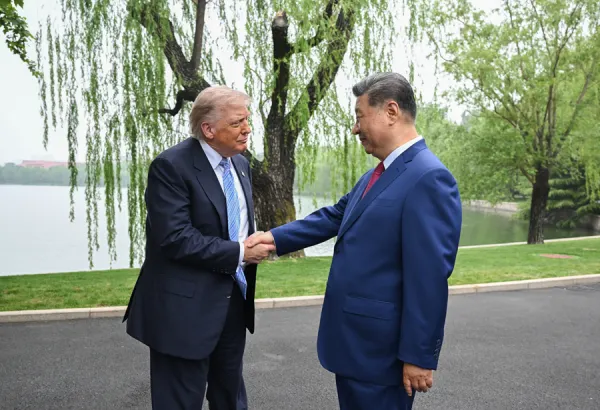
U.S. President Donald Trump left China on May 15 after two days of talks with President Xi Jinping that culminated in a private meeting at Zhongnanhai, the Beijing compound where the top Chinese leadership lives and works. The choice of this venue is a sign of respect, as visiting heads of state typically dine at the Great Hall of the People, and coheres with Trump’s positive comments about his relationship with Xi.
Trump claimed several substantial economic deliverables on the way home. He said that China agreed to purchase 200 Boeing aircraft (with what he called a “potential” to expand to as many as 750 planes), to resume purchases of American soybeans, and to import additional U.S. oil and liquefied natural gas. He also told Sean Hannity of Fox News that Xi had “committed to helping” the United States on Iran. Trump caveated his own Boeing claim, however, telling reporters: “I sort of, I think it was a commitment. I mean, you know, it was sort of like a statement, but I think it was a commitment.” Notably, according to the New York Times’ live coverage, tariffs—expected to be a major agenda item—were “not brought up” during the visit; Treasury Secretary Bessent said the two governments would open separate discussions on AI guardrails, including protocols to keep advanced AI models out of nonstate hands; and Trump said he did not ask Xi to pressure Iran on Hormuz because “I don’t need favors,” though he predicted Xi would help anyway.
The most consequential new substance was on Taiwan. Speaking to reporters on Air Force One, Trump said he and Xi had “talked a lot about Taiwan” and discussed “in great detail” the $14 billion U.S. arms package the administration has so far withheld from approval. Asked about the 1982 Six Assurances to Taiwan, including Washington’s commitment not to “consult with” China on arms sales to the island, Trump said: “Well, I think the 1980s is a long way. That’s a big, far distance,” and added that Xi had raised the issue, so “what am I going to do? Say ‘I don’t want to talk to you about it'?” Trump declined to commit on whether the U.S. would defend Taiwan in a Chinese invasion, expressing the most personal form of strategic ambiguity: “There’s only one person that knows that. You know who it is? Me.”