May 19—How should we best commemorate the 250th anniversary of America’s Declaration of Independence? A rock concert/prayer service for a holy war, held on the National Mall? A mixed martial arts exhibition on the White House lawn? Invite the United Kingdom’s King Charles III for a state visit asserting our “common heritage and values,” and with nary a protest (indeed ovations from our elected representatives) to remind him that we are not subjects, but citizens here? And a “no, thank you” to his directive that together we must continue the splendid little wars burning around the globe?
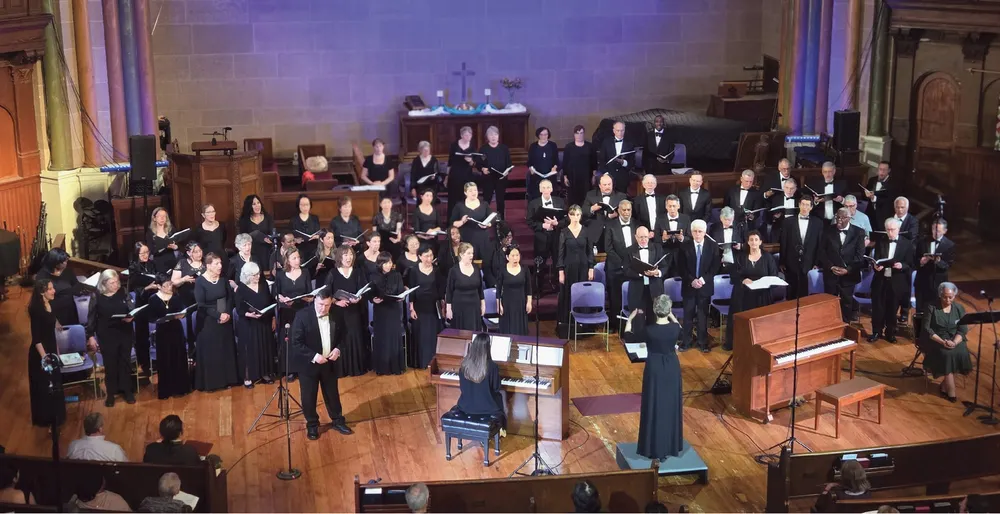
The Schiller Institute NYC Chorus chose to sing for peace instead, presenting a concert in Manhattan, May 17, titled “America’s 250th in Music & Lore,” as a musical drama, celebrating and rekindling the Spirit of ’76. The multifaceted program had four parts of the Americana genre: spirituals, river songs, and Classical works by two friends of American republicanism, Mozart and Beethoven, punctuated by America’s first “unofficial” anthem, “Chester.” These were woven together seamlessly by a series of narratives, recitations, and re-enactments with the help of a libretto written by Dennis Speed of the Schiller Institute.
Narrating the program were special guests Elvira Green, a mezzo-soprano at the New York Metropolitan Opera for 19 years, currently president of the Foundation for the Revival of Classical Culture, and board member of the Greensboro Opera in North Carolina; and Jonathan Kruk, master storyteller, based in New York.
Singing the Spirituals, and ‘Chester’ National Anthem
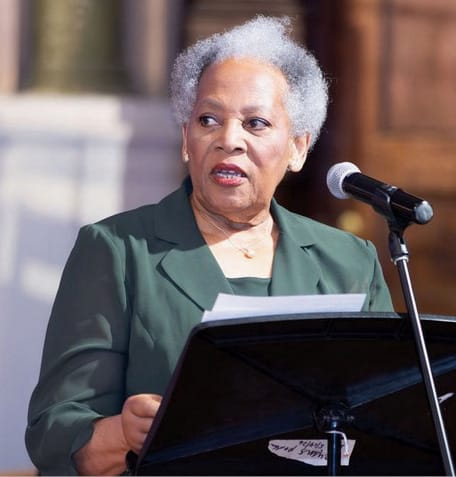
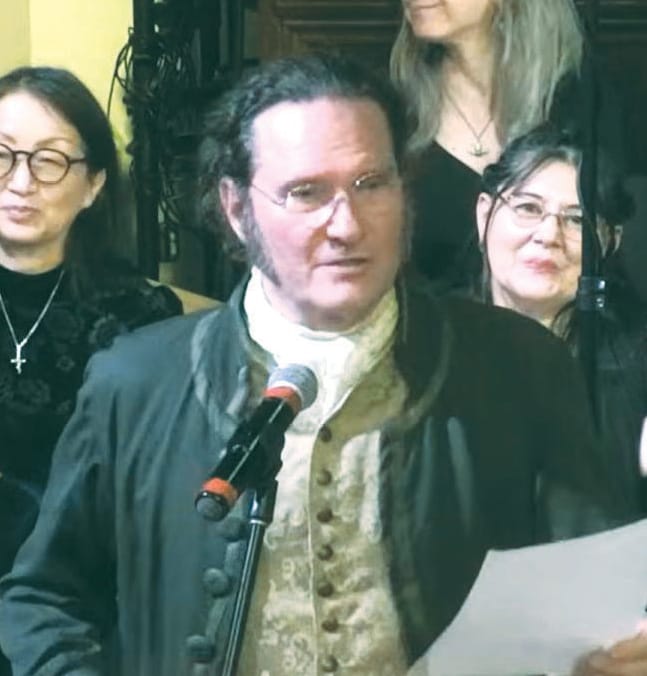
In her prologue, Ms. Green opened the program reciting words from the cantata called “Ballad for Americans,” by Earl Robinson (music) and John La Touche (lyrics), which was first sung by Paul Robeson in 1939.
In ’76 the sky was red,
Thunder rumbling overhead,
And King George couldn’t sleep in his bed,
And on that stormy morn,
Ol’ Uncle Sam was born.
Green then invoked the paradox of America with Langston Hughes’ poem,
O, let America be America again—
The land that never has been yet—
And yet must be—the land where every man is free.
The land that’s mine—the poor man’s, Indian’s, Negro’s, ME—
and went on to assert that the old, largely forgotten freedom songs hold the emotional key to our national salvation today. Green and Kruk then alternated powerful presentations: “The Long Train” (Kruk), “A Massachusetts Petition” (Green), “The Curse of Slavery,” which was Gouverneur Morris’s speech to the 1787 Constitutional Convention (Kruk), and the story of “The First Rhode Island,” told by Kruk.
EIR’s 250th Anniversary Series

The year 2026 marks the 250th anniversary of the Declaration of Independence by what would soon become the United States of America. That instrumental document laid down the principles of an anti-oligarchic republican form of government, and would go on to be the inspiration for countless other peoples around the world, forever changing the shape of history. Today, this history is either misunderstood or intentionally misconstrued, and the U.S. has nearly abandoned the outlook of its Founding Fathers. Over the course of this year, EIR will be publishing key articles on the true anti-oligarchic history of the United States in the hopes of contributing to the widest possible discussion of these principles, the rediscovery of which has enormous implications for whether the world can get out of its current state of turmoil today.
These recitations were interspersed with the chorus singing the spirituals, “The Lily of the Valley,” “Bye and Bye,” “Ain’t a that Good News,” “My Soul’s Been Anchored,” capped by Roland Carter’s arrangement of “Oh, Freedom,” as a bass solo, which was sung by Kevin Thompson. Then came a resounding chorus of “Chester,” considered America’s national anthem into the early 19th Century, written by the revolutionary “tunesmith” of New England, William Billings.
The spirituals were conducted by Megan Dobrodt and Diane Sare. Dobrodt is a member of the Board of Directors of the Schiller Institute NYC Chorus. Diane Sare in 2014 founded the Chorus, and is Chair Emerita of the Board.
River Songs, and the Course of Human Events
Ms. Green recited from a poem by Lemuel Haynes, and at this point the question was posed: Why is the phrase “in the course of human events” embedded in the very first sentence of the Declaration of Independence? What followed was a fascinating discussion begun with the question of, why the word “course”? The meaning of “course” can be taken as another word for river, always gathering, always growing, changing, never waiting, meandering but always moving, as a current in one direction toward a knowable destination. This was the course of human events that ran before, during, and after that moment in 1776.
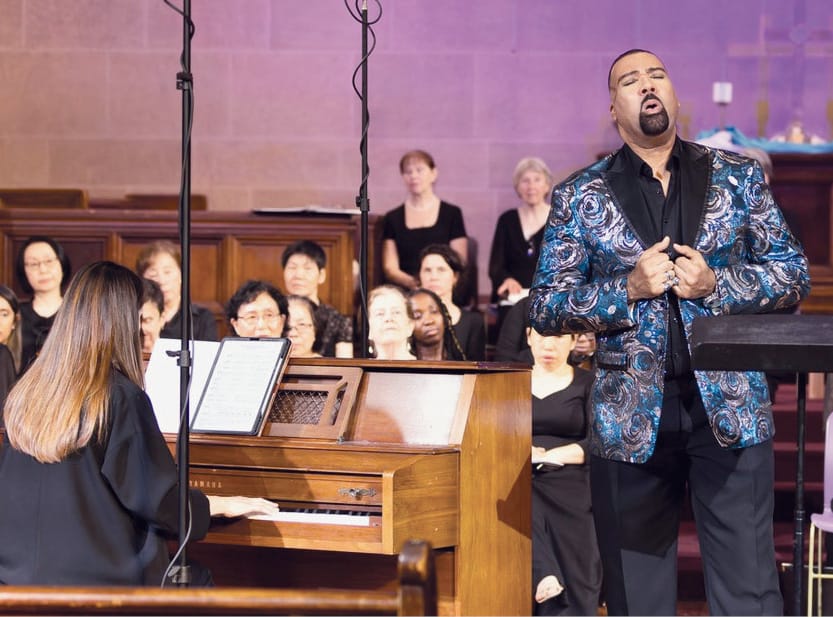
And so, the genre of American river songs was well presented by soloists Everett Suttle, tenor, and Kevin Thompson, bass. Aaron Copland’s “The Boatman’s Dance” is about the Ohio River. The traditional song “Shenandoah” is about the Missouri River. And, of course, “Ol’ Man River” is the Mississippi.
Masterworks by Mozart, Beethoven
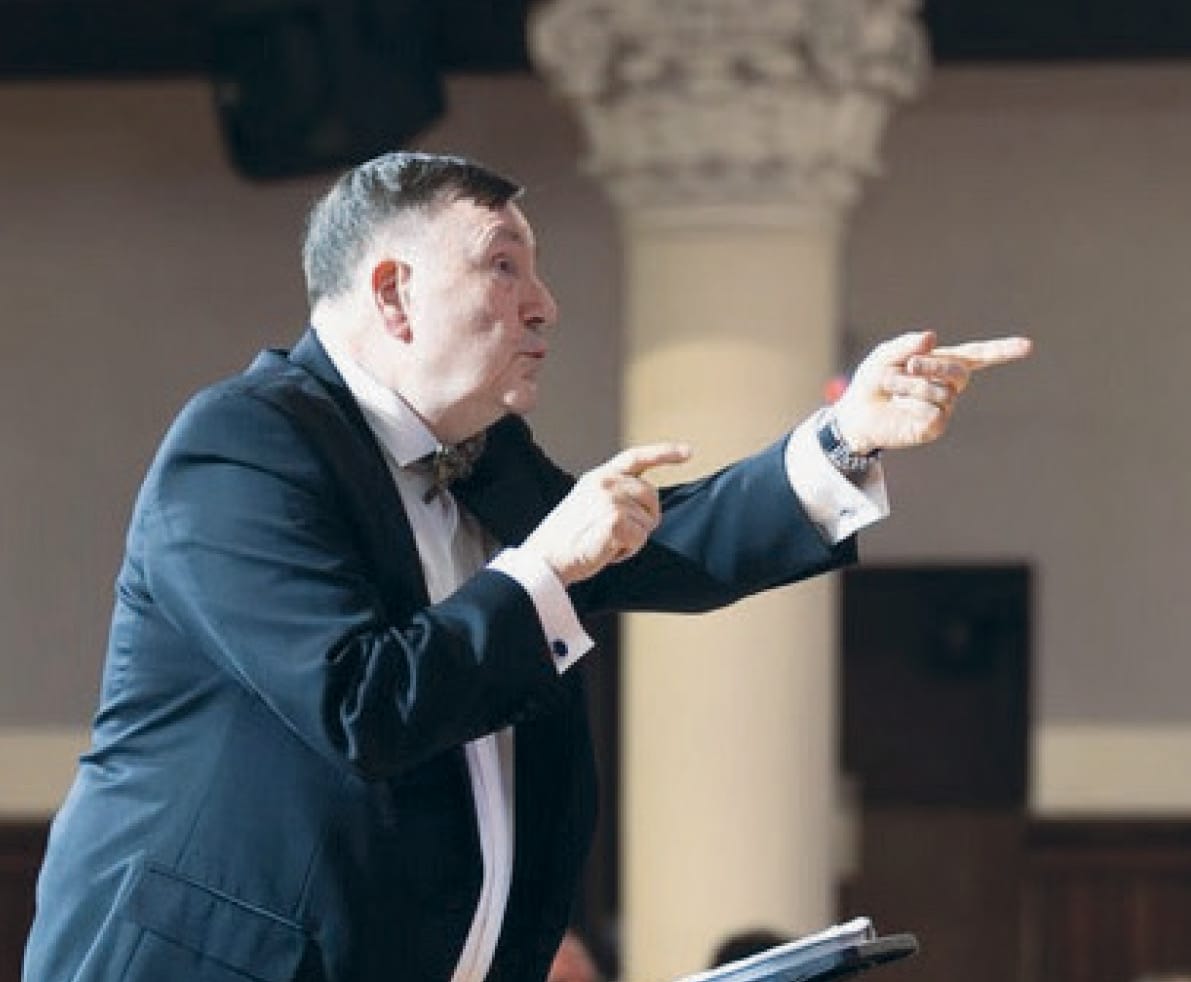
Following the intermission, the concert moved to two masterworks, both conducted by John Sigerson, the principal conductor and music director of the Schiller Institute NYC Chorus. Mozart’s “Ave Verum Corpus” was done sotto voce throughout, providing a profound effect, bringing the mind back to center.
Finally came Beethoven’s Choral Fantasia, for which the chorus was joined by the two truly amazing pianists, Dura Jun-Jones, who performed the piano solo, and Se Won Lim, who recreated the orchestra on the second piano.
For many people who may have become cynical, disheartened, or forgetful of our nation’s origins, the ol’ Spirit of ’76 was surely rekindled by this dramatic concert, and the American paradox better understood as the continuing process of creating a more perfect union.
The concert program and YouTube link of the concert can be found at www.sinycchorus.com.