
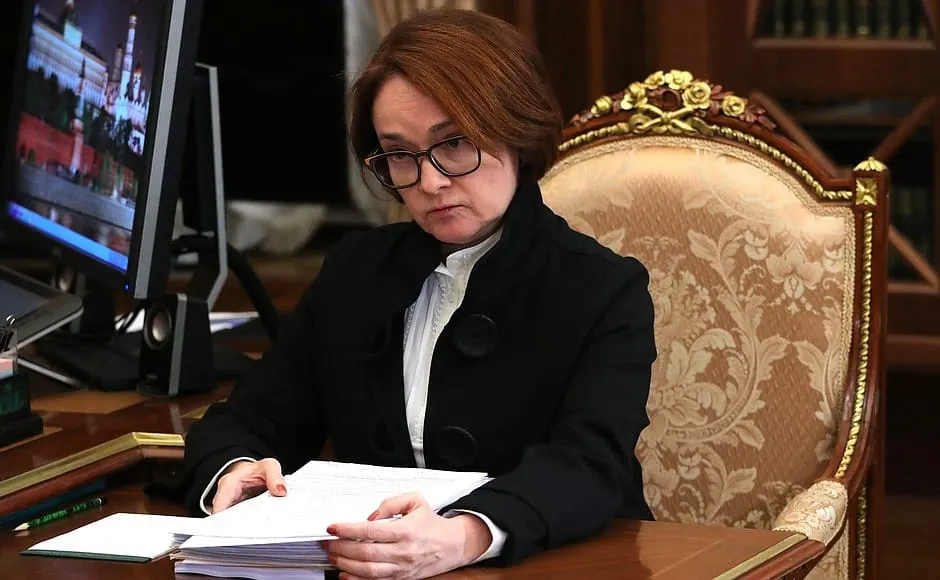
Long-simmering economic policy tensions in Russia are breaking into the open, both inside Russia and abroad, with growing rumors that Russian Central Bank head Elvira Nabiullina may be on her way out. One of the key matters at issue is that Russian business interests have been increasingly complaining that the Central Bank’s tight money policies – purportedly to curb inflation – are strangling industrial growth in the non-defense sectors. Those high rates are even affecting the defense industry, despite its hefty state subsidies, when it comes to obtaining credit to finance R&D. As Reuters reported, “Nabiullina has been under intense criticism from businesses over the central bank’s rate hike to 21% in 2024 to fight inflation, which contributed to economic growth slowing to 1% last year from 4.9% in 2023.” Already in April, President Vladimir Putin himself had demanded from economic officials “detailed reports on the current economic situation and why the trajectory of macroeconomic indicators is currently below the expectations” of government and Central Bank forecasts.
Prior to the June 3-6 St. Petersburg International Economic Forum (SPIEF), Bloomberg claimed that officials from Nabiullina’s Central Bank and her ally Anton Siluanov’s Finance Ministry had met with Putin to advise him that heavy government spending for the Ukraine war was no longer sustainable.
At a June 10 meeting with government officials Putin himself noted: “Of course, we were aware, just as we have been saying all along – and I think I raised this point at the economic forum in St. Petersburg – it was quite apparent that by taking measures to ease and curb inflation, we proceeded from an understanding that this would affect economic growth rates and investment. But one of our colleagues was right to note that we must prevent this pause in investment from bringing the entire economy to a halt. We had this understanding from the outset and this is what we meant.” Putin went on to say that “I believe that we can expect a lower key interest rate and to be able to achieve other key indicators,” but also praised monetary policy to date.
Neither Nabiullina nor her deputies were at that government meeting, which is highly unusual, nor did she appear at SPIEF, where she was scheduled as a featured speaker. In fact, she has not been seen publicly since May 28, which has helped fuel rumors of her imminent departure – although both the Central Bank and the Kremlin report that she is merely out on sick leave.
Nabiullina has maintained a policy of ruble convertibility, thus making the exchange rate dependent on high domestic interest rates – a policy for which she has been repeatedly criticized by Sergey Glazyev, among other top Russian economists, in that it has also fostered massive capital flight from Russia and penalized domestic industrial growth.
Reflective of the anger against such policies, Mikhail Delyagin, the anti-monetarist economist who is Deputy Chairman of the State Duma’s Committee on Economic Policy, and author of works such as A Civilization of Cannibals: The British Roots of Hitler and Chubais and his current programmatic book The Transformation of Russia, wrote on his Telegram site:
“Reports indicate that the Ministry of Finance is preparing a blow whose destructive power would surpass all attacks by the Banderites using UAVs and HIMARS: plans are afoot to cut the budget by 2.9 trillion rubles. Every expenditure category—except for the military—is slated for the chopping block. Admittedly, the source cited is a Financial Times article referencing internal Ministry of Finance documents. If this information proves accurate, we are looking at a veritable attempt at full-scale destruction of the Russian economy. After all, 2.9 trillion rubles may not amount to 10% of the federal budget, but it is certainly well over 5%. Today, the Russian economy has only one remaining resource for development (let me repeat: one): federal budget spending. The fact that military spending has been exempted from this proposed act of sabotage offers no salvation; social programs, infrastructure, and manufacturing would all fall victim to it.”


