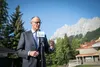
Pope Leo XIV began a seven-day Apostolic Journey to Spain on June 6, where he would encounter “a deeply polarized European society in the nation of Spain,” in the words of Vatican News Editorial Director Andrea Tornielli. “The Church in Spain, called to bear witness to a polyphonic unity in this age of polarization and confrontation, has endured, together with the entire Iberian people, the tragedy of civil war during the last century. Some of those wounds have not yet fully healed,” Tornielli wrote. On top of Spain’s civil wars, in the current century the issue of desperate migration to Spain (and Europe more generally) from impoverished and war-torn nations in Africa and Southwest Asia has been additionally divisive in an already polarized society—and Catholic Church—including all-too-frequent expressions of Islamophobia.
The Pope took the issue head-on during his visit to Spain, addressing both the most profound philosophical and theological questions about the nature of man, good and evil, and the One and the Many—questions that have fascinated and perplexed mankind for millennia—while also issuing a strong call for concrete action today to save the suffering world in the interest of the common good.
This double emphasis is beginning to be the hallmark of the new Papacy under Leo XIV, as intimated in his early focus on the central role of 15th-Century Cardinal Nicholas of Cusa and his method of Coincidentia Opositorum, his trip to Africa in April of this year, and his first encyclical letter, Magnifica Humanitas—a subject for later treatment in these pages.
As the Pope stated in his homily during the Holy Mass celebrated before almost 1.5 million people gathered in the Plaza de Cibeles of Madrid on Sunday, June 7:
“We too are called to be present in the realities and challenges of society, not shying away, but personally committing ourselves to the building of the common good…. Let us drink anew from this Eucharistic spring, which does not enclose us in private devotion, but sends us out to refresh our brothers and sisters, our families, the poor, the suffering, and those who have lost hope. Eucharistic grace transforms us and makes us protagonists of the transformation of history, a sign of hope for those we meet.”
We Need a Culture of Encounter, Not Confrontation
Pope Leo’s first public remarks in Spain were delivered on Saturday, June 6 at the Royal Palace of Madrid to leading representatives of civil society and the diplomatic corps.
“I come among you to affirm … a deeper reconciliation and collaboration among the various elements of this nation,” he stated. “After all, your own history suggests that a culture of encounter, not confrontation, is what fosters stability and prosperity. In reality, the message of peace, which at present unfortunately strikes some as naïve and others as confrontational, is welcomed by those who do not shut themselves off in preconceived ideologies, but are rather open to the truth.”
He insisted on this issue: “Today, the temptation to gain popularity by fanning the flames of polarization seems to have grown rather than diminished, and human dignity continues to be violated…. For the love of truth, I invite everyone to set aside the divisive and polarizing narratives of your societal reality and history, so as to overcome sterile simplifications through the fruitful appreciation of complexity. I see here a vocation particularly suited to Europe, in which Spain plays a unique and fundamental role.”
The Pope then elaborated on the theme of complexity in unity, sometimes referred to in philosophy as the problem of the One and the Many (for example, see Lyndon LaRouche’s Jan. 1991 article “The Science of Music: ‘the One’ and ‘the Many’ ”), a theme the Pope had previously taken up in his groundbreaking October 2025 discussion of Cardinal Nicholas of Cusa’s method of the Coincidence of Opposites.
“Appreciating and studying complexity,” the Pope told the gathered leaders, “learning not to deny it but to embrace it as a blessing, and fleeing from identity-based approaches that seem to explain everything yet only fill the world with ‘ghosts’ and enemies, are the tasks of those who are heirs of a great history…. Security, which we all too often expect to find in weapons and walls, is in fact best achieved by learning to move forward alongside one another, growing together, side by side.”
He turned his attention to one of the high points of Spanish humanist culture, the Era of King Alfonso X (“the Wise”) in the 13th Century, as a model to be followed today
“Your own history bears witness to this. The presence of Islam on the Iberian Peninsula, for example, constituted a long-standing political, cultural, and religious reality. During that period, there was not only confrontation, but also an attempt to create a space for contact, conversation and dialogue on the meaning of truth among Christians, Muslims and Jews. At the School of Translators enhanced by Alfonso X (the Wise), experts from all three religions collaborated on translating the texts of the rich Arabic, Greek and Hebrew heritage, contributing to the dissemination of texts such as those of the philosophers Averroes [1126-1198] and Maimonides [1138-1204], among others. The cities of Córdoba and Toledo, in particular, became centers of dialogue between languages, religions and knowledge. This is the truth told by European cities: their historical stratification, the fabric of solidarity that has shaped their differences over the centuries, transforming inevitable conflicts into new beginnings.”
The Pope concluded his remarks on a clearly political note, praising the role of Spain in opposing the crimes in Gaza and the war in Iran—without ever mentioning those specific situations by name. “I express my gratitude to your country for its faithful adherence to international law and multilateralism, which is reflected in an active commitment to peace and solidarity among peoples. At the same time, I encourage you to cultivate as well dialogue and civic friendship within your own country, to take into account the perspectives of the poor and the young when envisioning the future, to harmonize the claims for autonomy and unity, and to advance the cause of unity in Europe—not in opposition to other powers, but as a gift to the entire human family.”
The Schiller Institute Factor
In the course of the Pope’s visit, the Schiller Institute in Spain organized in the streets of Madrid carrying a banner reading “Economic Development, Dialogue of Civilizations—the Road to Peace,” while handing out hundreds of leaflets of Schiller Institute founder Helga Zepp-LaRouche’s March 9 open letter to Pope Leo, “Zepp-LaRouche Calls on Pope Leo XIV To Intervene on the Level of Nicholas of Cusa.” That leaflet also carried a QR code linking to a new 32-page Spanish-language pamphlet issued by the Schiller Institute on the occasion of the Pope’s visit, “Development Drive Means Billions of New Jobs, No Refugees, No War.” (For more on the pamphlet, including the new introduction, see the article below and at this link.)
Huge throngs turned out in Madrid for the Pope’s visit—an estimated 1.5 million people for the Sunday, June 7 Mass in the downtown Plaza de Cibeles, and 600,000 young people for a Saturday, June 6 prayer vigil—and the excitement and optimism were palpable, as Schiller Institute organizers attested. He spoke before 12,000 representatives of the worlds of culture, art, economics, and sports; and he received an unprecedented seven-minute standing ovation after addressing the Spanish Parliament on Monday, June 8, which included an impassioned and highly controversial call for respect for migrants’ rights, moral renewal, and the need for world peace.
Pope Urges Youth To Lead the World Out of Darkness
But it was Pope Leo’s dialogue with the 600,000 youth who participated in a Saturday night prayer vigil, which may prove over the long term his most significant intervention while in Spain, given its impact on the future of that country and all of Europe.
Before the prayer vigil per se, Pope Leo answered questions posed to him by eight older adolescents and university-age youth, who spoke on behalf of the Catholic youth groups of which they were a part. He answered with a combination of vigor and compassion, developing themes which he has been emphasizing throughout his trip: that to be a Christian means you care for the poor, work to ensure justice, and turn away from ideologies, which are fleeting; it means you become truth-seekers—and have the courage to stand up to the emperors and powers of the day to defend that truth.
He challenged the hundreds of thousands of listening youths to take responsibility for changing history, entrusting to them “the mission to be truly human,” so as to be “the sparks of a new humanity.” He spoke to them in the most personal terms:
“Reflecting on the lives of these saints [St. John Chrysostom, St. Thomas of Villanueva, St. Turibius de Mogrovejo], I said to myself, as did Saint Augustine: if they were able to do it, why not me? [cf. Augustine’s Confessions, VIII, 27]. It is a question I am pleased to share with you, too, as I invite you to choose examples of a good life that are inspiring both to you and to others.”
The Pope urged the youth to be truth-seekers, and not be swayed by the noise and cacophony that surrounds them—both metaphorically and literally.
“When seeking to recognize God’s voice, silence is what can help us the most. I believe it is very important for each of us to cultivate the ability to be silent. Often we wear headphones, listen to music or seek distractions, and we don’t know how to be silent. I believe that it is often precisely in this experience of silence that God can speak to us or that we can discern God’s voice. When we seek silence, we choose what not to listen to and which noises not to let distract us. By freeing ourselves from the clamor of a thousand different voices, we recognize that some mislead our desires, others exploit us without providing for us, and still others speak out of self-interest. It is in silence that we come to understand that ideologies pass away, while the truth always remains. Here, too, I would like to emphasize the importance of seeking the truth, because many voices, many things on social media deceive us and tell us lies. Always seek the truth! God is truth! If it leads you away from God, it is not the truth! Do not forget this!”
And he then explained to them the impact they can have on all of society.
“A young Christian, in fact, is a source of light both in joy and in trial, giving flavor to reality as a person who enjoys life from within, without looking to wealth, pleasure or power as a source of flavor. Such is our freedom, which has its source in faith. It is capable of bringing light and flavor to every society, to every human experience. On the other hand, when life loses its flavor, it is as if it were stolen from us: we no longer feel it as our own. In the face of the emptiness of indifference and compliance, before the violence of war and lies, you must be the sparks of a new humanity.”
Pope Leo, brimming with contagious optimism, then called on the youth to lead, and thereby change history:
“I want to entrust to all of you the mission to be truly human. Yes, be human: men and women of flesh and blood! Not mere appearances, but trustworthy faces. People who seek justice because they hunger for it, as for their daily bread. People who desire an honest and upright life, because they gladly do to others what they would like others to do to them. Be human as Christ is human, the perfect man, the risen One who shares history with us in every age…. This, dear young people, is the virtue that will change history the most. You can change history! Do it with love!”